
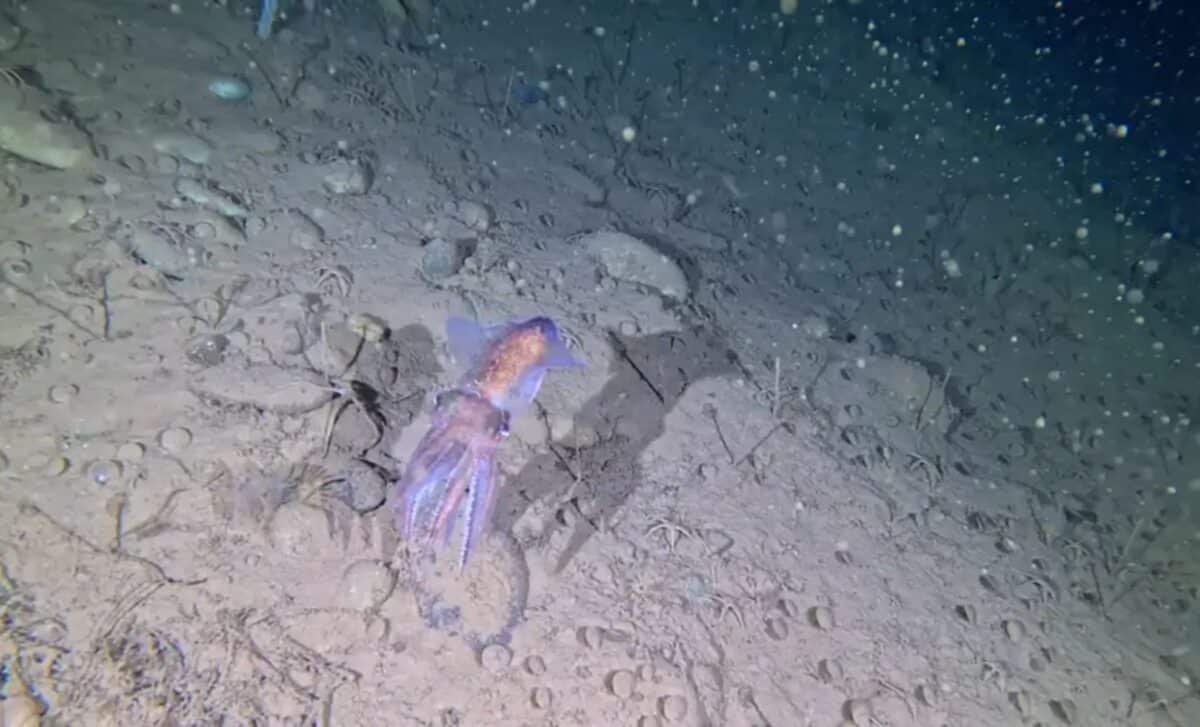
Researchers have filmed an Arctic bobtail squid in the waters of Northeast Greenland National Park for the first time, recording the elusive animal carrying an egg sac.
The discovery was made during the Polar BLAST Expedition, where scientists explored the seafloor using a remotely operated vehicle (ROV). Northeast Greenland National Park is the largest national park on Earth, yet its marine ecosystems remain largely unexplored, making every documented species an important piece of the puzzle.
According to the study published in Polar Biology, the sighting is the first confirmed record of the Arctic bobtail squid (Rossia moelleri) in the region. The footage also captured the squid carrying eggs, something researchers rarely get the chance to witness in its natural environment.
A First for Northeast Greenland
The squid was spotted about 50 meters below the surface in water measuring around −1.6 °C. Using lasers mounted on the ROV, the research team estimated that it measured roughly 10 centimeters long.
Dr. Paige Maroni, a postdoctoral research fellow at the University of Western Australia, stated in a University of Western Australia (UWA) news release that:
“Northeast Greenland National Park is the largest national park on Earth but one of the least biologically documented marine regions in the Arctic.”
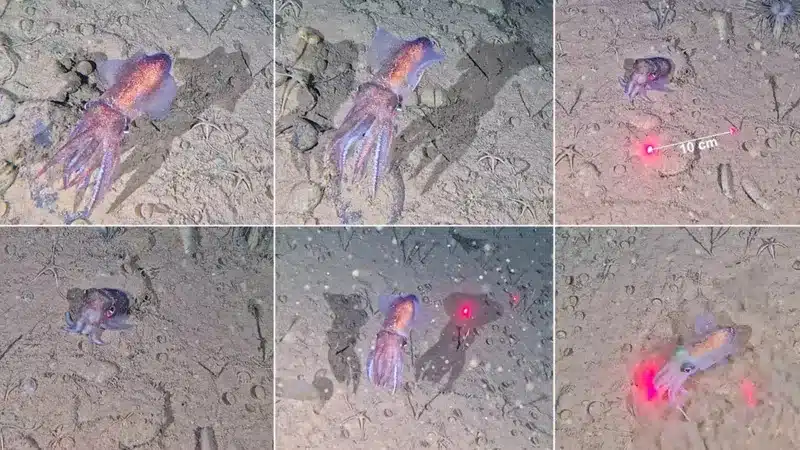 Arctic bobtail squid (Rossia moelleri) filmed in Northeast Greenland National Park. Credit: Polar Biology
The observation came during an expedition aboard a Secret Atlas Micro Cruise Expedition vessel, which gave researchers access to waters that are rarely surveyed.
Reproduction Caught by Surprise
The discovery became even more interesting when researchers realized the squid was carrying an egg sac. The ROV also recorded three clusters of eggs resting on the sandy seafloor.
As reported in Polar Biology, one egg sac contained around 50 eggs, while the other two held about 33 and 22 eggs. The footage shows the pale, pearly egg masses attached to the seabed.
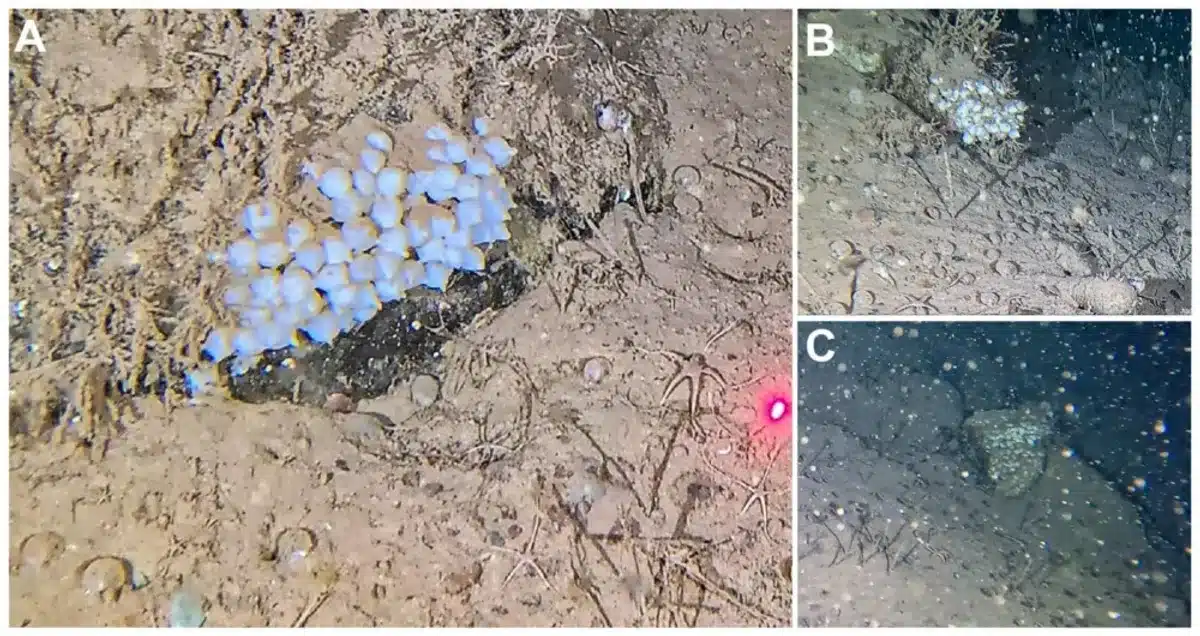 ROV footage shows three egg clusters attached to the seafloor, with each sac containing approximately 50, 33, and 22 eggs. Credit: Polar Biology
The Arctic bobtail squid is the largest of the three Arctic bobtail squid species and is especially well adapted to cold waters. While it is known for its large eyes and compact body, it also plays an important role in the Arctic food web, acting as a predator between animals living in open water and those on the seafloor.
Researchers also point out that the species has a short lifespan and a rapid life cycle, making it particularly sensitive to changes in environmental conditions.
Why This Single Observation Counts?
Studying marine life in remote Arctic waters is never easy, which is why observations like this carry so much scientific value. During the expedition, the team relied on the ROV to explore the seabed without disturbing the environment.
“Establishing knowledge of the biodiversity in this region is crucial for understanding ecosystem function and resilience under accelerating climate change,” Dr. Maroni stated. “This study provides a valuable new baseline for tracking ecological change in the rapidly warming Arctic.”
Dr. Maroni said that this approach can help fill significant biodiversity gaps in remote polar regions. She added that:
“In poorly studied polar ecosystems, even one verified observation can provide important insight into species distributions, reproduction and resilience under climate change.”