
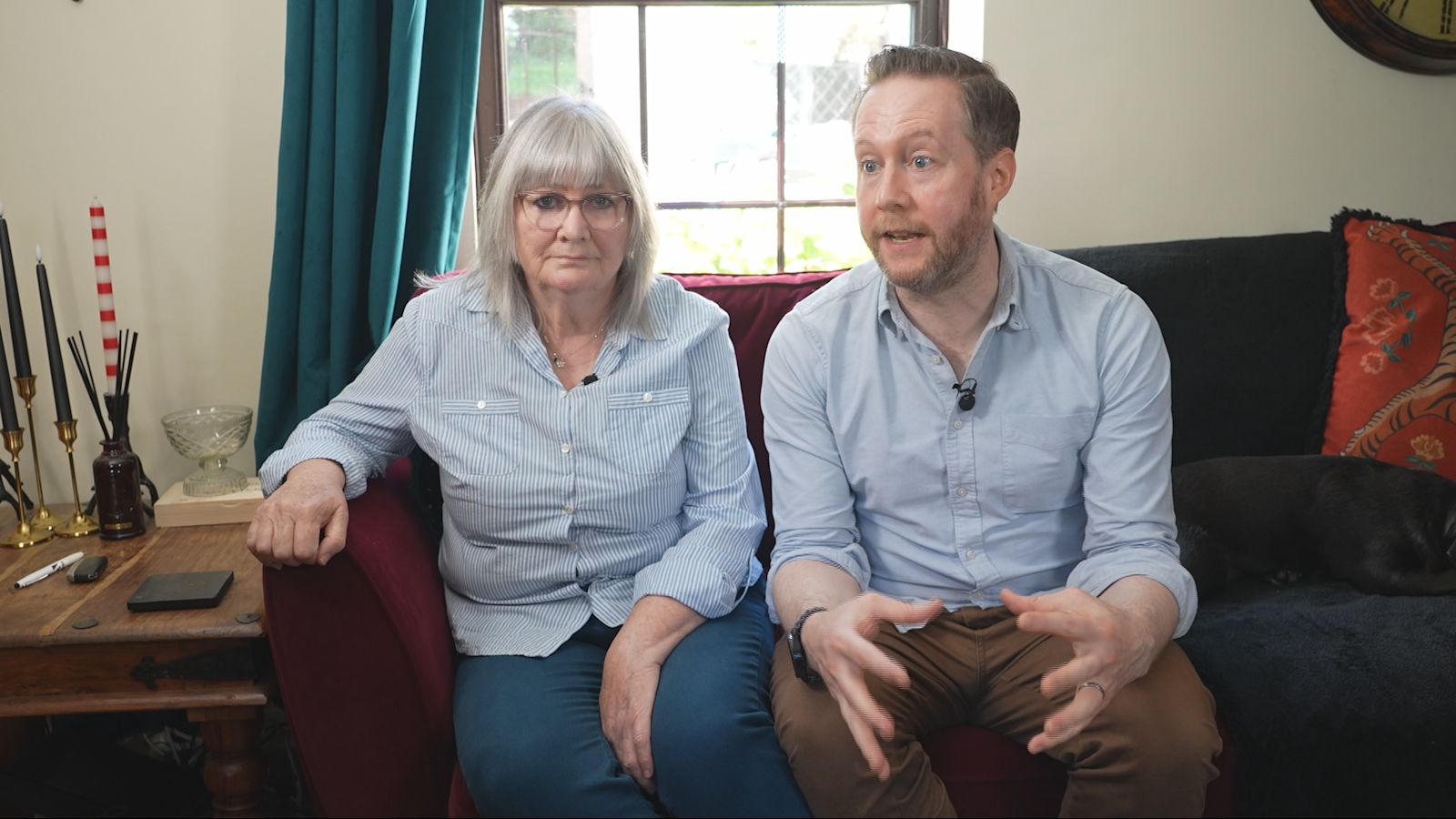
The family of a mentally ill man in Somerset say they are at breaking point after years of trying and failing to get help for their son.They say they are faced with a mental health system that is not fit for purpose.
Their adult son, Michael, lives with his parents who are now in their seventies and care for him around the clock. He has autism and has developed symptoms of severe mental illnesses and physical health problems, including psychosis and obsessive compulsive disorder. They say he experiences delusions, refuses food, has started fires inside the family home and sees aliens in people, leaving him unwilling to engage with treatment.
Because he refuses to be assessed, his family say professionals have been unable to provide the support they believe he urgently needs.
His mother and brother, Isabella and Nigel Thomas, told ITV News they feel trapped.
“It’s like living in hell. Everyday we fear the worst could happen.” they said, describing years of trying to get help while watching Michael become increasingly unwell.
The family say every attempt to seek support has been met with barriers, leaving them left to deal with this alone. They say no agency or support system is able or willing to take responsibility because of the current system.
They say the current legal threshold for serious intervention is too high and that services are often unable to act until someone presents an immediate risk to themselves or others.
Speaking to ITV News, their Liberal Democrat MP Tessa Munt, who has raised Michael’s case in Westminster, said families like his are falling through the gaps in the mental health system. She argues there is support for people with relatively mild mental health conditions and intensive services for those in acute crisis, but that the threshold for this is too high, leaving lots of people with nowhere to turn.
Tessa Munt, Lib Dem MP for Wells & Mendip Hills, said there’s a huge gap in the care system for people who “clearly need help” Credit: ITV West Country
She said, “It’s so difficult to get help for people who have a mental health problem. The services will take top level crisis, that’s where they will intervene. We’ve got some brilliant local organisations who can help people on the milder end, but there’s a walloping great gap in the middle where people clearly need help.”The Department of Health and Social Care said mental health services should provide care in the least restrictive way possible, while ensuring people receive the support they need. It said the government is investing in mental health services.
A spokesperson said: “We are developing a cross-government Mental Health Strategy for England that will transform mental health care into a system that responds earlier, reduces wait times, intervenes earlier, and helps people stay active and participate in education, work, family and community life.”
Mental health charity SANE says it regularly hears from families in similar situations.
Its founder and chief executive, Marjorie Wallace, said cases like Michael’s are becoming increasingly common, with relatives left carrying enormous responsibility while struggling to access appropriate care.“It could’ve been helped if we hadn’t lost so many beds and mental health services over the years”, she says.The case comes as Prime Minister Andy Burnham announced plans to speed up reform of England’s social care system, saying too many people and families have been let down. Speaking on Tuesday, Burnham said successive governments had failed to tackle the issue and confirmed Baroness Louise Casey’s independent review into adult social care would be brought forward to next year as part of plans for a National Care Service.
While the review is focused on broader social care, Michael’s family say mental health support must be treated with the same level of care as physical health problems.