
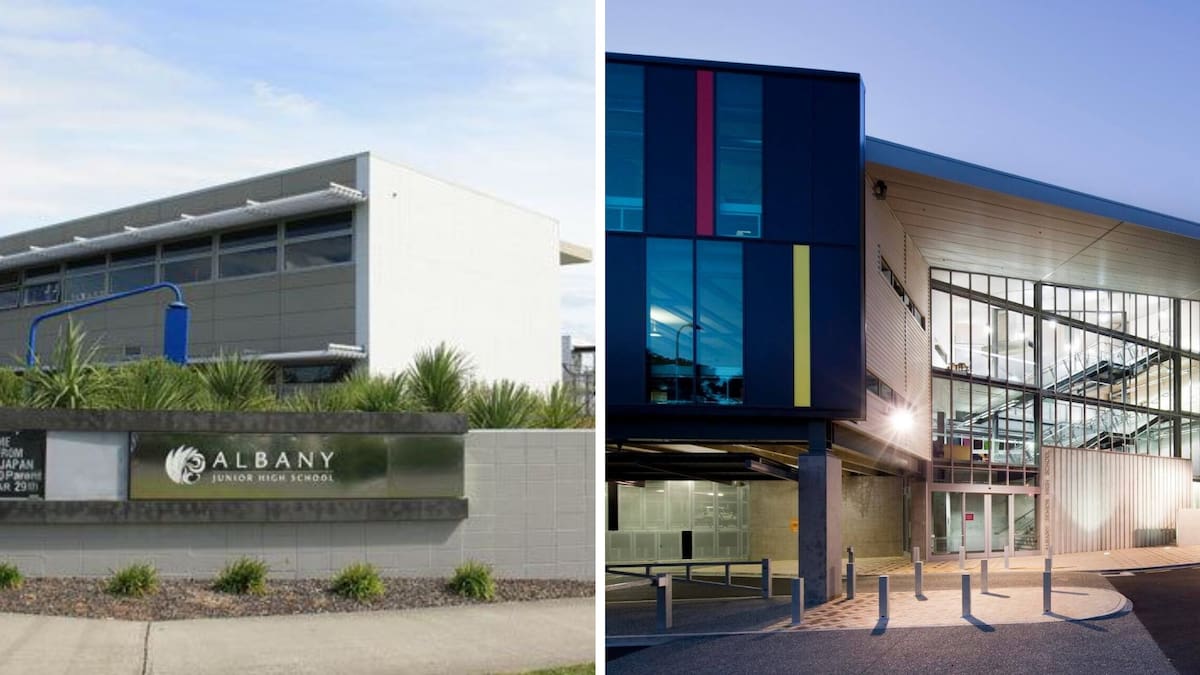
Others fiercely defended Albany Senior High’s model, saying it offered inclusiveness and flexibility, and was a lifeline for students with additional learning needs.
Albany Senior High principal Claire Amos said she was not interested in any “simplistic debates about ‘traditional’ versus ‘progressive’ education”.
Amos told the Herald anyone with doubts over her school’s learning programme should “come and visit and experience the school first-hand”.
The school’s approach was “deliberately designed” for senior students, she said, and combined academia with real-world training for university and employment.
Albany Senior School principal Claire Amos.
Amos argued the alumni valued the “experience of both schools and their complementary approaches”.
Albany Junior High board chair Samantha Ebel-Brown said their application would explore whether the school could provide “families with greater continuity beyond Year 10”.
Ebel-Brown would not go into specifics about the application, to “respect the integrity” of the Ministry of Education’s process.
A parent with a child at each school said the only connection between the two schools was proximity and similar names.
They were “totally different” in style and philosophy.
“Albany Junior is very traditional, uniforms, sport and academic-focused, all of that.
“Whereas Albany Senior is very arts-focused, student-led, with open-plan classrooms. [Students] don’t wear uniforms and they call teachers by their first names.”
Albany Senior High School caters well to students with additional learning needs and has a progressive education model.
She knew of at least one family that had relocated to the zone for Rangitoto College as they wanted a more “traditional route”.
“It’s not because Albany Senior is a bad school necessarily; it’s just different.
“North Shore parents typically want to follow the traditional schooling route.”
Rangitoto College principal Greg Thornton said he was told by many families they had moved into the area to attend his school.
Rangitoto College does not accept enrolments from out-of-zone families.
He would not say if those families were from the Albany Senior High catchment.
Parents and former students also flooded social media after the Herald’s reporting.
Some said the proposed shake-up would allow students to remain in a school where they were already thriving.
One parent with children in Years 8 and 9 said extending Albany Junior High to Year 13 would be “an incredible opportunity” for families, arguing not every student suited Albany Senior High’s learning model.
“[Albany Senior] won’t be the right fit for every child, and having another option on the North Shore, where schools are already under pressure, can only be a positive thing,” they wrote.
They said students who had built friendships, sporting teams and relationships with teachers should have the option of continuing those through to Year 13.
Others claimed some families were already avoiding the current pathway into Albany Senior High.
“There is a mass exodus at [Albany Junior] for Year 9 and 10 because parents don’t want their kids going to the senior college,” one parent claimed, adding they believed the current system “doesn’t work for the many”.
Albany Junior High has a more “traditional” model of education, the community says.
A former student of both schools said each model had strengths.
“Albany Senior’s unique model makes it the most effective for transitioning to university … but if you don’t have a good work ethic and self-drive you’ll fall behind,” they wrote.
Others strongly defended Albany Senior High, particularly for students in the LGBTQIA+ community and those with learning difficulties.
A parent with two children at the senior school said its flexibility and wraparound support enabled their daughter, who had additional learning needs, to achieve NCEA Level 2 before finishing Year 13.
“Both struggled big time in mainstream schooling, and [Albany Senior] saved them,” they wrote.
Another parent said their children had “thrived at [Albany Senior]” and they were “in total support of this school’s model”.
A person identifying themselves as a North Shore secondary school teacher, who said they had taught at both schools, argued Albany Junior High was responding to “genuine community needs”.
They said greater choice would better serve families across the area.
Rachel Maher is the education correspondent for the New Zealand Herald. She also covers a variety of other topics like Auckland issues, crime and local government. She started at the Herald as a breaking news journalist in 2022, before joining the Auckland team this year.
Sign up to The Daily H, a free newsletter curated by our editors and delivered straight to your inbox every weekday.