
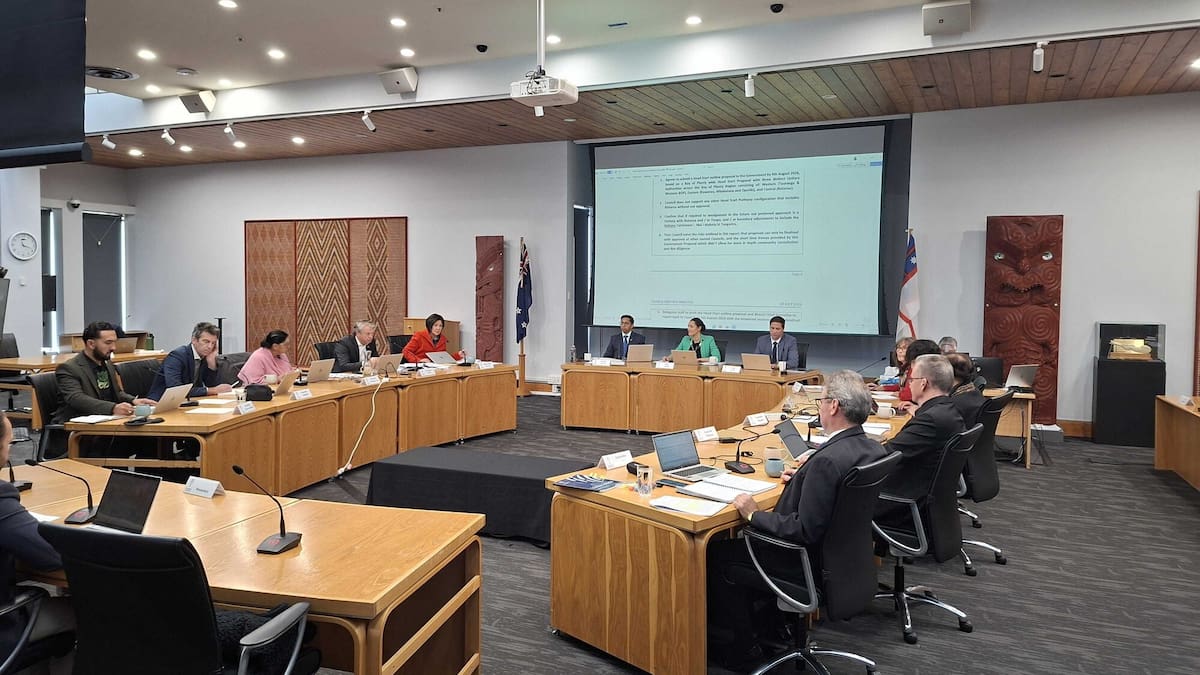
Rotorua initially explored a three-way proposal with Taupō and South Waikato. Those plans fell apart after Taupō District Council decided it was not in a position to continue with a merger.
South Waikato was then described as a “locked in” partner last week, but shifted its focus to a possible Waikato River catchment proposal with Waipā and Waikato district councils at the last minute.
South Waikato Mayor Gary Petley said his council had been forced to “reassess our position” after Taupō withdrew, with the Waikato option emerging “at the 11th hour”.
That left Rotorua without a merger partner, prompting the council to pursue its own unitary authority within the wider Bay of Plenty proposal.
Rotorua would effectively keep its current district boundaries and become its own unitary authority rather than merging with neighbouring councils.
Mayor Tania Tapsell said the proposal presented an opportunity for Rotorua.
“Staff have done absolutely phenomenal work getting this together in a short timeframe,” she said.
“This is actually a really exciting opportunity for us to create a unitary [authority] instead of our communities having to deal with two councils; they can just deal with one.
“I do believe there are efficiencies to come from this.”
The proposal would combine Rotorua Lakes Council and Bay of Plenty Regional Council functions into a single authority.
Councillor Merepeka Raukawa-Tait was the only councillor to vote against the proposal.
“Bad government should not be supported, and this is an example of bad government,” Raukawa-Tait said.
Rotorua Lakes councillor Merepeka Raukawa-Tait. Photo / Andrew Warner
She said there was not enough detail because of the short timeframe and was disappointed councils across the country had not rejected the proposal together.
“We are being bullied,” she said. “I wonder if at the end of the day we might burden our ratepayers with this.”
Deputy Mayor Sandra Kai Fong abstained from the vote, saying she wanted to wait for confirmation that Rotorua’s proposal aligned with the positions of other Bay of Plenty councils.
“I think we are being forced into making a bad decision,” Kai Fong said.
“We don’t have legislation, rules, adequate timeframes, or due diligence.
“This is a momentous intergenerational decision, and we are being asked to make it in three months.”
Deputy Mayor Sandra Kai Fong. Photo / Laura Smith
The remaining councillors voted in favour of the proposal but also raised concerns about the process.
Karen Barker said councillors had “been forced into a corner on a chessboard that is not easy to play on” but believed the risk of entering the Government’s Back Stop process outweighed her concerns.
Gregg Brown echoed concerns that councils were being “bullied” into the process.
“It has gone too far and too fast, but the risk is of losing representation built up over decades that we cannot take,” he said.
Trevor Maxwell said the council needed to make sure Rotorua’s position was clearly heard.
“They [central government] are not going to listen to us,” he said. “So, let’s get something in there which shows how strong we are.”
Robert Lee and Don Paterson supported the proposal because it would largely preserve Rotorua’s current boundaries and governance arrangements.
“It’s the least terrible and best option,” Lee said.
Paterson said he was pleased the proposal removed any threat to Rotorua’s Māori ward arrangements.
Rotorua’s local iwi and hapū had previously indicated a preference for a catchment-based model, reflecting the Te Arawa connection from Māketū to Tongariro.
However, Ngāti Rangitihi Trust chairperson Leith Comer told councillors the wider Bay of Plenty model had now become Te Arawa’s collective “number one option”.
“We support the three Bay of Plenty councils, and we want to be involved in the co-design,” he said.
Ngāti Rangitihi Trust chairperson Leith Comer. Photo / File
Councillors also agreed Rotorua should not be included in any other Head Start proposal without the council’s approval.
They also reaffirmed a preference for any future amalgamation to involve Rotorua and potentially Taupō or include boundary changes to bring in the Kaituna catchment.
Councillors acknowledged the Government’s short timeframe had limited opportunities for community consultation and detailed analysis.
The Bay of Plenty’s other councils are expected to confirm their own Head Start positions next week.
An “overarching” support letter is being circulated among Bay of Plenty mayors and chief executives to signal support for the regional approach. Tapsell said she was confident the other councils would support the proposal.
Rotorua’s proposal will be discussed further at a workshop next Wednesday, before an extraordinary council meeting on Friday.
Head Start proposals must be submitted to the Government by August 9.
Mathew Nash is a Local Democracy Reporting journalist based at the Rotorua Daily Post. He has previously written for SunLive, been a regular contributor to RNZ and was a football reporter in the UK for eight years.
– LDR is local body journalism co-funded by RNZ and NZ On Air.