
Asked if that was a risk, Penk said it was a “risk that always exists if you don’t train your people well”. While it “hasn’t crystallised so far”, he said “we’d be in danger… danger over time” without investment.
The New Zealand Defence Force (NZDF) wouldn’t comment, instead deciding to treat media questions on the matter as Official Information Act (OIA) requests that give them 20 working days to respond.
Defence Minister Chris Penk says trade-offs are made while developing training systems. Photo / Annaleise Shortland
The deteriorating condition of New Zealand’s defence infrastructure has been highlighted through various reports in recent years. They’ve shown NZDF outputs have been “compromised to the point of failure” by inadequate or poorly performing infrastructure.
In May, Cabinet approved a business case for investment in modernising recruit training infrastructure. That was followed by $22.9 million in capital funding and $2.576m in operating funding in Budget 2026 for the design stage of the programme.
A just-released Cabinet paper from Penk’s office says much of the training infrastructure is World War II era, “increasingly ineffective and creating a potential for unsafe training environments”.
“The infrastructure to support training of recruits, in particular, is not in a position to meet existing or future demand in an effective way, and investment is needed to avoid future failure,” the paper says.
The land training system, which consists of 88 different components, ranging from classrooms to rifle ranges to training areas, “is under pressure as a result of ageing assets, long term underinvestment and an inability to keep pace with modern technology and training methods”.
It outlines four different problems facing the training system; it’s been used for 30 years and “is not capable of ensuring success for the next 30 years”, “poor infrastructure in failing conditions makes it difficult to train and retain people”, and “rigidity” in the system “limits the adaptivity” needed to respond and prepare. A fourth problem was redacted.
Recruit training is one of four sub-systems of the overall training programme and is centred at the Waiōuru Military Camp and Training Area.
According to the paper, it is “experiencing a range of significant challenges”. One example in the document is that “analogue manually operated ranges [are] inefficient and unsuitable for modern weapons and training”.
An annex attached to the Cabinet document says about 60% of the land training system infrastructure is at the end of its life and by 2035 that would rise to 80%.
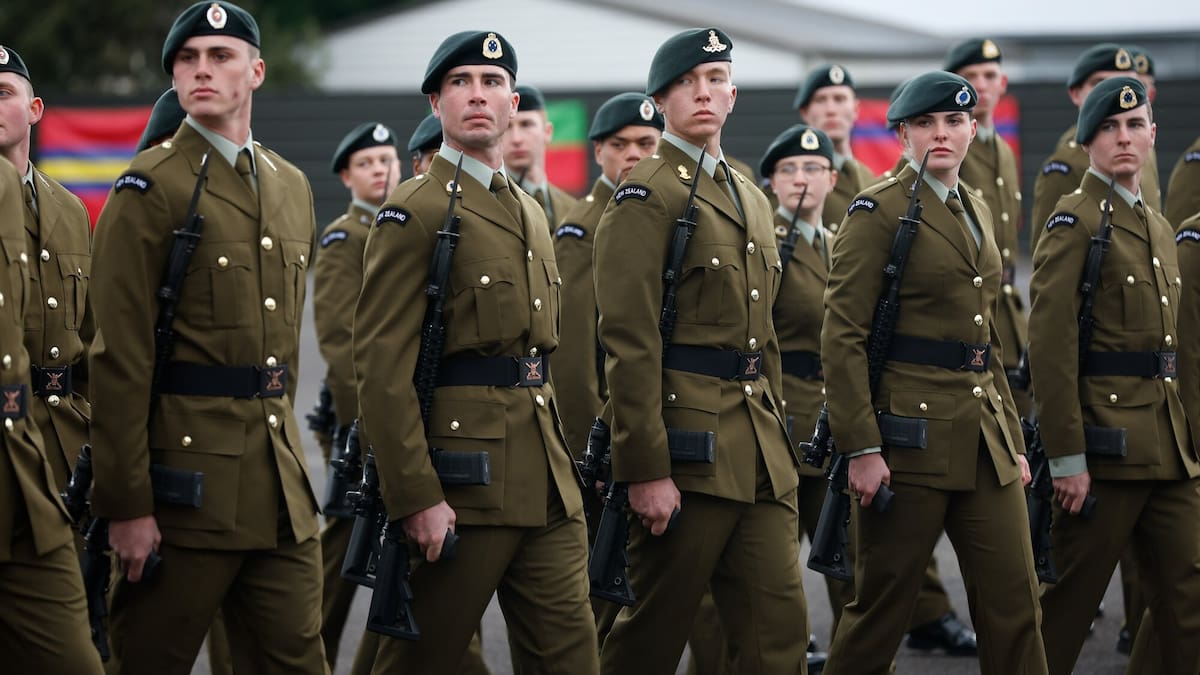
Former Defence Minister Judith Collins (centre) joins Army chiefs last year to inspect the Graduation Parade for Recruit Regular Force 416, Rafah Company, at Waiōuru Military Camp, the main centre for recruit training. Photo / Sylvie Whinray
A business case was completed with several options presented for investment. Most of the analysis of these options was redacted in the document.
The option that Penk recommended is described as a “Land Training System that equips the NZ Army to integrate with Australia and other partners, and operate jointly with other Government services”.
“When viewed through a primary lens of affordability, timeliness and achievability, [this option] focusing on recruit training only, is considered to be the minimum viable capability needed in the short term,” the paper says.
He recommended a detailed business case and told Cabinet he was seeking funding for a design phase. That money was ultimately confirmed in the Budget.
This design phase would include reviewing and redesigning the system and curriculum, making a series of “targeted facility upgrades to add resilience to a significantly degraded capability” that would be of value regardless of future decisions, and developing the detailed business case.
That business case would include more information on a range of possible investments. The paper highlights the major components of recruit training at Waiōuru include the headquarters, instruction facilities, and weapon training simulation and ranges.
A timeline for the programme shows the “design phase” as occurring between the third quarter of 2026 and quarter two of 2029. The dates for the delivery phase and closure phase were redacted in the document.
Penk told the Herald recruit training was “an important element of having the right people” and recruitment would be an “important factor for the long-term future of the force”.
He said the issue was “underinvestment and the situation we’ve inherited has been suboptimal across the board”. He pointed to the state of training facilities and defence housing.
Asked whether enough urgency was being given to the issue, given the timeline of the design phase reaching out to 2029, Penk said the Government was trying to “sequence a whole heap of infrastructure”.
“We’re trying to sequence it all so that we can physically get it done. Of course, if it’s possible to do more quickly, then we will,” he said.
Jamie Ensor is the NZ Herald’s chief political reporter, based in the press gallery at Parliament. He was previously a TV reporter and digital producer in the Newshub press gallery office. He was a finalist in 2025 for Political Journalist of the Year at the Voyager Media Awards.