
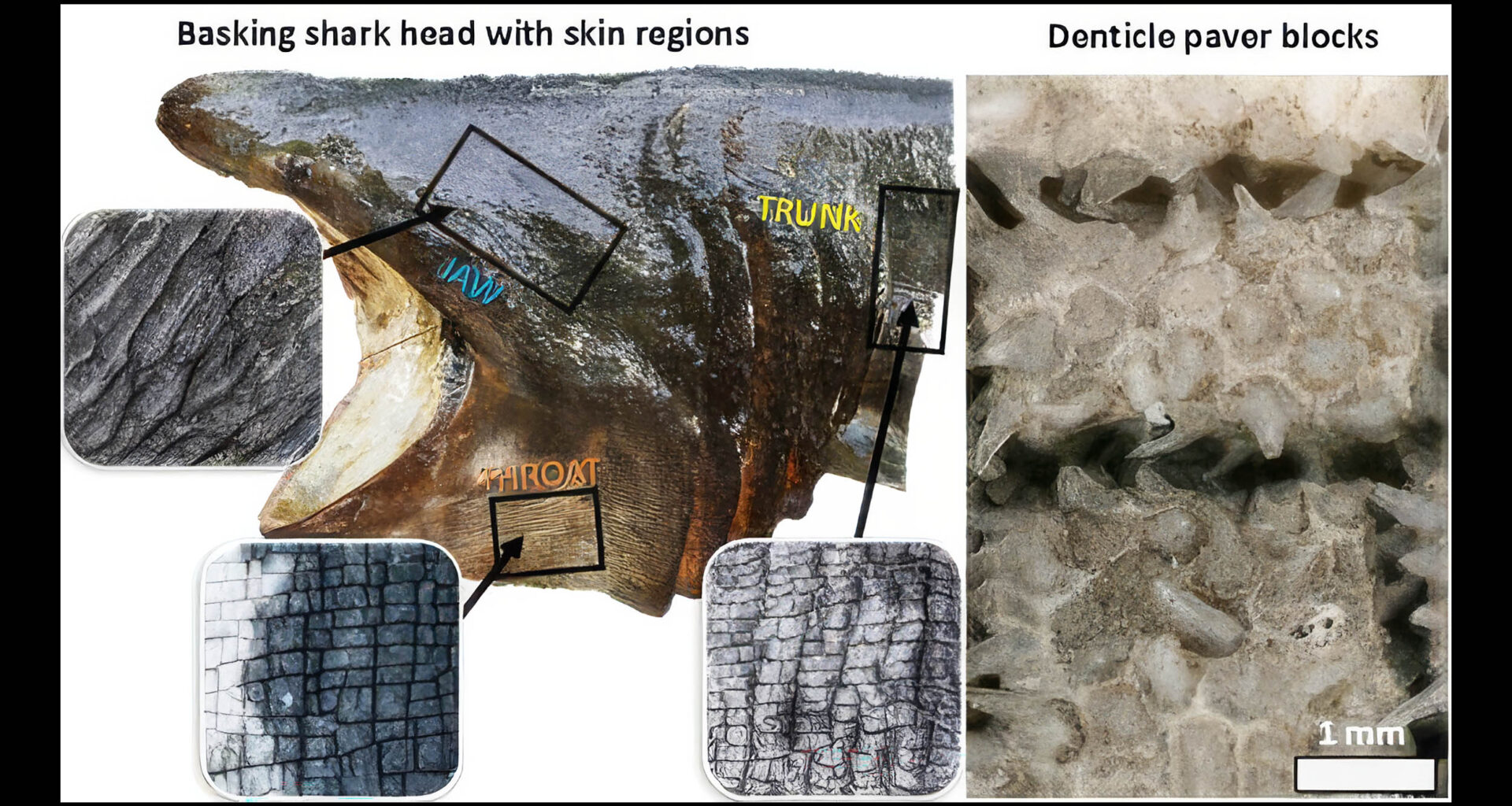
Most shark skin feels like fine sandpaper. One way it runs smooth, the other way it grips. That texture comes from millions of tiny, tooth-shaped scales called dermal denticles.
They lie flat against the body, all angled backward to cut drag through the water, keep parasites from latching on and give the skin a hard coat of armor.

The basking shark ignores that blueprint. Its scales run large and blunt, and are scattered in odd directions across patches that look like wrinkled elephant hide.
The species ranks as the second largest fish alive. It feeds by cruising slowly along with its mouth held wide open, sieving plankton from the water. This habit reshapes what the skin has to handle.
Shark skin that rips
The discovery came almost by accident. A team set out to study how basking sharks strain their food from seawater, but the skin caught their attention well before the feeding structures did.
“We only noticed that basking shark denticles where so special when we first investigated the bodies of beached specimens for the purpose of studying their oral filter structures,” said Mike Schindler, a Ph.D. student at the City University of Hong Kong (CityU).
On a typical shark, a hand sliding from head to tail meets firm, even resistance, indicating that the scales are all locked in a single direction. Every denticle points the same way, smoothing the water’s path across the body.
“However, when we touched the basking shark’s skin with gloves, they quickly ripped apart – a sign that something was very different about the size and alignment of basking shark denticles,” Schindler said.
Scanning rare museum specimens
Basking sharks are an endangered species. Intact bodies almost never wash ashore, so the team leaned on museum material. They drew on both physical specimens and virtual scans to squeeze out every detail.
They began with laser scans of whole bodies. Microscopes came next for small patches, then micro-CT imaging mapped each scale in three dimensions.
The project drew backing from the Human Frontier Science Program (HFSP). Later steps measured each denticle for volume, curvature and length, then pulled on skin samples to test how far the tissue would give.
The plan ran from the whole animal down to a single scale and back again. Each scale had to make sense on its own and as part of the larger skin.
Unusually large shark skin denticles
Size was the first surprise. On most sharks the denticles stay so small that only a microscope brings them into view.
“While a microscope is needed to see other shark denticles, basking shark denticles reach a diameter of around half a millimeter and are visible with the naked eye,” Schindler said.
The shape had shifted too. Instead of the flat, hooked scales that cover most sharks, these looked like tiny fangs, jutting out in seemingly random directions.
The scales also held nearly the same shape all along the body. That kind of uniformity almost never shows up in other sharks.
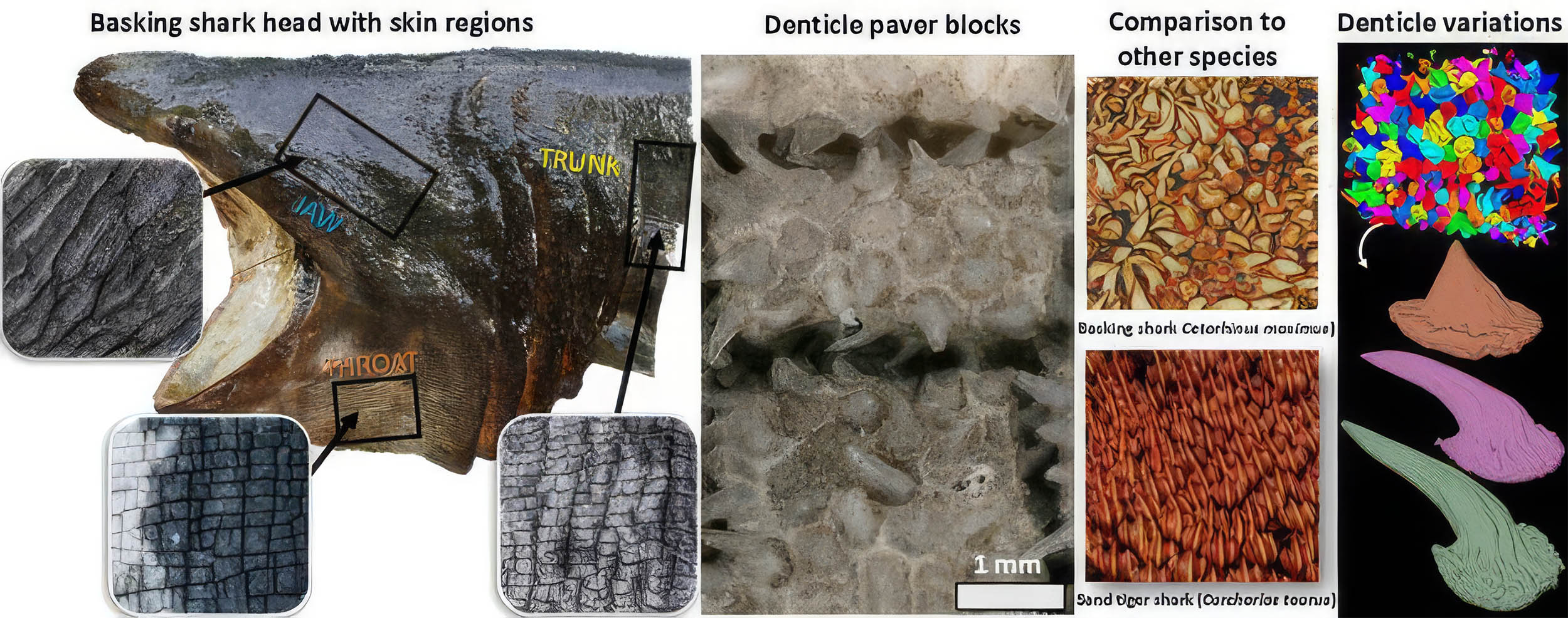 (1) The basking shark head, (2) Their distinctive skin consisting of ‘paver block’ arrangement, (3) Renderings comparing the skin denticle shape/arrangement with another close shark species (not on same scale!), (4) The shape variations of denticles. Credit: Mike Schindler. Click image to enlarge.Denticle clusters called paver blocks
The arrangement of scales set the species even further apart. The denticles do not spread out evenly across the body; instead they gather into tight patches, with bare, denticle-free skin running between them.
“What makes the basking shark’s denticles particularly unique is their arrangement, since they are clumped together in groups to form what we’re calling ‘paver blocks,’ tight clusters of denticles in areas where deformations occur due to body motions,” Schindler explained.
Seen up close, the packed blocks and the empty grooves between them recall the deep creases of an elephant’s hide.
The blocks gather where the body bends and flexes the most. Between them the bare skin can fold freely, with nothing rigid in the way.
Shark skin built for stretching
Those bare grooves may be the whole point. Basking sharks feed by holding their mouths wide open, straining plankton from huge volumes of passing water.
The head swells and stretches with every gulp. Skin locked into rigid, tail-facing scales would simply tear under that strain.
The paver blocks sit apart, so the grooves between them open and close like the pleats of an accordion.
“Interestingly, the denticles of the ‘paver blocks’ are arranged like floral whorls, so that the denticle crowns overlap the folds and interdigitate with denticles of neighboring blocks, covering the folds when the mouth is closed,” Schindler said.
Where the shape began
This strange skin has deep roots. Fossils of extinct basking shark species carry the very same odd denticle pattern.
That pattern appears exactly where filter-feeding anatomy does. The scales and the filter-feeding diet seem to have evolved side by side, with one change dragging the other along.
Close relatives drive the point home. Neither the sand tiger shark nor the filter-feeding megamouth carries anything like it.
“We suspect that, due to this species’ slow swimming speed, denticles were released from a constraint, and the ‘skin armor’ instead took on a novel role in accommodating the stretching ability of the skin and repelling parasites between the folds,” Schindler said.
From shark skin to sportswear
The lesson reaches well past sharks. A surface that stays strong in one direction while bending freely in another could help engineers in unexpected places.
Stretchy sportswear is one possibility. Flexible bandages that bend with a moving joint are another.
Nature solved a tough problem here, holding a surface together while still letting it move. That balance is the very thing many that synthetic materials struggle to strike.
The work was presented at the annual conference of the Society for Experimental Biology (SEB).
—–
Like what you read? Subscribe to our newsletter for engaging articles, exclusive content, and the latest updates.
Check us out on EarthSnap, a free app brought to you by Eric Ralls and Earth.com.
—–