
It was two Fridays ago when Paul Crawford began receiving unusual emails and photos from his friends in Penticton, B.C.
Some curious items had been found at the local Value Village, they told him: framed pictures that looked oddly familiar. And if anyone could ID the artwork that was rolling onto the shop floor bin by bin, it would be Crawford. For nearly two decades, he’d been the curator and executive director of the Penticton Art Gallery, a position he held until last year.
Crawford’s friends were correct. He knew the items well. “Immediately, I recognized them all from the gallery,” he says. And indeed, on Tuesday the PAG confirmed they dropped hundreds of things at the Value Village earlier this summer, news that’s confounded many in the community.
It’s unclear just how many artworks were discarded by the PAG; when asked by CBC Arts, an exact number was not provided by the gallery. The stuff they left at Value Village was never part of the museum’s permanent collection. Rather, they were gifts to the PAG intended to be sold at fundraising events, including an annual auction gala that benefits the non-profit’s community education and outreach programs.
Friday, Crawford began sharing posts about the situation on Facebook. During his tenure at the PAG, Crawford says he was the “primary fundraiser” for the museum. He personally gathered items for auction, and he approached the job with a curatorial mindset. He was interested in accepting art that had a “good Penticton connection” — a tie to the history and culture of the Western Canada — and in addition to work by artists from the area, the holdings included work by national and international talents.
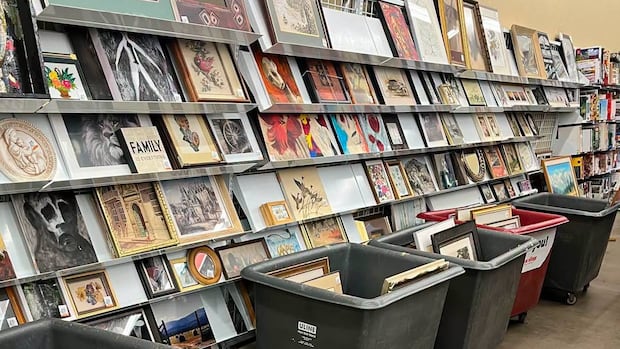
When Crawford finally made it to the store to take in the scene for himself, he says the shelves were “pretty picked over,” but he quickly spotted items from the PAG’s fundraiser stock, now priced as low as $9.99. “I basically filled up people’s shopping carts with art,” he says, giving thrift shoppers extra context about the artists and the work.
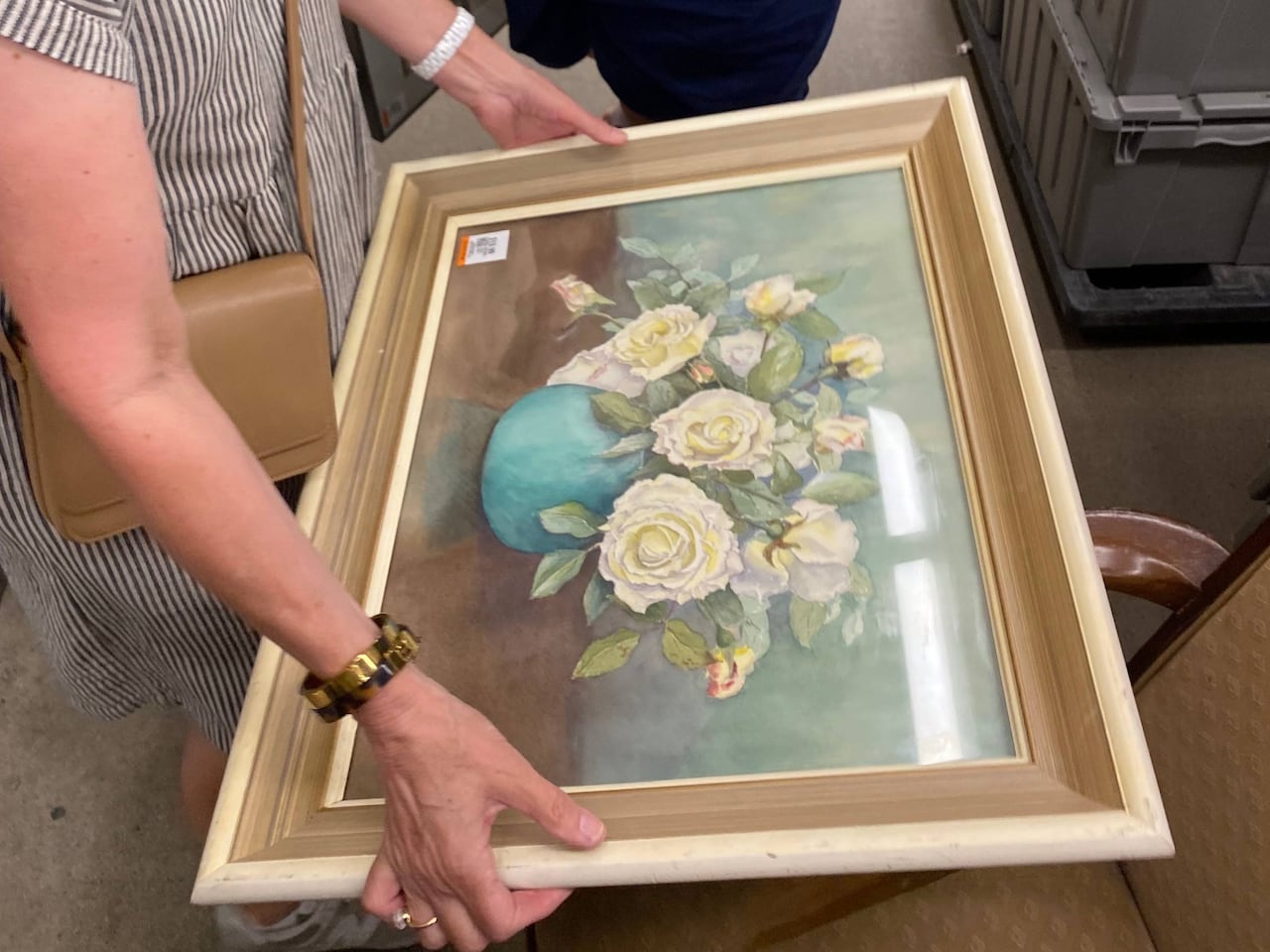 A shopper at the Value Village in Penticton, B.C., gets a closer look at a piece by the late B.C. artist Mabel Aileen McWilliam. (Paul Crawford)
To date, his discoveries have included a harbour landscape in pastels by Irene Hoffar Reid, a member of the first graduating class of the Vancouver School of Decorative and Applied Arts (now Emily Carr University of Art and Design) whose work is in the collections of the Vancouver Art Gallery and Art Gallery of Greater Victoria.
A watercolour by H.G. Glyde was put out on the shop floor; the English-born painter established the Department of Fine Art at the University of Alberta. And for just $17.99, one lucky shopper took home a two-for-one treasure with a celebrity connection: a mountain scene framed by a hand-painted mat. Titled Glacier National Park and Eagle it’s the work of Bill Alexander, the PBS television host who paved the way for Bob Ross.
“Anybody with just a cursory knowledge — who would take the time to look at these works — would surely know these are worth more than nothing,” says Crawford, who’s distressed to see so many gifts to the gallery turn up at the thrift shop.
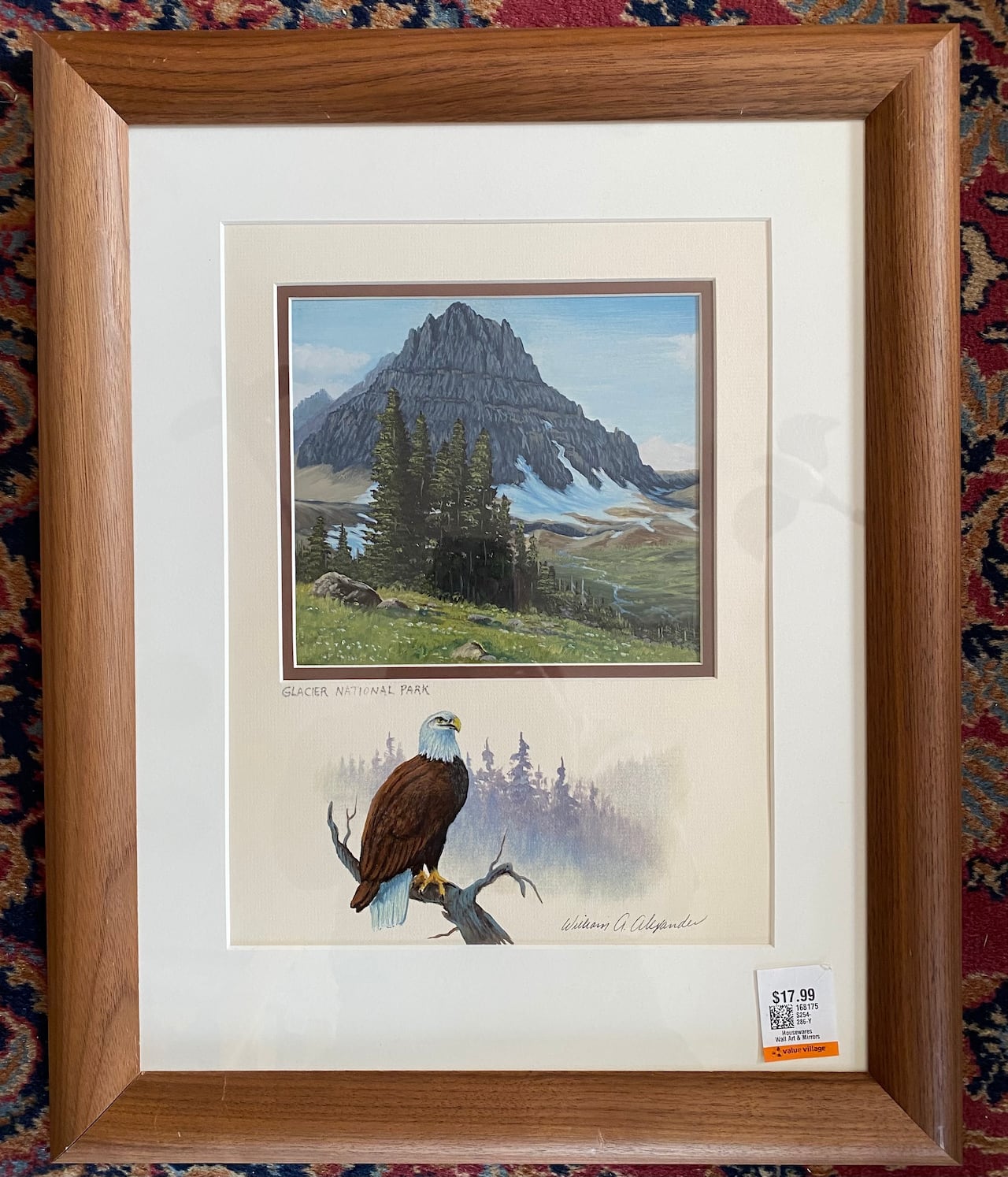 As seen at the Penticton Value Village, Glacier National Park and Eagle by Bill Alexander. The artist and former PBS television host was a mentor to Bob Ross. (Paul Crawford)
“I owe a duty of care to all those people who donated and trusted me and the gallery with their donations,” he says. That’s why he’s been posting about the situation on Facebook. “I’m not here to damage the institution,” he says, referring to the PAG. But by raising his concerns, he hopes the gallery will be more transparent about its divestment process going forward. “
“It’s not at all about the fact that they got rid of the work,” says Crawford. “It’s just how they went about it.”
Crawford’s posts have likely inspired a few opportunistic pickers to go thrifting in Penticton. But they’ve also prompted plenty of heated discourse, and the big question is, of course, how these artworks landed at the Value Village instead of a fundraiser auction as intended.
It’s not at all about the fact they got rid of the work. It’s just how they went about it.- Paul Crawford, former curator and executive director of the Penticton Art Gallery
This Tuesday, the PAG responded to messages from the public, emailing members to address the “real concern and confusion” within the community. In that letter, they confirmed rumours of a donation to the Penticton Value Village. Their statement, which was signed by board president Leslie Whatmough and board secretary Kathi Irvine, explained the PAG did not have the space to “safely and responsibly store” hundreds of fundraising donations which were being kept on the premises. A six-person committee was formed last fall to sort and review the holdings, and they evaluated items based on criteria including condition, provenance and whether it had previously been offered at auction.
“For every piece that we had to let go, at least one other has been kept for future fundraising, and there are many more still to be reviewed,” the email states. “We are aware that our choice of donation recipient has raised concerns for our community. Please know that we donated the art to a location that would ensure the pieces received maximum exposure. It is our hope that those who see value in the works that were donated will take them into their own homes. Going forward we commit to exploring other avenues when making those choices.”
On Wednesday’s episode of Daybreak South, CBC Radio’s morning show for the Southern Interior of B.C., local artist Norberto Rodriguez de la Vega responded to the gallery’s statement. “The whole thing to me is insulting,” said the artist. A friend had recovered one of his works at the Value Village for $11, which wouldn’t even cover the cost of materials, he said.
LISTEN | Daybreak South with Chris Walker:
Daybreak South14:55Penticton Art Gallery sets the record straight on why donated art ended up at the local Value Village
Leslie Whatmough, board chair for the Penticton Art Gallery, says a team of people with extensive art knowledge spent months vetting the art work that was eventually donated to the Value Village, and the decision was made with much consideration.
Crawford worries the situation has damaged the gallery’s relationships with artists like de la Vega; by making their work available at reduced prices, future sales are undermined — a reality that impacts commercial galleries in the region, as well, many of which have supported the PAG through donations and financial support.
Whatmough was also on Wednesday’s Daybreak South to respond to the thrift-shop debacle. She spoke with CBC Arts later that day. “We made, in hindsight, a really bad decision,” said Whatmough, who joined the PAG board in May.
Recently arrived from Ontario, where she was the curator of education at the Burlington Art Gallery, Whatmough was appointed interim board president last October. It’s been a tumultuous period at the PAG. Last fall, the board took over the gallery’s operations. In August, the PAG announced a series of staffing changes, claiming financial woes were to blame. Crawford was among those affected. The gallery said the long-time curator had been placed on a temporary layoff; that October, he filed a civil lawsuit against the PAG seeking damages tied to his dismissal. Later that month, multiple board members split, including the president, Claude Roberto.
We made, in hindsight, a really bad decision.- Leslie Whatmough, board president of the Penticton Art Gallery
In November, Whatmough and the reshuffled board were trying to find more exhibition space for the PAG’s permanent collection when they discovered hundreds of undocumented items taking up valuable real estate in the gallery’s storage rooms.
“I’m not saying it was all artwork. There was framed posters you would have got at Winners, there was memorabilia, there was randomness that did not make any sense,” she says. “So, we don’t know why it was there. And the only reason we called it the ‘fundraising inventory’ was because there was a sign on the shelf that said ‘for fundraising.’”
Whatmouth says the gallery spent months trying to locate more information about the fundraising inventory: records of provenance, tax receipts, etc. “There was nothing attached to any of the pieces,” she says. A few works were successfully returned to the artists who created them, she says.
“We realized the quality of a lot of things wouldn’t have raised us any money,” she says. “What do we do? Like, where do you take it when you’ve got that much stuff?”
“We’re a small community, and there are a handful, maybe, of thrift shops. But most of them don’t have art in them,” says Whatmough. “Value Village has art and shelves where it displays it. So it’s like, OK. That made sense on a weird, fast level.”
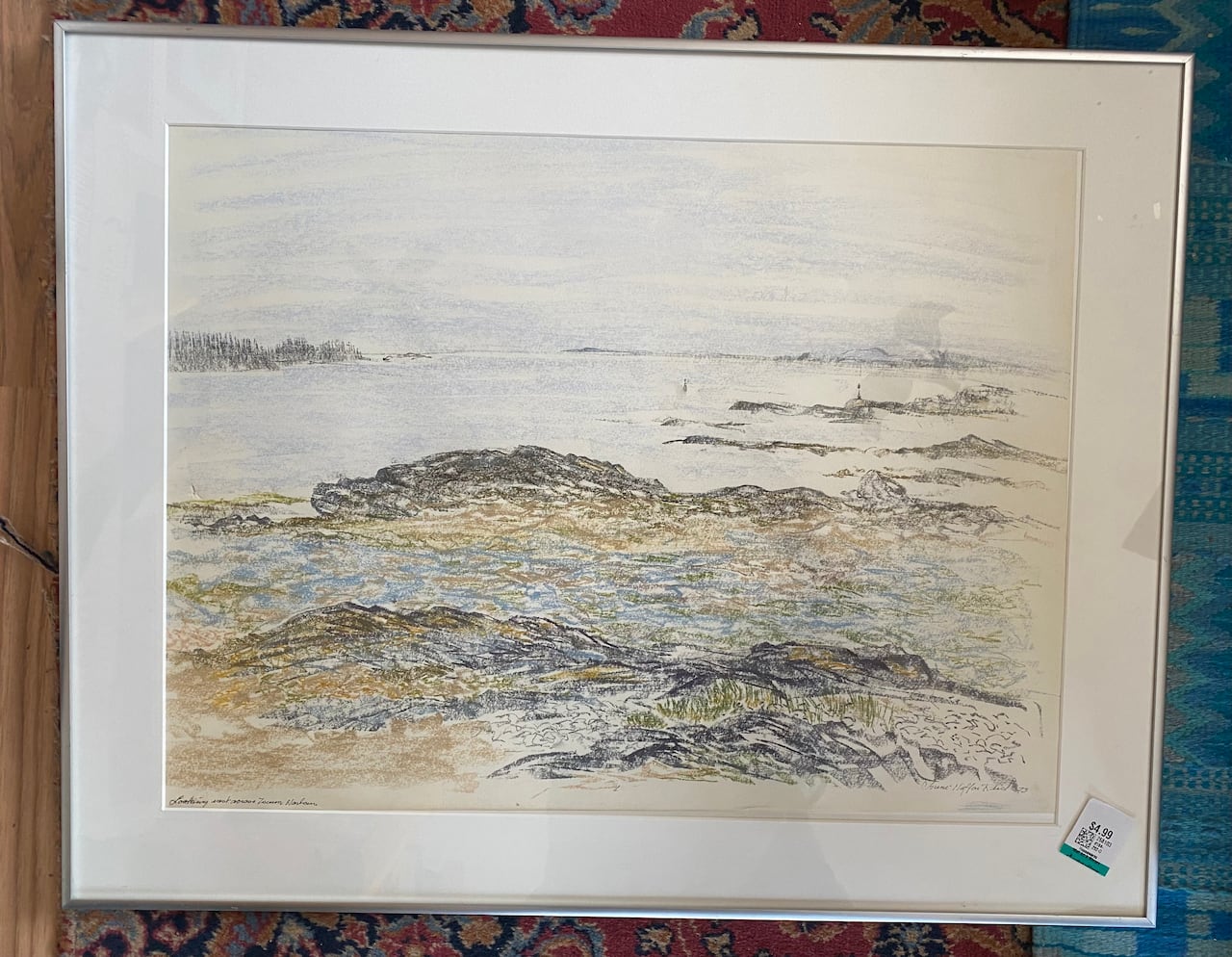 This 1973 landscape by Irene Hoffar Reid, Looking West Across Tsehum Harbour, was on sale at the Penticton Value Village for $4.99. (Paul Crawford)
During his time at the PAG, Crawford would hold onto fundraiser donations if they didn’t achieve an auction price that reflected their value. Unsold works often appeared at future fundraisers, he says. Donated artwork was also sold through professional auction houses, and he says the PAG could have contacted an auction company about some of the “higher profile items” that have turned up at Value Village. He singles out works by H.G. Glyde, Nicholas de Grandmaison, Irene Hoffar Reid.
“These options would also have helped ensure that the majority of funds generated from the sale of these works were returned to support the gallery’s programs and operations,” he says in an email.
Jennifer Vincent has lived in Penticton since 2009, and the PAG has always been one of her favourite places in town. Last week, she was shocked when she saw one of Crawford’s Facebook posts from the VV boutique.
As a regular gallery goer, Vincent knew the PAG kept a collection of contributions from the community, artwork intended for fundraising events. “To hear that they had been delivered in a U-Haul van to Value Village without any notification to the community felt like a betrayal of that trust,” says Vincent. The next morning, she was outside the store, waiting for the doors to open.
“There was a handful of other people too,” says Vincent. “Most of us went straight to the section where the art was.”
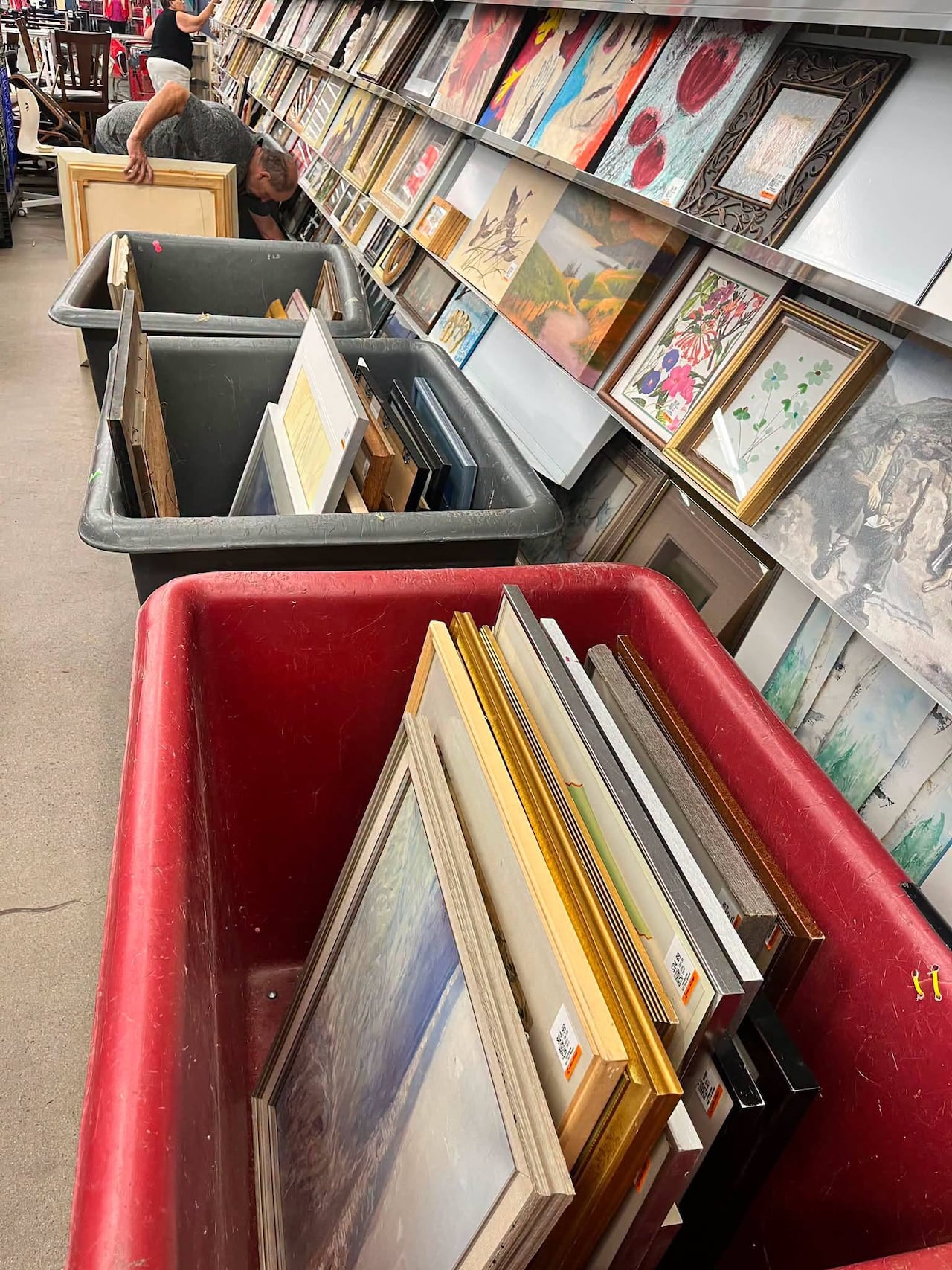 A few bins of artwork that appeared on the floor of the Penticton Value Village last week. Paul Crawford posted this photo after visiting the shop in search of items donated by the Penticton Art Gallery. (Paul Crawford)
Vincent arrived at the store with a mission. Her mother, former CBC Radio broadcaster Carol Munro, was passionate about art. Over the years, Munro had gifted several of her original paintings to the gallery’s fundraisers.
“My mother passed away two years ago,” says Vincent; in early 2025, the PAG presented an exhibition devoted to her lifetime of work.
“I didn’t know if I was going to walk into Value Village and see her work priced at $9.99,” says Vincent. “That was the piece that really felt disturbing.”
When Vincent reached the store’s art and homewares department, the mood turned sombre. “It was like going to a car crash or something, and seeing if there’s somebody there that you knew,” she says.
“Nobody spoke to each other. And then after about a moment, somebody broke the ice. Conversation started to happen the way it does in a community that is looking at a bit of a tragedy together. People started to talk about why they were there,” she says — and what the art gallery means to them.
“The artwork came back to life right away. You know, as soon as people were looking at them, they had a story to tell or a story to be a part of,” she says.
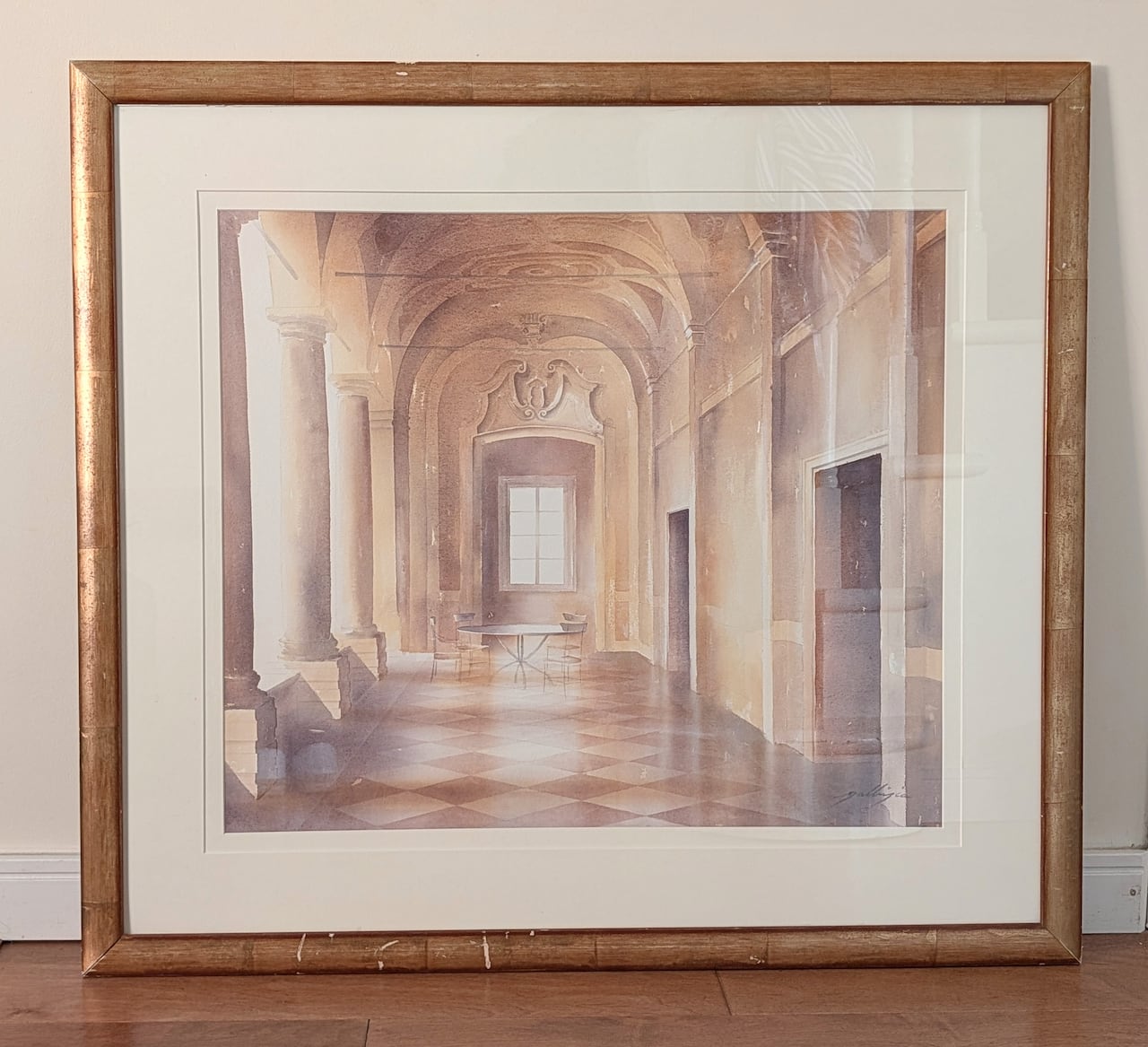 Penticton resident Jennifer Vincent purchased this watercolour by Janine Gallizia from the local Value Village. (Jennifer Vincent)
Vincent didn’t find any of her mother’s paintings, but she rescued two works that day: an abstract photograph and a watercolour of a tranquil Italian palazzo. Vincent says she contacted Crawford for help identifying her new treasures; the painting, he explained, is by an Australian-born artist, Janine Gallizia.
Crawford continues to be contacted by locals who are keen to learn more about their Value Village finds, and he’s eager to oblige. As more items from the PAG’s trove of fundraiser donations are recovered, they ping him on Facebook. He plans to share more information about the works on his page.
“If there’s any sort of assertion that these were works of no value, or by minor artists, or anything along those lines, no. … They were important to the people that owned them and the people that donated them,” says Crawford. And now they’re important to the people who’ve taken them home from the thrift.
Vincent is still deciding where to hang her acquisitions, but she’s preserved their thrift-shop price tags. She’s stuck them on the backs of the frames and added a handwritten note: “Rescued at Value Village.”
“That’s now part of the story of the artwork,” she says. “A side benefit of this whole situation is that a lot of art is now probably in someone’s life, somewhere it’s being seen and enjoyed. It’s unfortunate that the profit of that is not being realized within the arts community, as it was intended, but I’m glad the art’s being seen.”