
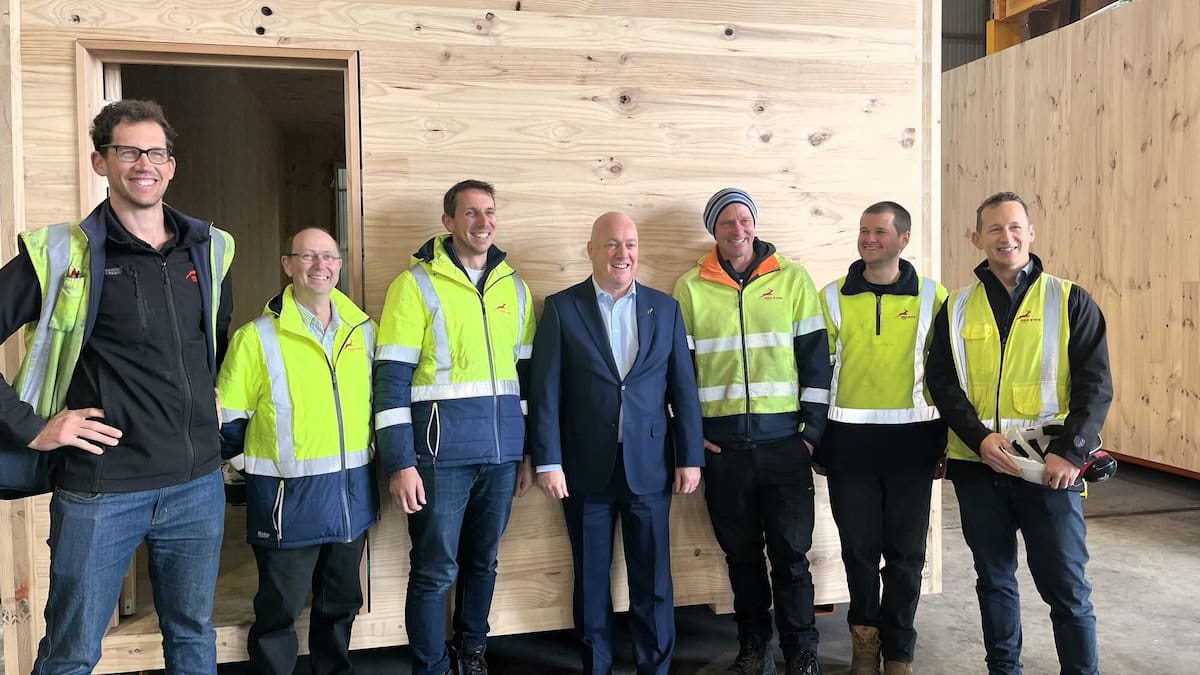
The boxes were the first examples of Red Stag’s new volumetric modular – or VoMo – manufacturing system, officially commemorated with a ribbon-cutting by Prime Minister Christopher Luxon at the mill.
The production line is the first in the Southern Hemisphere to use cross-laminated timber (CLT) to manufacture complete room-sized building modules in a factory before taking them to construction sites.
Verry said the system was based on technology used in Austria and Germany.
The project was a collaboration between Red Stag, German architecture firm NKBAK and Austrian construction company Kaufmann Bausysteme, with support from the Ministry for Primary Industries’ Primary Sector Growth Fund.
Verry said the approach could help developers significantly reduce construction time as work on building foundations and modules can happen simultaneously rather than consecutively.
“Typically, this takes one-third to one-half out of the overall construction programme.”
The facility was expected to service multiple projects, including classrooms, apartments, townhouses, cabins, hotels, student accommodation, offices and retirement care facilities.
Red Stag had secured projects requiring 150 modules over the next two years. The production line would eventually produce up to 800 modules a year.
Verry said using CLT, instead of imported steel and cement, could deliver environmental and economic benefits while supporting New Zealand businesses, jobs, rural communities and iwi-owned forests.
He said it would give Red Stag and other New Zealand processors a “better cost base to be able to compete in export markets”.
“This is something we want politicians and bureaucrats to realise and adopt strategic procurement policy around.”
At the mill, Luxon said he was “interested in” VoMo’s potential to keep more construction spending in New Zealand.
“I don’t want to send money offshore to bring in overseas steel and cement into New Zealand.”
He said New Zealand had spent decades treating timber as a commodity instead of adding value through innovation, and technologies such as VoMo offered a chance to change that.
Prime Minister Christopher Luxon opens Red Stag’s new volumetric modular (VoMo) manufacturing system. From left are: Rotorua MP Todd McClay, Luxon and Marty Verry, chief executive of the Red Stag group.
Photo / Rodney Thurlow
With a significant pipeline of schools, hospitals and military facilities to build, Luxon said engineered timber could play a much bigger role.
He said from his ninth-floor Beehive office in Wellington, he could see a six-storey building under construction using Red Stag’s product.
He described it as exciting, inspiring and a “fantastic example of what we can do going forward”.
“You see a building like this, and you go, ‘Why can’t we do more of this?’.”
Forest Owners Association chief executive Elizabeth Heeg said domestic processing would take some “volatility out of the supply chain”.
“It means we have a more secure environment for the building … we’re not having to import as many materials,” Heeg said.
Mark Ross, Wood Processors and Manufacturers Association of New Zealand (WPMA) chief executive, described the innovation as “stabilising”.
Ross said it was “great to hear” Luxon acknowledge the need to “use more wood” in Government construction.
“We don’t want to keep importing steel and concrete.”
Todd McClay attended the opening as Rotorua’s MP and Minister for Agriculture, Forestry, and Trade and Investment.
These wooden boxes were the first examples of Red Stag’s new volumetric modular (VoMo) manufacturing system.
McClay said backing the project was “an easy decision”.
“It is taking the trees that we grow well and providing a choice, providing an option.”
McClay said not exporting trees as logs would “add about seven times the value to those trees for New Zealand, the local economy”.
McClay thanked Verry for his contribution to the local and national economy, and for providing about 500 locals with “job security” by continuing to invest and innovate.
The sector was advocating for three policy changes:
Requiring a wood design option to be considered for Government projects.Recognising carbon stored in harvested wood products within the Emissions Trading Scheme.Introducing embodied carbon reporting for larger buildings.
Annabel Reid is a multimedia journalist for the Bay of Plenty Times and the Rotorua Daily Post, based in Rotorua. Originally from Hawke’s Bay, she has a Bachelor of Communications from the University of Canterbury.