
But an artist’s temperament is one of self-reflection and Sydney, widely regarded as one of New Zealand’s greatest living painters, isn’t a man who has always moved easily through the world.
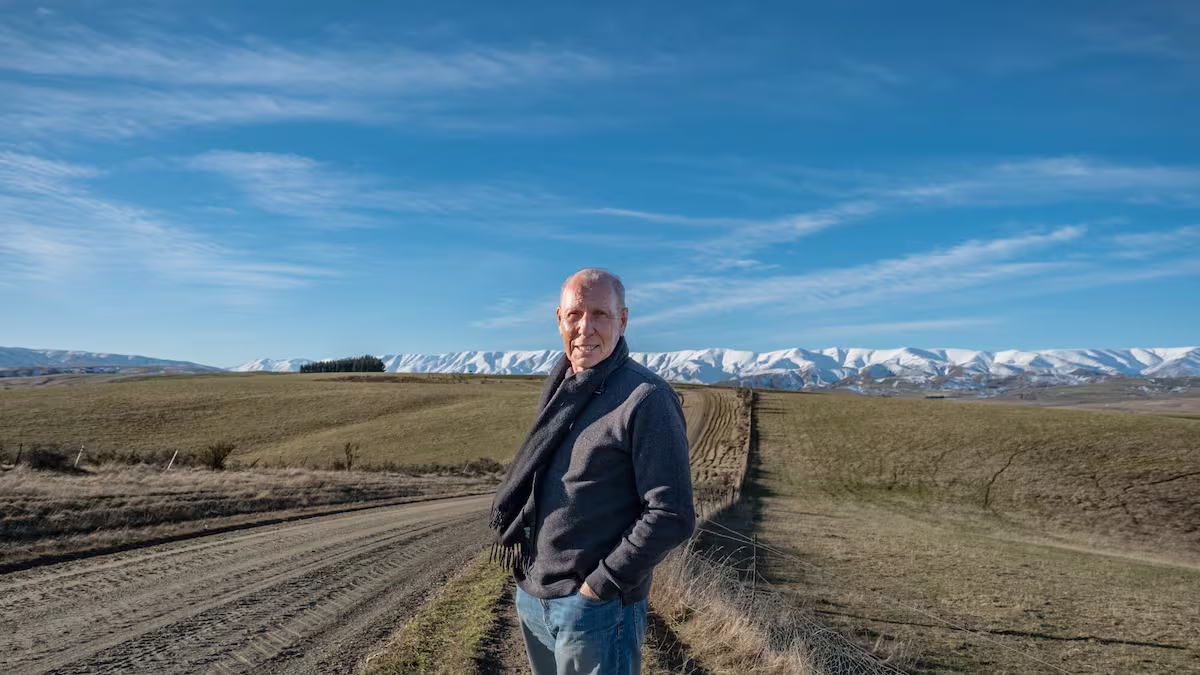
A lion in winter. At 78, Grahame Sydney believes he is yet to produce his best work. Photo / Tim Hawkins
“I’m a serious person, I suppose, and it’s a serious moment,” he says, when I ask what he sees of himself in the portrait now.
“I look at things acutely and probably more clinically than most people. I’m thoughtful and internal rather than flamboyant and extravagant, and I think that shows.
“I’m looking back at myself in the mirror, but it’s also looking back on a life and saying, ‘This is what it feels like being me.’”
As with so many of Sydney’s paintings, the self-portrait has never been exhibited.
Grahame Sydney, “Myself at 76”, 2024. Egg tempera on gesso on board. Private collection of the artist. Photo / Glenn Frei
His depictions of Central Otago, where he’s spent most of his life, have been widely reproduced and speak to the stark grandeur of that landscape so deeply it’s called “Sydney Country”.
Yet in recent years, the vast majority of his work has been seen by only a select few, going straight from his studio into the hands of private collectors and rarely coming up for auction.
So today’s announcement of a new exhibition, Close to Home – his first in 15 years – is a big deal. As one insider puts it: “People in the art world are fizzing.”
Grahame Sydney, “Evening Shadows at the Shearer’s Kitchen”, 2021. Oil on linen. Private collection, Queenstown
More than 30 paintings and possibly several drawings will be on show, spanning work from the early ’90s onwards, including half a dozen new pieces.
Most of the artworks are on loan from private collections; only a handful are expected to be available for sale. All but two have never been exhibited before.
Close to Home opens on August 22 at Milford Galleries, which moved into new bespoke premises in Queenstown last year. A second survey collection, featuring a further 20-plus paintings, is set to follow in early 2028.
While the exhibition’s title Close to Home references tūrangawaewae – a deep connection to the land – it’s also an opportunity for Sydney to display the breadth of his practice beyond the landscapes that have come to define him.
Image 1 of 9: Grahame Sydney, “The Rabbiters’ House, Gimmerburn”, 2026. Oil on linen. Private collection, Queenstown
The silent, haunting beauty of Becks, Gimmerburn and Waipiata sits alongside scenes from Antarctica, Amsterdam and France, where a crucifix stands on the rocky coastline looking out across the Mediterranean Sea.
There are half a dozen portraits of his wife, Fiona – love letters, he says, to the woman he calls “an extraordinary enabler of my work”.
He considers his figure studies, a classical art form he’s pursued since the early 80s, to be among his most significant achievements.
Grahame Sydney, “In Amsterdam 2023”, 2026. Egg tempera on gesso on board. Private collection of the artist.
Sydney’s long career has been filled with accolades. In 1996, the New Zealand Government gifted his painting Moonrise on the Maniototo to South Africa’s new President, Nelson Mandela, and Elton John famously bought one of his figure paintings – paying full price after his request for a discount was declined.
Still, he’s nervous about how this new show will be received.
“I never go into these situations confidently because I’ve never taken for granted the fact that there’s either interest or support for me,” he says.
“I often look at my paintings and find it hard to believe that I did them, but that’s part of the magic of it, really. A tiny trapdoor opens and you’re transported back in time.
“The nature of the profession is that you send them out to adoptive homes and hope they’re in a loving family. This will be like an assembly of long-lost children for me.”
Grahame Sydney in his studio with a work in progress on the easel. Photo / Tim Hawkins
Close to Home is Sydney’s first solo exhibition since 2011, when Porirua’s Pātaka Museum of Arts and Cultures showed a selection of his landscape paintings.
A 25-year retrospective, curated by the Dunedin Public Art Gallery in 1999, toured New Zealand for three years, attracting record attendance.
Timeless Land, the book he published in 1992 with writer Owen Marshall and poet Brian Turner, has been reprinted multiple times.
More recently, however, Sydney has been more visible for his environmental activism than his artwork – fighting the invasion of wilding pines that threatens Central Otago’s unique landscape and standing alongside his close friend, actor Sir Sam Neill, to oppose the proposed Bendigo mine.
Neill’s death, coming so soon after the loss of Turner last year, has knocked him badly. At 78, he feels time rushing by.
“It’s awful being left behind,” he says. “But then it makes you more determined to make the most of it while you can.
“I still feel genuinely that I haven’t done my best work yet. I’m very much possessed by this notion that I want to be better, and that I have all these things I want to leave behind.”
From his home, Grahame Sydney can watch shifts of light on the low-slung Hawkdun Range, but he’s also seen the creep of wilding pines that have turned tussock on a neighbouring property into a forest of exotic trees. Photo / Tim Hawkins
Sydney pauses, shaping his thoughts carefully. He feels it profoundly, this calling that drives solitary hours in his studio at home in the Cambrian Valley, where the house was built so he could see the light change.
Right now, the long, low horizon of the Hawkdun Range to the north-east and the swell of Mt St Bathans to due north are covered in snow. The week before, hoar frost had laced the valley.
He loves it when winter hits hard. “I find beauty in things that are bleak and raw, and I try to turn that harshness into something memorable,” he says.
“I don’t know if this is pretentious or not, but I feel a sort of duty to add beauty to the world in what I do and to help people understand that things can be significant and memorable and beautiful in ways that are not necessarily conventional.
“I think paintings do that, in the same way that musicians and writers and film-makers do. They help people become more aware, and they also help define a sense of their culture and where they belong.
“I frequently think how wonderful it is that I’ve lived in the same time as the likes of Dave Dobbyn, who writes songs that feel like us. I love him for that.”
Sydney no longer takes commissions, producing only five or six new pieces each year. In 1995, he broke away from the dealer world to go it alone, selling directly to a private client list.
That may go some way to explaining why exhibitions of his work are so rare, but why hasn’t one of our major public art galleries curated this one?
“The simple answer is that l was never asked,” he says, when pressed. “I’ll keep my thoughts to myself on the reasons why that might be.”
Although this is their first collaboration, Sydney and Milford Galleries director Stephen Higginson have known each other since the late ’60s when they were at the University of Otago together.
Higginson was the editor and publisher of a poetry magazine called Pilgrims. Sydney, who was studying English, thinks Higginson might have reproduced one or two of his paintings.
“Steve had been keen for many years to put on something because he was anxious about the fact that I’m slogging away and people don’t know,” he says. “He had a strong sense that wasn’t right and that it wasn’t a good thing for me.”
Grahame Sydney, “Chapelle St Vincent, Collioure”, 2018. Oil on linen. Private collection of the artist.
Headquartered in Dunedin, Milford Galleries opened its Queenstown branch in 2003, moving to custom-fit contemporary premises with three large gallery spaces last year.
Milford’s senior art consultant and curator, Vanessa Eve Cook, says Close to Home will surprise people who know Sydney only as the landscape artist he’s become recognised as through his books.
“To see these works in person is so moving,” she says. “The magic about Grahame is that he’s able to tap into your emotions and experience of a place, or of home. He’s painting a poem and people translate that in different ways.
“This is one of our most important painters of all time and to be able to see this amount of work in one space is absolutely monumental.”
Over the past five decades, Sydney has fought to protect the distinctive Central Otago landscape, opposing the Clyde Dam project in the 1970s and helping to block a controversial wind farm on the Lammermoor mountain range in 2012.
Grahame Sydney, “For the Forgotten”, 2022. Oil on linen. Private collection of the artist.
He rejects the idea of political activism through his paintings – “They’re not posters for a campaign” – although his work does champion the environment in a truly meaningful way.
He’s said people are defined by the landscape in which they choose to live. That’s become true for him, too.
“There appears to be something in me that responds powerfully to Central Otago’s emptiness; the sense of grandeur and majesty of its wide open spaces, and that attendant notion that we are so insignificant.
“We’re passing by briefly. I’ve always felt that, and I feel it most strongly here.”
Close to Home runs from August 22 to September 21 at Milford Galleries in Queenstown, milfordgalleries.co.nz
Joanna Wane is a senior lifestyle writer with an interest in social issues and the arts.