
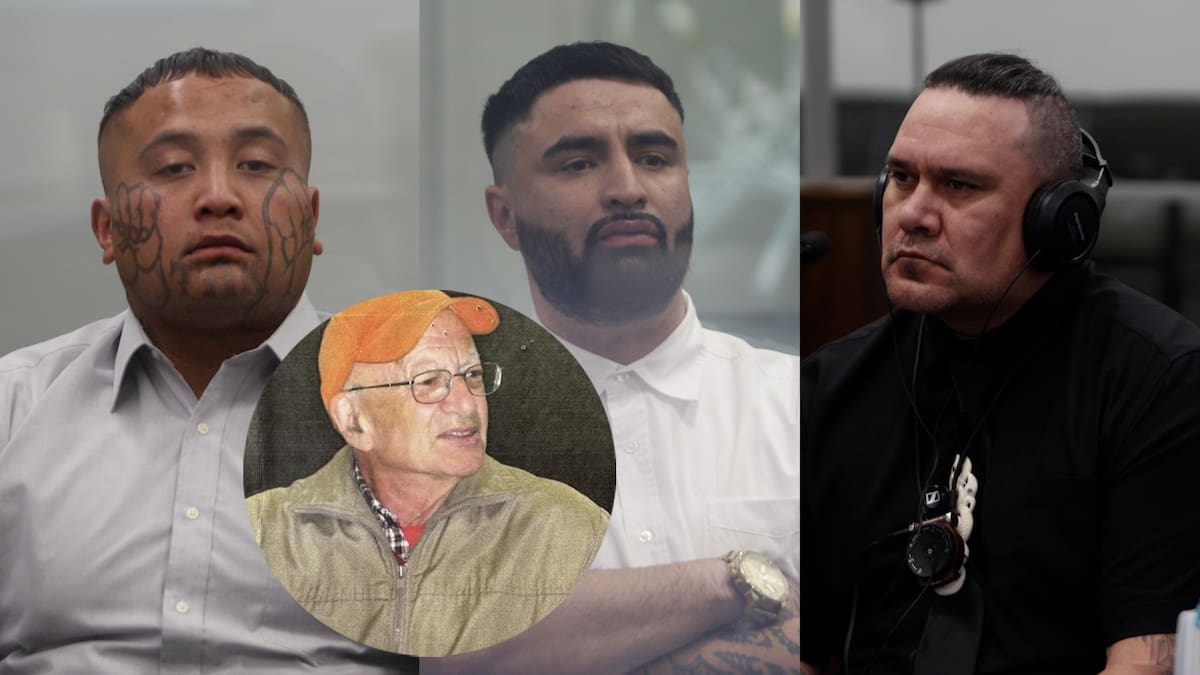
There were three fires at the flats in 2024, but only the third, in November 2024, proved fatal. Moller died in Wellington Hospital several days after the fire, from smoke inhalation.
Mangu Kaha gang members Arden Neho, Reardon Kamaru and Henare Barber have denied arson and murder.
Neho also faces two charges relating to fires on October 10 and 14.
The Crown says the fires were lit under the direction of a gang.
Their simple proposition is that Neho, Kamaru and Aiga lit the fires to get gang patches, under the direction of Barber, a patched Mangu Kaha member.
Defence counsel have urged the jury to keep an open mind.
‘I didn’t draw that, that’s not right’: witness
In the witness box, Kimura refused to look at a sketch map of the flats when Crown prosecutor Anselm Williams tried to refer her to it.
“I didn’t draw that, that’s not right,” she told the court, also denying the signature at the bottom of the page was hers.
When she was asked to look at a photograph of the flats, she told Williams she was fully aware of what her flat looked like.
The prosecutor patiently explained that the jury needed to understand it – to which Kimura responded that the jury needed to understand there were three people present on the night of the fatal fire and none of them saw anything.
“I’m just cutting to the chase, witnesses are coming to court saying things they didn’t even see,” she said.
Kimura told the court on the night of the final fire, she was asleep in her bed when she was woken by a man banging on her window.
By the time she got out of bed, fire engines and police were outside, she said.
Questioned by defence counsel, she told the court she had been serving an electronically monitored bail sentence and initially thought it was the police, and she was under arrest.
Earlier 111 calls
Kimura made two 111 calls, reporting the October 10 and 14 fires.
However, when Williams tried to question her about the first fire, she refused, saying it “was a completely different situation”.
On the night of the first fire, Kimura says she was standing in her flat when she told police she heard two men coming down the stairs and watched them leave the flats.
She later told police one was Pākehā and the other was Māori and recalls one saying; “Hurry up Kane”.
Kimura told the police she knew the man Kane by another name, which she gave to the jury.
She also told the court she’d seen the same man running from the scene of the second fire four days later.
Asked by Barber’s lawyer Shane Robinson how she knew it was the same man, she said she’d seen half of his face.
“It was the way he ran; he ran like a gang guy. He had quite a distinctive run,” she said.
Kimura also told Kamaru’s counsel, Marty Robinson, that she didn’t believe his client could have lit the fires, because the two were good friends and their families had known each other for a long time.
“He’s my bro, I love him. I’ve known his family since I was born, but I met him about four or five years ago.”
She told the court the two would have sessions together, smoking methamphetamine, which they’d kept to themselves as the gang frowned upon it.
She agreed she hadn’t spoken with him about the fires until after the third fire, and was adamant he wouldn’t have tried to burn down the building where she lived.
‘We were close as’
In re-examination, Williams picked up on the witness’ assertion that Kamaru wasn’t responsible for the final fire.
“I said the onus was on the police to prove his guilt with the physical evidence. I wholeheartedly do not believe he did that, because of the background and the history that we had.
“We were close as”.
Williams then asked her if a fourth defendant – Shyheim Aiga, who was dating her niece – could have been responsible.
“I absolutely know that he didn’t,” she responded.
Earlier, the court heard Aiga has pleaded guilty to the two earlier fires and will be dealt with separately.
The trial before Justice Boldt resumes on Monday, when jurors will hear the second week of evidence.
The trial is estimated to take up to five weeks.
Catherine Hutton is an Open Justice reporter, based in Wellington. She has worked as a journalist at the Waikato Times and RNZ. Most recently she was working as a media adviser at the Ministry of Justice.
Join NZ Herald’s Open Justice team for Case by Case, a video and podcast series examining the disputes and decisions making headlines across New Zealand.