
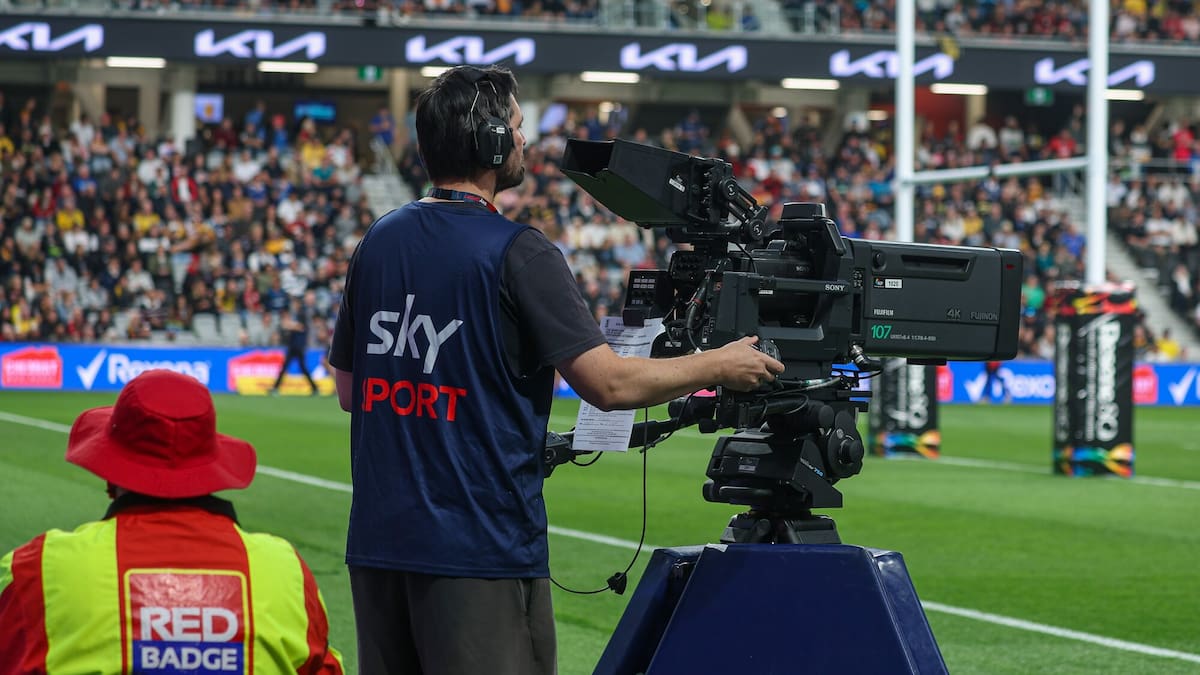
Whereas overseas equivalents were quick to embrace the streaming age and shift from satellite technology, Sky appeared reluctant to make the same move – and was that because the customer yield was so much lower?
Nor could it embrace – not fully at least – the strategic concept of using Free to Air (FTA) to grow overall interest in specific sports and by extension, convert more people into paid subscribers, as was happening overseas.
It tinkered with Prime – which became Sky Open – but it was a channel with no brand recognition or habitual usage and hardly sat in the public imagination as a genuine FTA offering.
But what’s become apparent in the last 12 months is that Sky doesn’t want to be the “bad guy” anymore.
It seems genuinely determined to recast itself as the “good guy” and recognise that it’s not a binary choice on whether to be customer-friendly or shareholder-focused.
The $1 acquisition of the failed TV3 has given it a dual structure of being both a subscription and FTA broadcaster and the framework to strategically use the latter to grow the former.
The first move in this direction came in July, when the All Blacks’ Nations Championship tests were shown as delayed live on what is now called Three.
Now Sky has announced that the entire tour of South Africa – dubbed Rugby’s Greatest Rivalry – will be shown delayed on Three.
The broadcaster is also offering free access to Sky Sport Now for the first game of the tour – sign up, get the code and you can watch the All Blacks play the Stormers live.
It’s also worth noting that Sky is making a heavy investment in getting personnel on the ground in South Africa, with commentator Jeff McTainsh leading the coverage with analysts Justin Marshall and Jeff Wilson – both of whom toured the Republic in 1996 with the All Blacks.
It has become increasingly common for commentary to be done remotely – but that’s a cost-cutting measure that lowers the production value and says to the consumer they are not worth the expense of putting people on planes.
Sky has, therefore, made a statement play with its South African coverage – it’s putting the customer first, and for all the world, it looks like this once-monopolistic force now seems to be hell-bent on being the “good guy”.
But while Sky’s intentions are undeniably true, there remains a trace of Lex Luther in its execution.
The first and second tests are being shown delayed on Three eight hours after kickoff, and the third test will be shown eight and a half hours after it starts.
In the age of mass news proliferation, it’s almost impossible to credibly deem this genuine FTA coverage, as who, honestly, will have avoided knowing the result so long after the games have finished?
And who, honestly, is going to watch a delayed live game in its entirety when they already know the result?
The fourth test in Baltimore will only be three hours after the kickoff; even that, though, feels like an eternity and if Sky wants to fully commit to being the “good guy”, why not show the first test on Three at the accessible time of 7am?
Free access to a test at a convenient time feels like a stronger “good guy” play than offering free access to the Stormers game, which kicks off at 5am on Saturday August 8.
But this is maybe Sky’s problem now – that as much as it wants to play the role of the “good guy”, it doesn’t really know how.
It’s not just its conservative, strategic use of its FTA platform that hints at it still being lost in this new world of customer-first, but its unwavering conviction that former players make the best broadcast analysts and that there is consumer appetite to hear what they have to say.
Again, Sky is trying to be the good guy by offering a wide portfolio of content around Rugby’s Greatest Rivalry brought by a wide range of personalities, but there is no diversity in the talent pool.
It’s all former players who, by the uniformity of their own experiences, see the game through the same lens.
Their familiarity with one another also promotes the use of in-house jokes, a matesy-matesy culture that lacks professionalism, particularly when they use nicknames to address each other, and the promotion of technical jargon that leaves the layperson guessing what’s being talked about.
There is, clearly, a place for former players in the broadcast ecosystem – and some, such as James Parsons, are articulate and insightful – but the introduction of some (former) coaches, journalists and broadcasters would provide the diversity of views and perspectives Sky’s coverage is currently missing.
That Sky is on a journey to be a more lovable institution is commendable, but it might need help changing some of its habits.
Gregor Paul is one of New Zealand’s most respected rugby writers and columnists. He has won multiple awards for journalism and written several books about sport.