
This month offers several celestial highlights for stargazers, including the Perseid meteor shower, which is expected to peak on Aug. 13, the Taipei Astronomical Museum said yesterday.
In a news release, the museum said the best viewing period for the Perseids would be from around 8pm on Aug. 12 until dawn the following day.
With the moon near its new phase and causing little interference, the number of visible meteors is expected to increase as the night progresses, peaking at an estimated 70 visible meteors per hour, it said.
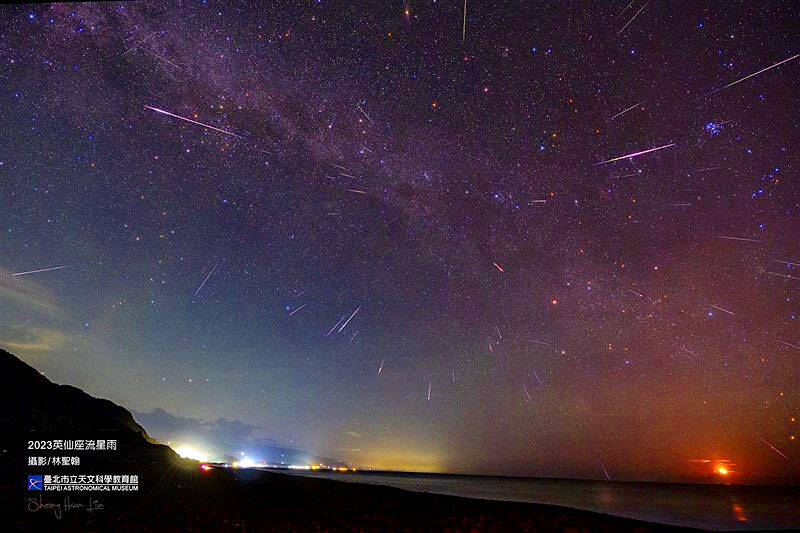
Photo courtesy of the Taipei Astronomical Museum
The Perseids are known for their fast-moving, relatively bright meteors, with fireballs often appearing during the shower. The museum recommended finding an open area with an unobstructed view of the sky to enjoy the spectacle.
In addition to the Perseids, Mercury and Venus, the solar system’s two innermost planets, would also be well positioned for observation this month, the museum said.
Mercury would reach its greatest apparent separation from the sun tomorrow, the museum said, adding that in the days before and after, the planet can be seen low in the eastern sky before dawn.
Meanwhile, Venus would reach its greatest apparent separation from the sun on Aug. 15, offering the year’s only opportunity to observe the planet under those conditions.
Venus would shine at magnitude minus-4.5, making it one of the brightest objects in the night sky after the moon. It would also appear alongside a thin crescent moon in the western sky at dusk, the museum added.