
Died: July 19, 2026
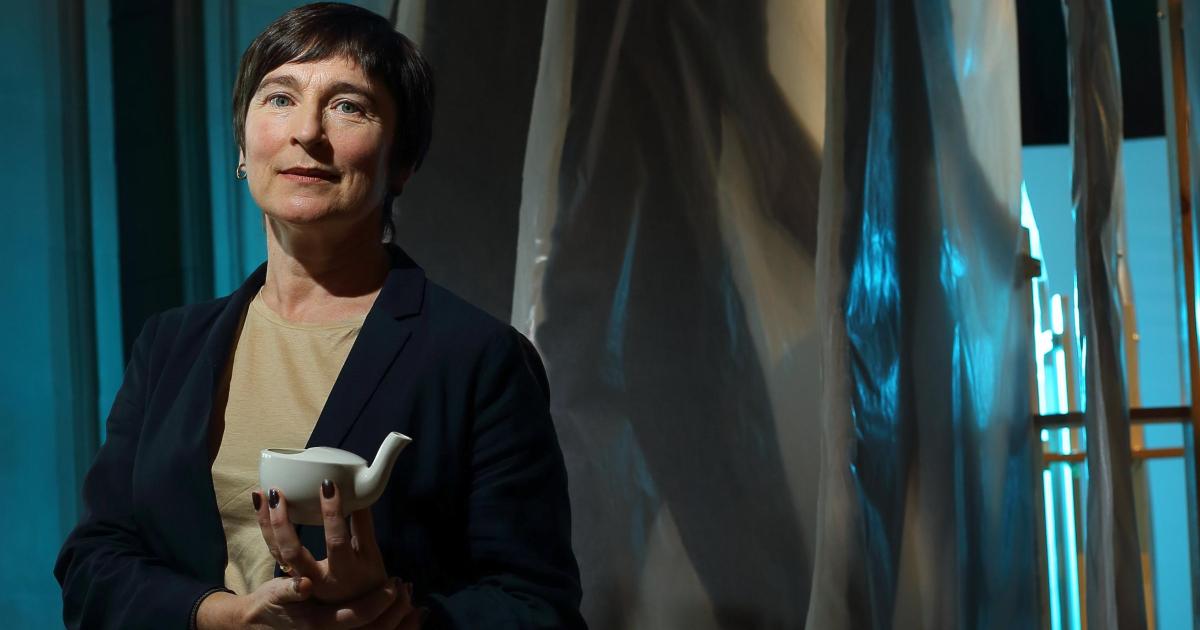
IN October 1994, the contemporary artist Christine Borland, who has died aged 61, was interviewed by The Herald’s art critic about her first solo exhibition, From Life, at Glasgow’s Tramway.
It had begun with the purchase of an anonymous, female skeleton from a mail-order, medical educational supplier and, via discussions with forensic anthropologists, facial reconstruction and identification experts, culminated in the production of a reconstructed portrait in bronze. The skeleton was that of an Asian, aged 25.
From Life, as Ms Borland acknowledged to Clare Henry, involved “buying a person to make an artwork of it. I’m conscious that the owner of the skeleton I’ve used as the basis for my reconstruction and portrait bronze head didn’t give her permission. It does worry me. I’ve asked myself every question – but in the end you have to stop agonising and just go for it; do it.’’
Ms Borland, just 28 at the time, was, in Henry’s words, “small, considered, self-effacing yet assured; an intelligent, thoughtful person with steely determination”.
She had already achieved much renown. There had been international shows in Germany, Holland, Portugal, Paris, London, Ireland and New York. She had represented Britain at the Venice Biennale Aperto; and she would go on, in 1997, to be nominated for the Turner Prize.
At London’s Tate Gallery, her Turner exhibits included an installation about a 7ft 10in tall ‘Irish Giant’ who had died in 1783, and a 22in so-called ‘Sicilian Dwarf’ who had died aged nine in 1824. Their bodies, reported The Guardian, “exist here as traces: Borland had replicas of their skeletons made, and used them as stencils, laying the fabricated bones out on sheets of glass that were then dusted with fine, slightly glittery powder. The bones were then taken away, leaving a powdery silhouette of the absent forms”.
Read more
Such approaches were deeply characteristic of her art. Her website noted that, since From Life, she often developed work in negotiation with experts in institutions of science and medicine and in museums, collections and archives, in order to make “invisible, often discredited practices and hidden narratives accessible”.
Professor Penny Macbeth, director and principal of the Glasgow School of Art, said: “Christine Borland was one of Scotland’s most important contemporary artists and a deeply valued member of the Glasgow School of Art community. Through an extraordinary cross-disciplinary body of work that combined art, science and medicine, she challenged audiences to think differently about identity, ethics, memory and what it means to be human”.
The school added that Ms Borland’s “pioneering practice and commitment to teaching” helped shape contemporary art in Scotland and earned international recognition over a career spanning more than three decades.
Christine Borland was born in Darvel, Ayrshire, in May 1965 to John and Chrissie Borland. In a National Galleries of Scotland video she recalled her early inspirations. “I suppose just being a bit of a wild child in the seventies, kicking around the countryside as your playground, really, that an interest, that an interest in botany – of course, I wouldn’t have called it that there, but a general interest in natural sciences, life and death, the way things interact with each other and interconnect, was very much a part of my childhood wondering”.
She studied environmental art at Glasgow School of Art between 1983 and 1987. “When I was [there] I was really intrigued by life-drawing, representing the figure. I was really bad at it but I knew that that interest in the body was very much there. Art and anatomy from the earliest days had a real interconnected relationship in terms of representing the body.
“So when I went for the first time to the [Hunterian’s] Anatomy Museum and I saw the specimens in jars, the intricacy and beauty of both the human specimens preserved, dissections preserved, just the beauty of that, it was kind of like, ‘that’s it – that’s the jigsaw puzzle piece that was missing. This is how I can think about my interest in relation to the body and the presentation of the body’.”
She became one of the artists who made Glasgow an internationally feted centre for contemporary arts in the nineties, a epic decade that encompassed the accolades of European City of Culture 1990 and the 1999 UK City of Architecture and Design.
She completed a Master of Fine Art at the University of Ulster in 1988 and was a member of the artist committee at Glasgow’s influential Transmission Gallery (1989-1991). She was a teacher and latterly a research fellow at Glasgow School of Art and in 2011 was appointed professor of contemporary art at Northumbria University, combining her internationally recognised artistic practice with an unswerving commitment to research and education. In 2016 she was awarded an honorary degree of Doctor of Letters from Glasgow School of Art/Glasgow University, and in 2020 she became a Fellow of the Royal Society of Edinburgh.
Ms Borland undertook numerous exhibitions, projects and commissions over the last decade. Critical responses to her creativity were summed up by Jan Patience, reviewing, in The Herald in 2018, an installation entitled The Power of Twelve, at Mount Stuart on the isle of Bute. “Like every piece of art I have seen made by Borland,” she wrote, “there is beauty and a deeper meaning wrapped around the work.”
Ms Borland, who lived on Kilcreggan, is survived by her husband, Professor Ross Sinclair, lecturer in sculpture and environmental art and researcher of contemporary art practice at Glasgow School of Art, and their daughters, Grace, Agnes and Jean.
RUSSELL LEADBETTER
At The Herald, we carry obituaries of notable people from the worlds of business, politics, arts and sport but sometimes we miss people who have led extraordinary lives. That’s where you come in. If you know someone who deserves an obituary, please consider telling us about their lives. Contact garry.scott@heraldandtimes.co.uk