
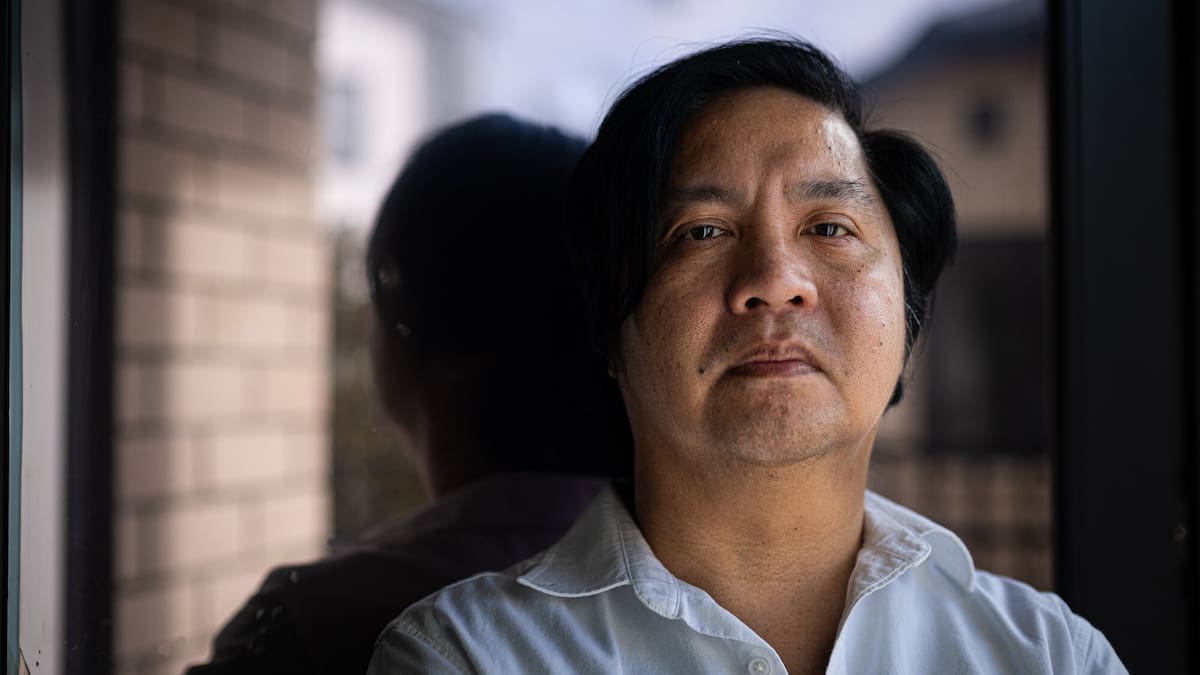
If he does find a special someone to share his life with, “it would mean absolute happiness”.
“I’d be really grateful for that, because I would be blessed and fortunate.”
Dating and relationships can be challenging for anyone living with a disability or long-term health condition.
Cara Gallagher works for Kaikaranga, formerly the Needs Assessment and Service Coordination, which connects Aucklanders with disability support services.
She spent almost two years working with Gutierrez and has witnessed those challenges first-hand.
“I think everyone wants to find the right person, someone who understands them and accepts them,” she says.
“Sometimes the people we support tell us that accessibility stops them from meeting other people, like challenges using a device, or that they don’t even know where to begin to search.
“Confidence can also be a hurdle, just like it is for many people.”
While most people’s support needs are practical or for help with day-to-day living, Gallagher says; “It’s absolutely okay for people to tell us that one of their goals is to date”.
“That way all their support services know to prioritise this goal and work on finding opportunities to reach this goal.”
There’s no one-size-fits-all approach, she says.
“Everyone’s circumstances are different, so the way they go about building relationships will be different too.”
Gutierrez’s diagnosis in 2011 came as a shock.
“I was surprised and a bit worried because things came into my mind – how would it affect my work, my career, my plans for having a baby.”
He had a successful career managing inventory, logistics and supply chains – what he sums up as “solving problems”.
He’d been fit and healthy. As a teenager, he’d represented the Philippines as a national youth football player and competed internationally.
He’d moved to New Zealand from the Philippines in 2007 seeking new opportunities.
“My attitude back then was I would choose the [career] path where it’s more difficult and challenging, because there’s more to learn out of it, and the higher the risk, the higher the reward,” Gutierrez says.
A decade after Andy Gutierrez’s diagnosis with early-onset Parkinson’s, his marriage ended. Now, he’s looking for companionship. Photo / Jason Dorday
Parkinson’s is one of the most common neurological conditions, affecting about one in 500 people in New Zealand. About 10% of those diagnosed here are under 60, like Gutierrez, which is considered early-onset.
The main symptoms are tremor or involuntary shaking, slow movements, stiff muscles and loss of balance, as well as depression, anxiety, sleep problems and fatigue.
For Gutierrez, the only signs something was wrong were shoulder pain, which he likened to a torn ligament, and fatigue.
Looking back, he thinks of it in two phases: “there’s the early stage and the dark stages”.
From 2011 to 2018, the disease’s progression was slow, he says.
“There are two kinds of symptoms, the non-movement and the movement.
“The non-movement was more manageable, tolerable, while the physical movement was the one that affected me, but only minorly – like my way of walking and dragging my feet.”
He and his then-wife moved to Australia in 2014. By 2019, his symptoms had worsened.
“I was hallucinating, crying, and getting detached from worldly life – not listening to music, not watching TV, not communicating to anyone.”
Two things gave him hope: the opportunity to undergo deep brain stimulation surgery in Australia, and then to return home to New Zealand, where as a citizen he would have adequate support for his condition.
There is no cure for Parkinson’s, but treatments include medication, exercise, speech therapy and physiotherapy.
Deep brain stimulation surgery involves implanting electrodes in the brain and connecting them to a battery device in the chest. This sends signals to parts of the brain affected by Parkinson’s.
For Gutierrez, the procedure, which he had in 2021, restored his movement. It also reduced his reliance on medication.
That same year, his marriage ended and he moved back to New Zealand after his operation, alone.
“There were many challenges. Going back alone, being by myself after spending 14 years with someone there, with my family, and then [going back to] no work,” he says.
“I had to face it and come up with a solution for each [problem].”
Meeting support workers through Kaikaranga helped.
“It changed my life 180 degrees.
“They were able to provide me with a budget to work on my rebuild plan for myself, and then also provided the necessary support to achieve my goals that I set.”
Andy Gutierrez plays multiple sports as well as the piano to strengthen different parts of his body. Photo / Jason Dorday
Since both his parents are dead, and his only brother still lives in the Philippines, he considers his support workers his “newfound family”.
They helped him return to sport as a way to manage his symptoms.
Now, he’s playing football again, competing with Special Olympics NZ, alongside other sports.
Each sport has different physical benefits for him: football helps strengthen his legs, basketball his upper body, while badminton helps with lateral movement.
He also plays the piano to strengthen his fingers. Gutierrez volunteers for Inclusive Football, for children with disabilities, and for Special Olympics.
All his hobbies help him meet people, give back to his community, and benefit his mental health.
“I’m happy that I’m able to play again and enjoy life.”
He hopes to show other people that life with Parkinson’s doesn’t limit him. But he adds the impact of the disease goes beyond the visible symptoms.
“People think we’re just having a hard time with movement symptoms, because that’s what they see.
“But in reality, it’s only 30% [of what we are coping with]; 70% is the non-movement symptoms.”
Those include sleep and memory problems, anxiety, and depression.
Gallagher says Gutierrez’s willingness to push himself out of his comfort zone – whether through his sport and community work or his drive to form new relationships – has helped shape his new normal.
“There’s plenty of individuals who would not have made the connections that he’s made with the same opportunities. It’s been quite amazing in terms of what has changed for him,” she says.
“He’s doing things that he’s really challenged by, which I think is really important.
“That’s what we’re all about, is making sure that people have the same opportunities as everyone else. So it’s really cool to see someone like Andy, who’s so driven and so motivated to make those changes for himself.”
Bethany Reitsma is a lifestyle writer who has been with the NZ Herald since 2019. She specialises in all things health and wellbeing and is passionate about telling Kiwis’ real-life stories.