
What’s remarkable about South Africa and New Zealand is that if one is not rated top of the world, the other usually is.
All Blacks captain Sean Fitzpatrick (left) and coach John Hart after the New Zealand side clinched a historic series win in South Africa in 1996. Photo / Photosport
It really came to a head in the final of the 1995 World Cup at Ellis Park in Johannesburg. That day it was as if the long, very often controversial, history between the All Blacks and the Boks had culminated in every good way you could think of, from new President Nelson Mandela wearing a Springbok jersey when he met the teams, to a vibrant, sellout crowd.
Looking around the ground, it was obvious support for South Africa came from a mix of races that made the phrase “rainbow nation” actually come true for one sunny afternoon. And, after the Boks won, 15-12, it was a joyful, peaceful night in Johannesburg, usually one of the scariest cities in the world.
Sport can unite
Nelson Mandela’s appearance in a Springbok jersey after the 1995 World Cup final became one of sport’s enduring images of reconciliation in post-apartheid South Africa. Photo / Photosport
It’s one of life’s oddities that a country deep in the South Pacific colonised by the British, as we were, would find such common sporting ground with a country on the African continent where a fierce contact game like rugby would draw its most passionate followers from the descendants of Dutch settlers.
Our rugby relationship with South Africa has certainly been seriously tested, but has always recovered. During the shameful apartheid era, when racism was part of the South African constitution, we bowed to South Africa’s wishes. So in 1949, for example, our best Māori players were left behind when the All Blacks toured.
It took what almost mounted to a civil war here when the Boks toured in 1981 for our administrators to decide enough was enough, and that we would not tour until South African laws about race had changed.
Household names
The rivalry made household names on a generational basis. To aged Kiwis, the name of South Africa’s 1937 captain and 1956 coach Danie Craven was instantly recognisable. Currently, there’s almost a cult following here for Boks coach Rassie Erasmus, and given that he’s won the last two World Cups, that seems only fair.
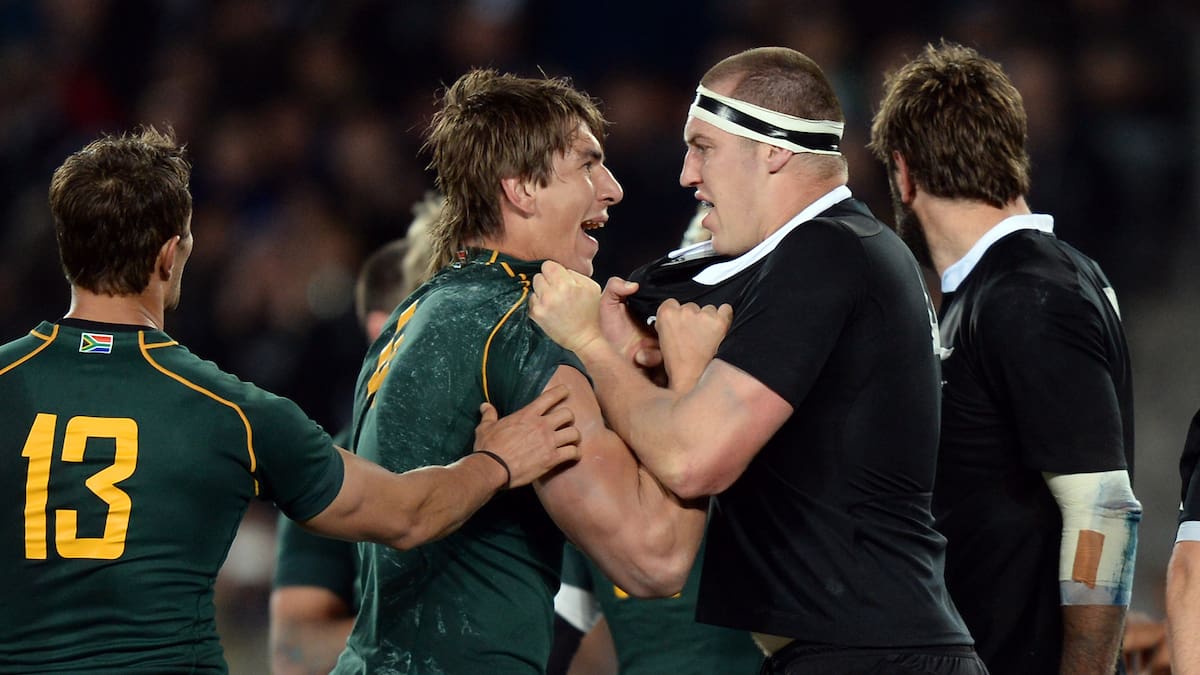
In the process, he has the Boks playing the sort of scarily physical rugby most New Zealanders would associate with the men in green and gold. It’s certainly been fully acknowledged by All Blacks coach Dave Rennie that we’ll need not just skill, but also size and brute strength to be successful on this tour.
It’s the sort of sensible thinking that led to the success of the ‘96 tour. Hart took over a team from his coaching predecessor Laurie Mains that was by quite a long way the best side to lose a World Cup final, as Mains’ side did in ′95.
Hart did the sensible thing. Basically, the line-up he fielded in the ′96 tests was the ′95 team with just one major change, the addition at fullback of a world-class runner with the ball in Christian Cullen. Organising an attacking backline had always been Hart’s great strength.
He slipped the leash on the players, most of whom were very familiar with and at ease playing alongside one another. Given the Springboks were the defending World Cup champions, there was almost a sense of disbelief talking with Boks fans after the tests in Cape Town, Durban and Pretoria, when New Zealand victories cemented the series triumph.
Springboks coach Rassie Erasmus has dominated recent exchanges with the All Blacks. Photo / Photosport
An even playing surface
It took the All Blacks 75 years to finally win a series in South Africa. An element that changed in ′96 was that for the first time, neutral referees took control of the matches played in South Africa. By contrast, in 1949 the All Blacks – who were penalised out of a series they lost 4-0 – would swear that South African referee Eddie Hofmeyr apologised to them for his displays as they prepared to catch their plane home, saying “I hope you understand, I have to live here.”
Gracious … but only in defeat
Kiwis lucky enough to be heading to South Africa for the upcoming series might discover, as I did in ′96, that South African fans are as well behaved when the team loses as any group in the world. Heading into the stadium in Cape Town for the first test of ′96, a group of noisy Boks followers jeered a group of All Blacks supporters: “We’re going to kick your arrrse” was the most popular phrase addressed to the Kiwis. Leaving Newlands after the All Blacks had won 29-18, I confess to having been a little nervous.
In fact, the South Africans who had been heckling before the game could not have been more generous-spirited. “Your team was just too good” was a line repeated several times. It was the same in Durban and Pretoria: derision before the match and high praise for the All Blacks after they won both tests and took the series.
Where it got truly bizarre was at Ellis Park, when a weary All Blacks side, with the first away series victory safely in the bag, lost 32-22. Far from being happy, or as well mannered as they had been when their team had lost, the Boks fans switched the vitriol they had directed at their own players back to the All Blacks.
So if the All Blacks take the new series, touring Kiwi fans shouldn’t be nervous about celebrating. Bizarrely, that’s when Boks supporters show their best side.
Phil Gifford is a Contributing Sports Writer for NZME. He is one of the most-respected voices in New Zealand sports journalism.