
“I said, ‘Yeah’. She said, ‘Did it wiggle much?’ I just burst into laughter.”
Newman still bursts into laughter telling the story.
“That’s what made me realise that I still had something in the tank that could carry on and that it was important,” he said.
“It’s like I’ve got 300 mokos [grandchildren] here and about 50 of them each day give me a hug in the morning.”
Newman’s connection with students and staff was obvious on New Zealand Principals’ Day last Wednesday, when schools nationwide celebrated those at the helm.
“It was meant to be a surprise, but a couple of 5-year-olds spilled the beans the day before,” he said of celebrations planned for him.
Newman played along as students “surprised” him with a special assembly, performing waiata and haka in his honour. Lunch was his favourite: seafood, followed by a “magnificent” chocolate cake.
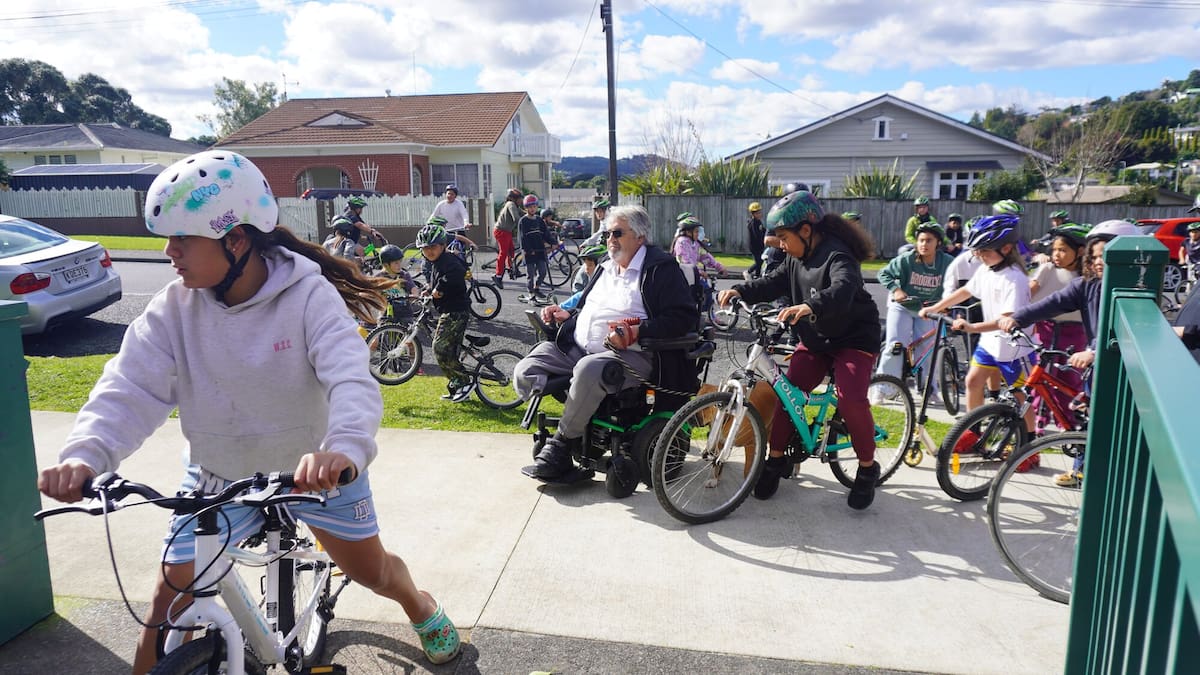
But what set the day apart was a lap of the block, with hundreds of students and staff riding alongside as he made the journey in his wheelchair.
“It reminds you why you do the job,” he said of the moment.
“It’s not about me, it’s not just about the staff, it’s not just about the kids, it’s not just about the community, it’s about the whole lot of us.”
The school’s core value, which Newman said he was most proud of, was taking care of one another – including the community.
“We don’t charge a thing – trips, school fees, kids don’t even pay stationery. We’re running three vans at our own cost to try and bring in about 80 kids a day because they wouldn’t be coming to school otherwise.
“We look at what the needs of the kids are and then we cater for those needs as far as we can.”
Hora Hora Primary School principal Pat Newman. Photo / NZME
Part of what keeps him motivated, Newman said, is advocating for students’ needs amid significant change in education.
“We’re being forced to do things for political reasons that have no educational pedagogy by people who know nothing about education and we’re trying to stop our kids being harmed.”
He criticised changes to the curriculum, school lunches programme and the “divisive” approach to Māori in education.
The Government says its education reforms are intended to improve achievement and provide better value, pointing to curriculum changes designed to boost learning outcomes and a school lunch programme it says feeds the same number of children at lower cost to taxpayers.
For Newman, students’ appreciation reinforces why he remains committed to the role despite the challenges.
“The reaction of the kids shows you that you’re doing the right thing,” he said.