

Listen to this article
Estimated 4 minutes
The audio version of this article is generated by AI-based technology. Mispronunciations can occur. We are working with our partners to continually review and improve the results.
For two years, whenever Jesse Tungilik went to the Northern Store in Pangnirtung or Northmart in Iqaluit, he was a save-the-receipt kind of guy. He knew one day, they could be of use.
Now, almost a decade later, they got him all the way to the National Art Gallery in Ottawa.
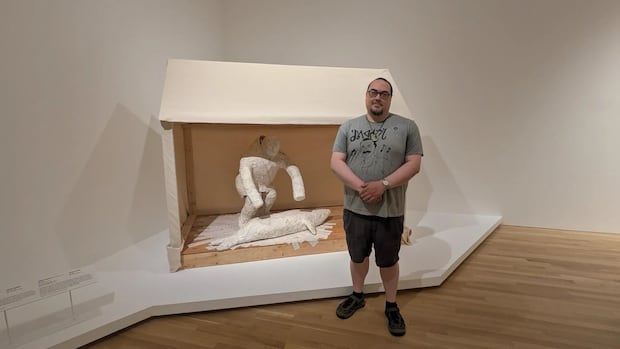
In 2019, Tungilik made a sculpture of about a meter-tall Inuk man hunting a seal. Both are wrapped in hundreds of those receipts. He called the artwork Feeding My Family.
Some of the prices are still visible: $3.59 for celery, $21.35 for shredded cheese and $19.99 for a pack of cigarettes. Back then it seemed like a lot – now, Tungilik says, it feels almost cheap.
“I think it’s actually gotten more poignant over time,” Tungilik said. “You can actually see the prices from the receipts from 2019 and how much higher the prices of food have gotten since then.”
Feeding My Family is now next to some of the most famed art in the country and the world. But Tungilik is most proud of being close to one particular artistic neighbour – his grandfather Mark Tungilik, whose miniature carvings have been part of the gallery’s permanent exhibition for years.
“It was extra special to see my work and his work in the same place,” he said.
WATCH | Nunavut artist turns grocery receipts into a sculpture July 29 News: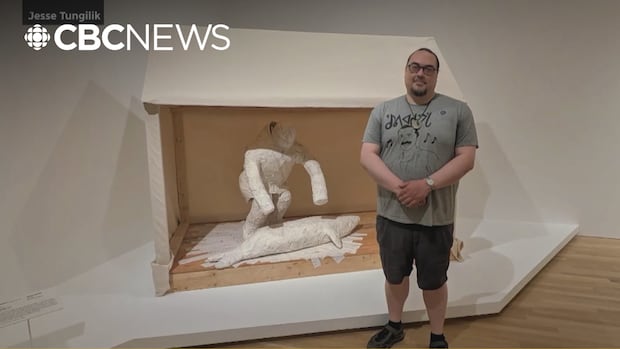
Nunavut artist turns grocery receipts into a sculpture
Nunavut communities have struggled with food insecurity for decades. An Iqaluit artist has decided to reflect that issue in his work. One of his pieces has now made it to a major cultural stage in Canada. Arty Sarkasian reports.Over half of Nunavummiut live in poverty: Statistics Canada
Originally, Tungilik created Feeding My Family as a tongue-in-cheek, get-people-thinking type of artwork. Over time, things changed.
“I didn’t realize at the time that [the price of food] would get so much worse in the coming years,” he said.
Over half of Nunavut households are food insecure, according to Statistics Canada. As of 2021, just under 40 per cent of Nunavummiut lived in poverty — the highest rate in the country.
And month after month, Iqaluit’s Qajuqturvik Community Food Centre is beating its own record for the number of meals served every day.
In July, the centre reported a 45 per cent increase.
Over the years, different governments tried to tackle this issue with subsidies and vouchers, but issues persist.
“We really need a real long-term solution so that people stop getting hungry and desperate,” Tungilik says.
He hopes his art will help bring awareness to the issue on the national level.
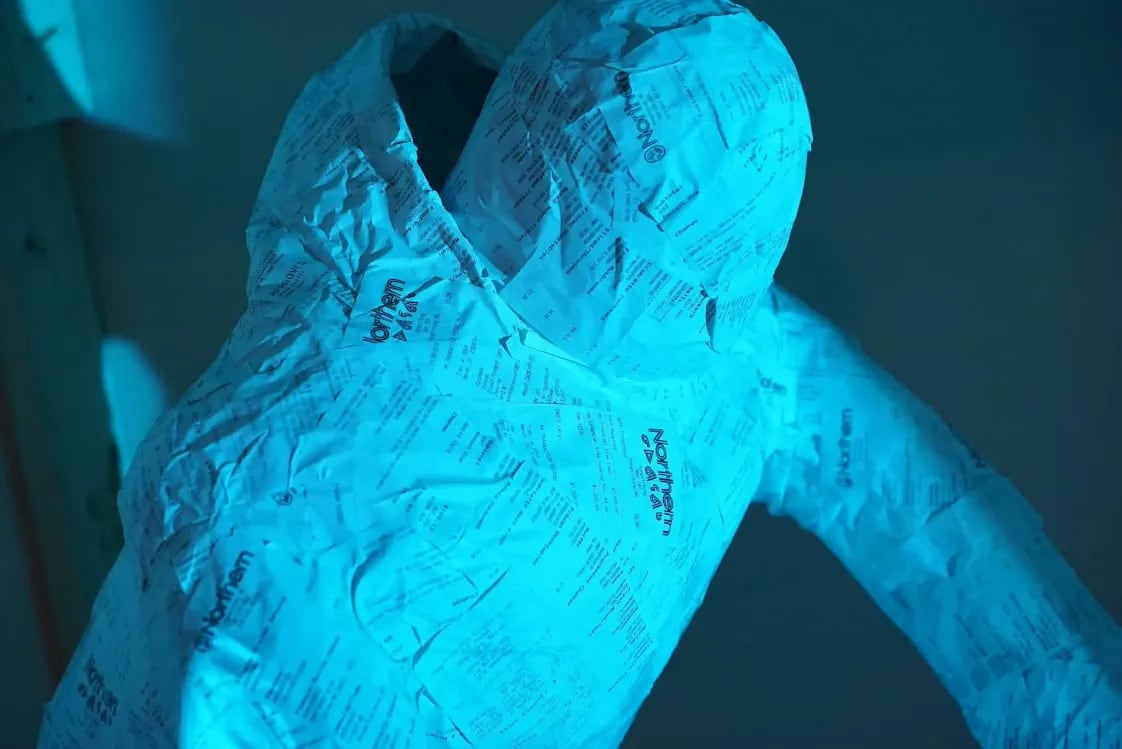 ‘Feeding My Family’ by Jesse Tungilik is part of a larger Inuit-focused exhibition at the National Art Gallery in Ottawa. (Jesse Tungilik)Circumpolar ‘badassery’ on the national stage
Tungilik’s Feeding My Family was part of an Arctic-focused exhibition at the gallery.
It’s called Qillaniq, which is an Inuktitut word to describe the way light shimmers as it reflects on water.
Qillaniq assembled more than 80 artworks by over 70 artists from across the Circumpolar world – largest exhibition of its kind in history, according to the National Art Gallery.
It runs from June 12 to Sept. 20.
To Laakkuluk Williamson, one of the guest curators of Qillaniq, the exhibition is about showcasing “radical joy.”
“When you walk through Qillaniq, you see a piece that has as big of impact as Feeding My Family, you are not left with this feeling of disenfranchisement,” Williamson said.
“You are surrounded by empowerment.”’
But at the core of Qillaniq is one word – badassery.
It’s an exhibition of badass artists doing badass things, Williamson said.
“And Qillaniq, as a huge exhibition at the huge National Gallery of Canada, is a massive statement,” she said.
“About solidarity, unity, creating peace, creating safety, creating respect by being badass.”