
Credit: Far Out / Tidal
Sun 2 August 2026 18:45, UK
There’s a common misconception that Crazy Horse are Neil Young’s on-again / off-again “backing band”, when in reality, they’ve always been a stampeding herd of broncos that Young has sporadically tamed and worked with.
In between the first two “Neil Young & Crazy Horse” collaborative records, 1969’s Everybody Knows This Is Nowhere and 1975’s Zuma, the band put out three albums of its own, sans Neil, albeit with a rotating cast of musicians. The first of those releases, a self-titled 1971 album, featured the same cast from Everybody Knows and some bits of After the Goldrush: singer/guitarist Danny Whitten, Billy Talbot on bass, and Ralph Molina on drums, plus guitarist Nils Lofgren and pianist Jack Nitzsche. When Crazy Horse reconvened for their next Young-less effort a year later, however, only the rhythm section remained, leaving fans sceptical about the revised line-up, led by new guitarist George Whitsell.
From Whitsell’s point of view, however, he was actually reclaiming his own band back, rather than joining someone else’s.
“I was angry at Neil [Young] for taking my band, or what I considered my band, because I’d helped them along so much,” Whitsell told Uncut in 2014.
As it turns out, Crazy Horse, under a few different names, could trace its origins back way back to 1963, when Neil Young was still playing with his high school band The Squires up in Canada.
Originally known as Danny & the Memories, they started out as a street-corner doo-wop group in LA, fronted by Danny Whitten, with Talbot and Molina as his sidemen, before eventually realising around 1965 that they probably ought to learn to play instruments. Rebranded as The Psyrcle at the dawn of acid rock, the band managed to get a record made up in San Francisco, produced by a local DJ and future funk pioneer Sly Stone, but nobody heard it. Finally, around 1967, guitar-playing brothers George and Leon Whitsell joined the group, leading to another rebrand as The Rockets, and a new album, released on the Turtles’ label, White Whale.
While Danny Whitten was the founder, soul, and cornerstone of the group, George Whitsell clearly felt that his supposedly more advanced talents on the guitar had elevated the Rockets into legitimacy, and indeed, despite the commercial failure of their self-titled 1968 album, the band was generating a pretty strong following in the LA rock scene.
Further reading: Features
Future Crazy Horse road manager Willie “Baby John” Hinds was part of the Rockets’ crew at the time, and in a 1973 interview with Zigzag magazine, recalled that the Whitsells had turned the band into a “dynamite” live act.
 Credit: Press / Reprise Records / Neil Young
“They had a residency somewhere and would play the Whisky once in a while,” Hinds said. “One night, Neil Young, who we all knew from the Buffalo Springfield days, walked in. He used to come around and jam with Danny [Whitten]. . . . Anyway, Neil saw one set and asked if he could come in and play on the second. He walked away that night with Danny, Ralph and Billy as his rhythm section.”
The Whitsell brothers, for whatever reason, didn’t get the same invitation, but in line with the peace and love messaging of the era, Young tried diplomacy, suggesting that he was merely borrowing the other members of the Rockets for a minute. Whitten, Molina, and Talbot seemed to legitimately think that it was a temporary arrangement, as well.
“We’d already started recording a second Rockets album,” Whitsell told Uncut, “And the word I’d gotten from Billy, Ralph, and Danny was that Neil was going to bring them back and help us complete it.”
Of course, that didn’t happen. Coming out of his rough power struggles with the Buffalo Springfield, and still generally displeased with how his 1968 solo debut album had turned out, Neil Young was singularly focused on his own project and didn’t have the mental bandwidth to worry about returning his new pals back to George Whitsell like overdue library books.
Whitten, Molina, and Talbot, having never really been part of a successful musical enterprise before, were caught up in the moment, too. They gladly accepted Neil’s new name for them, Crazy Horse, and went along for the ride.
“We felt, Danny [Whitten] and I, that as the big guy [Young] went up the ladder, we, the Horse, would also rise,” Molina told Perfect Sound Forever in 2021. “The sessions [for Everybody Knows This Is Nowhere] went free and easy, like they are to this day. No rehearsals. Neil walks in with a song, then we jump in. We get it in one, two takes. After that, the feel, heart and emotion are lost. Any more takes, and now you’re just playing a part”.
“When you’re young, there are no politics, nothing to get in the way. We just had fun playing. No thinking, just playing.”
Ralph Molina
Young was gracious enough to release Everybody Knows as an LP by “Neil Young WITH Crazy Horse,” rather than just using his own name or attaching Crazy Horse with an “AND”. Nonetheless, even after 50 years of regular working with Neil, Ralph Molina ultimately felt that those original dreams of “going up the ladder” with him were misguided.
“We didn’t climb as we thought we would,” Molina said, “And still haven’t really. We never have, nor do we consider ourselves a backup band.”
Young’s first of many break-ups with Crazy Horse came in 1970.
“Everything went fine until Danny [Whitten] got very heavily into junk,” Willie Hinds told Zigzag. “Neil said, ‘Either you quit being a junkie or we can’t play together’. When Neil lost Danny there wasn’t much point in keeping the rest of Crazy Horse around, so it all broke down for a while.”
 Credit: Alamy
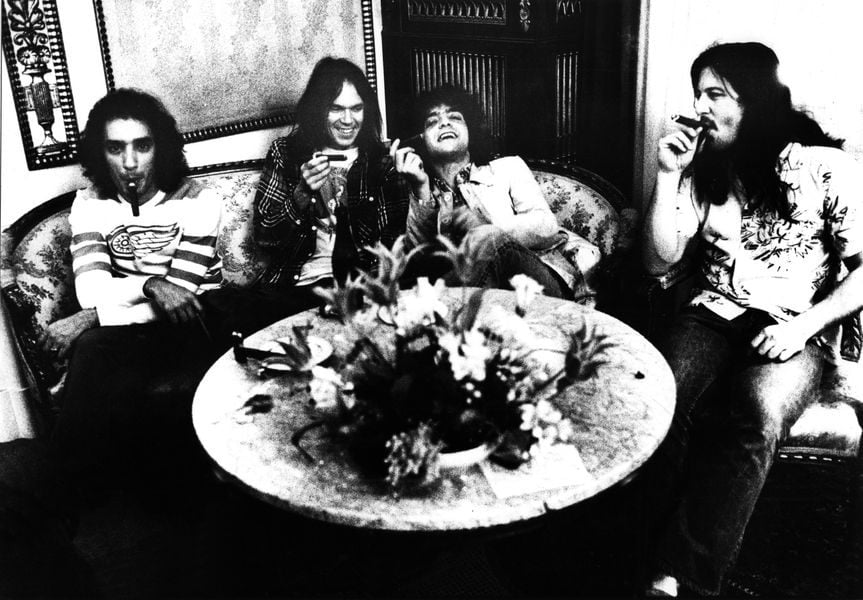
While Young had tried to give Danny Whitten an ultimatum, Crazy Horse, for better or worse, “put up with him,” as Hinds described it, carrying on to record their own self-titled debut in 1971.
“Danny was too loaded to play but they got him singing all his parts for the album,” Hinds said. “They took him away to a house and fed him well, looked after him, and after six weeks he came out fairly straight. Nils Lofgren and Ry Cooder came in to do most of the guitar.”
Unfortunately, with Whitten sinking deeper into his addiction (his 1972 death would inspire Neil Young’s ‘The Needle and the Damage Done’), the other members of Crazy Horse decided to move on without him, recording their follow-up album, Loose, towards the end of 1970, with George Whitsell making a surprise return to the outfit he’d previously known as the Rockets.
Sadly, for Whitsell, the return of the prodigal son was short-lived. He didn’t participate in the third Crazy Horse album, 1972’s At Crooked Lake, and never re-emerged as part of the band’s line-up. He did eventually work with Neil Young, however, playing guitar on the track ‘Vampire Blues’ from the 1974 album On the Beach.
Irony upon irony, Whitsell was also briefly hired by Young in 1988 as a replacement for his old Rockets / Crazy Horse bandmate Billy Talbot, whom Young had fired out of frustration during the This Note’s for You sessions. It was a brief arrangement, though, as Whitsell was swiftly replaced by Rick Rosas.
The story has a bit of a happy ending, though, as original Rockets Whitsell, Talbot, and Molina all reunited, at long last, to record a 2014 album under yet another band name, Wolves.
