
Venkat Raman
Auckland, August 3, 2026
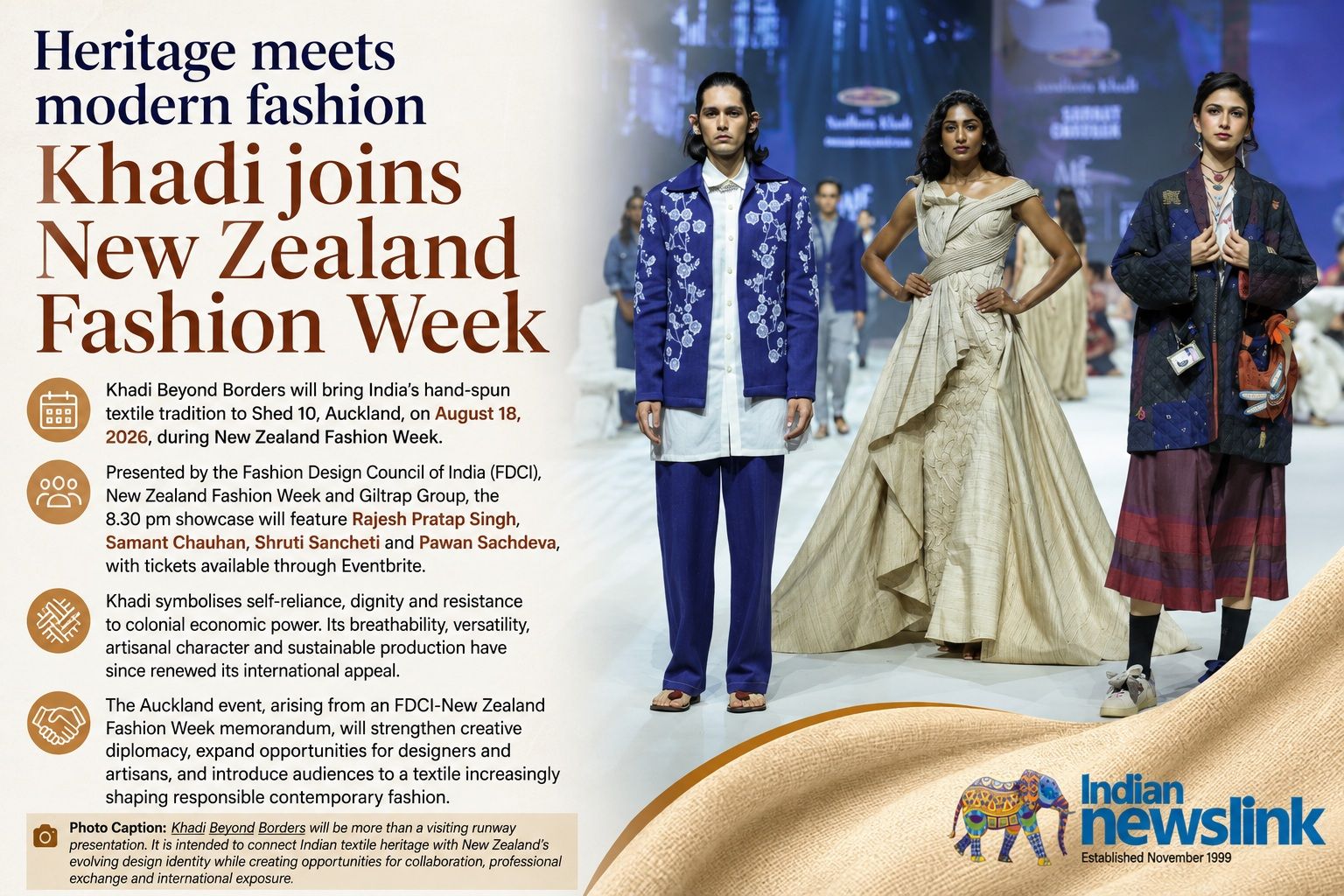
New Zealanders will have a rare chance to experience Khadi, India’s hand-spun textile tradition, on 18 August 2026.
Presented by the Fashion Design Council of India (FDCI) as part of New Zealand Fashion Week, the showcase, called ‘Khadi Beyond Borders,’ is scheduled to be held at Shed 10 located at 89 Quay Street, Auckland CBD on Tuesday, August 18, 2026.
Tickets to the show, commencing at 8.30 pm, can be purchased at Eventbrite.
The show will feature prominent fashion designers Rajesh Pratap Singh, Samant Chauhan, Shruti Sancheti and Pawan Sachdeva.
The programme will also feature the Lakmé Fashion Week in partnership with FDCI and India Couture Week, alongside collaborations with India’s Ministry of Textiles, Ministry of Commerce and Industry, international organisations and overseas partners.
Through these initiatives, the Council promotes Indian designers, textiles and craftsmanship in domestic and international markets while creating opportunities for its members across India and abroad.
Born in India’s Freedom Movement, Khadi carried the ideals of self-reliance, dignity and resistance to colonial economic control. Its breathability, versatility, craftsmanship and sustainable production have since driven a global revival.
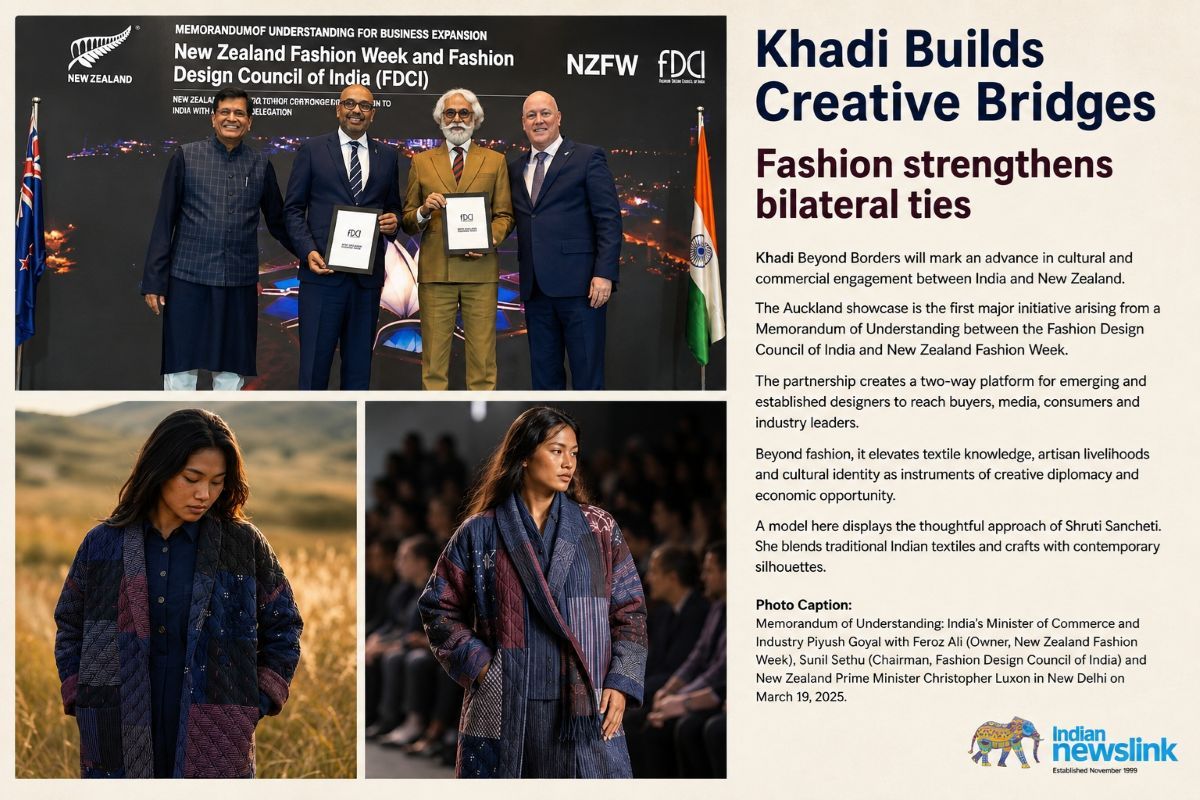
The Auckland presentation will deepen India-New Zealand creative ties while introducing local audiences to a fabric reshaping contemporary fashion and encouraging new thinking on responsible dress. With the Giltrap Group as another presenter, the event represents the first major undertaking arising from a Memorandum of Understanding signed by the Fashion Design Council of India (FDCI) and New Zealand Fashion Week.
A runway of cultural diplomacy
The partnership establishes a continuing reciprocal platform through which emerging and established designers from India and New Zealand can present their work before international buyers, media, consumers and fashion industry leaders.
It also extends the relationship between the two countries beyond conventional trade. Fashion, textile knowledge, artisan livelihoods and cultural identity are being positioned as instruments of commercial engagement and creative diplomacy.
Khadi Beyond Borders is therefore more than a visiting runway presentation. It is intended to connect Indian textile heritage with New Zealand’s evolving design identity while creating opportunities for collaboration, professional exchange and international exposure.
New Zealand Fashion Week Owner Feroz Ali said that the arrival of Khadi in Auckland will have substantial institutional and personal significance.
“Khadi on an Auckland runway: for me that is the moment the Fashion Design Council of New Zealand (FDCNZ) was born. When Prime Minister Christopher Luxon and India’s Commerce and Industry Minister Piyush Goyal witnessed the signing of our MOU with FDCI, we made a promise to both nations that this partnership would produce something the world would notice. Khadi Beyond Borders is that promise kept,” he said.
A Statement and a Movement
According to Mr Ali, Rajesh Pratap Singh headlining the New Zealand Fashion Week is a statement, and Samant Chauhan, Shruti Sancheti and Pawan Sachdeva joining him is a movement.
“Together, they will show Auckland and the global fashion community that Khadi is not simply heritage. In the hands of India’s finest designers, Khadi is the future. In creating FDCNZ, we are placing New Zealand firmly on the map of global fashion diplomacy. August 18 is just the beginning,” he said.
FDCI Chairman Sunil Sethi said that the collaboration represented a significant step in carrying Indian design and craftsmanship to new audiences and strengthening Khadi’s international position.
“This collaboration will further strengthen Khadi’s position on the global fashion map. During my tenure as Advisor to Khadi and Village Industries Commission, I have consistently worked towards showcasing the limitless potential of this extraordinary fabric to discerning audiences worldwide. We are delighted to bring the essence of Khadi to New Zealand and present its rich heritage, versatility and contemporary relevance to a new international audience,” he said.
The FDCI is a not-for-profit organisation, representing more than 400 members including fashion and accessory designers, industry professionals, educational institutions and corporate organisations. It is dedicated to advancing the business of fashion in India and supporting its sustainable development.
An international platform for Aotearoa
The New Zealand Fashion Week operates as an omni-channel event and content platform connecting designers with local and international buyers, media and consumers.
Reimagined under new leadership in 2025, it has placed greater emphasis on inclusivity, diversity, sustainability and public participation while retaining its position as the country’s principal fashion showcase.
The inclusion of ‘Khadi Beyond Borders’ advances its ambition to become a more internationally connected platform.
It will introduce local audiences to leading Indian design while offering New Zealand’s fashion community a closer view of a textile economy in which heritage, rural skills, innovation and commerce intersect.
The presentation may also provide a foundation for New Zealand designers to reach Indian audiences under the reciprocal arrangement.
Such exchanges can widen markets, cultivate professional networks and allow both countries to learn from their distinctive traditions of craft, production and storytelling.
When the first Khadi garments enter the Auckland runway on August 18, they will carry far more than design.
They will bear the memory of India’s Freedom Movement, the labour of its artisan communities and the imagination of designers determined to take the historic cloth into a new century.
For New Zealand, the occasion offers more than a view of Indian fashion. It presents an invitation to embrace a different conception of modern dress, in which elegance, history, comfort, responsibility and innovation are woven together.
A cloth woven into freedom
Khadi is hand-spun and handwoven from natural fibres, principally Cotton, Silk and Wool.
Its character emerges from the human rhythm of spinning and weaving rather than the mechanical uniformity associated with industrial production.
The subtle variations found in its texture are not imperfections. They are evidence of the artisan’s hand and give each length of cloth a distinctive identity.
A new language of dress
For New Zealand, the Auckland presentation may usher in a new era of dress by introducing a fabric that combines cultural depth with contemporary practicality.
New Zealanders increasingly expect clothing to demonstrate provenance, durability, environmental responsibility and individuality. Khadi responds naturally to those expectations.