

This article first appeared in Wealth, The Edge Malaysia Weekly on July 27, 2026 – August 2, 2026
Investing has become easily accessible as technology advances, but that does not sufficiently translate into better financial knowledge. Edrea Lee, co-founder of Vespid, aims to close the gap through the introduction of a gamified financial literacy platform that rewards users with incentives.
Amid the emergence of robo-advisory platforms and digital brokers, the Malaysia Financial Literacy and Capability (MYFLIC) Index improved to 62.9% in 2024 from 60.2% in 2021, according to Bank Negara Malaysia’s Financial Capability and Inclusion Demand Side Survey 2024.
The report explains that the improvement was due to growing awareness of financial products and concepts, supported by the prevalence of technology and digital literacy platforms.
Yet, many Malaysians continue to feel a lack of clear and reliable information on financial products, which affects their financial decision-making, Lee observes. A more engaging and interactive financial literacy platform could be a solution to such a problem.
“When you think of financial knowledge, you don’t really think much about apps or games. This is what we are doing,” she says.
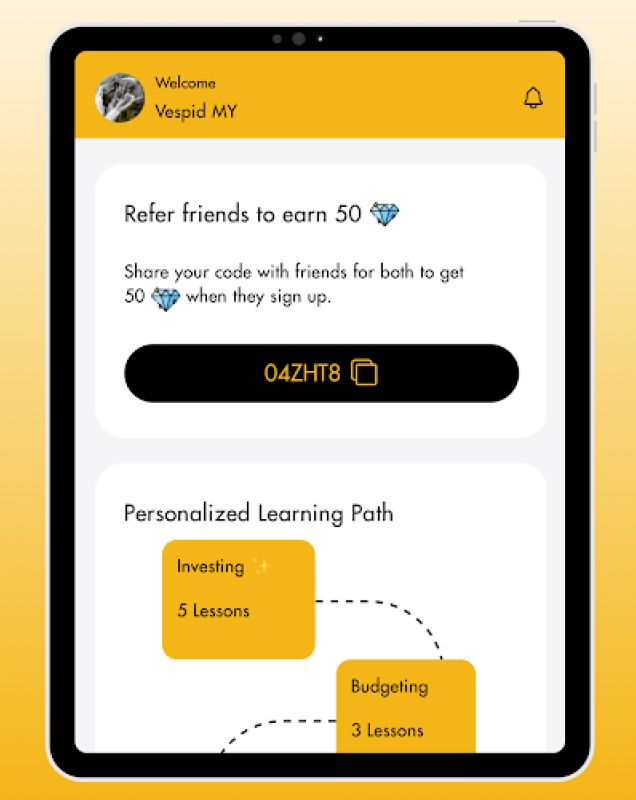
Conceived during a teh tarik session among Malaysian students at the University of Michigan, where Lee was doing her undergraduate degree in economics, Vespid started as a platform dedicated to demystifying stock investing and financial fundamentals through accessible, easy-to-understand content.
“What inspired us was the US stock-trading platform Robinhood. We learned about investing during university get-togethers among Malaysians, and saw many of our friends trading on Robinhood. We wondered why we didn’t have a simple, similar platform in Malaysia,” she says.
Founded in 2013 with the mission of democratising finance, Robinhood is now listed on the Nasdaq with a market capitalisation of US$102 billion (RM416 billion) as at July 8, serving millions of users. It gained popularity in the US by offering stock-trading access to retail investors.
As the market became increasingly crowded, alongside limited funding, regulatory hurdles and the challenge of building a sophisticated technological infrastructure, Vespid pivoted from a stock-trading platform to a gamified financial literacy platform.
According to Lee, the education feature in the beta version of the stock-trading app received the most positive user feedback, prompting the pivot.
“Then we started researching and found a similar innovation in the US called Zogo, which calls itself the Duolingo for personal finance. We realised we could do this in Malaysia and Southeast Asia too,” she says.
Founded in Texas in 2018, Zogo is a financial literacy app that teaches users about money through short, interactive lessons and rewards them for learning. According to the company’s website, it now has more than two million users, who have completed more than 40 million financial literacy lessons.
The example showed Lee the potential of a business model that was easier to replicate.
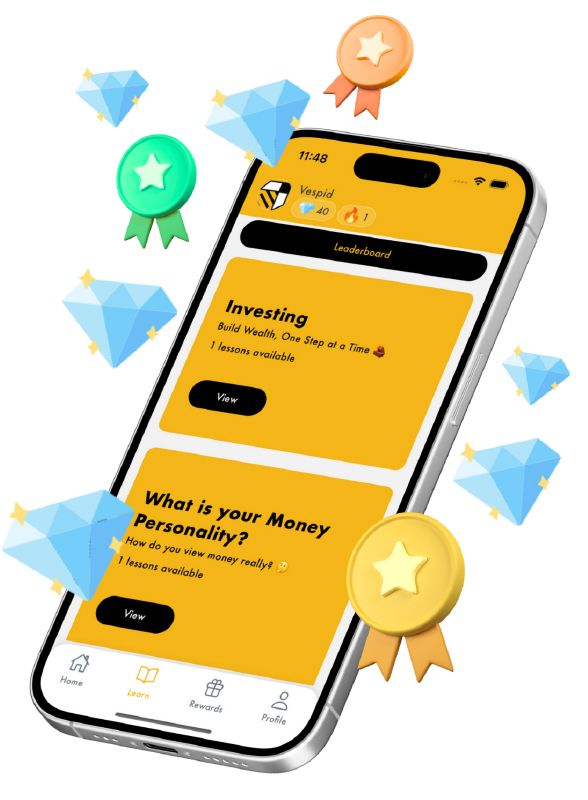
Learn budgeting, saving and investing through games and rewards
The appeal of gamification lies in making learning more engaging through elements such as challenges, rewards and progress tracking, particularly for complex subjects such as finance. Lee says Vespid moves beyond traditional financial education methods by offering bite-sized lessons on budgeting, saving and investing through interactive activities, quizzes and milestones.
According to Vespid’s website, users begin by downloading the application from the Apple App Store and Google Play Store and creating an account. They are then guided through a series of financial literacy lessons.
Rather than relying on lengthy reading materials, the app presents these lessons in an interactive format designed to keep users engaged. As users progress, they complete quizzes and challenges that test their understanding of each topic.
Successfully completing these activities unlocks further lessons, with progress tracked through the learning journey. The platform uses gamification elements such as milestones and achievements to encourage users to continue learning and return to the app regularly.
As users accumulate points and climb the leaderboard, they can redeem rewards such as Touch ’n Go eWallet cash vouchers and Zus Coffee discount vouchers.
The app has recorded more than 2,400 downloads and registered users on the Apple App Store and Google Play Store.
“We are not in financial advisory; we are purely educational. Everything we do is not financial advice. Our goal is to shape the user’s mindset so that they have an idea of what to do for themselves,” says Lee.
Other than offering a free learning app for financial literacy, Vespid operates on a B2B2C model, which allows businesses to subscribe to the platform to deliver gamified financial education and engagement experiences to their own customers.
For instance, an insurance company or credit rating agency, whose customers use its app only occasionally, could integrate Vespid’s gamified learning experience into its platform to encourage more frequent engagement.
“By offering educational content in a fun and interactive format, we are helping financial institutions increase customer engagement while promoting financial literacy. The platform is designed to appeal particularly to younger users, including Gen Z, by making financial learning more interactive and engaging,” Lee says.
To support its growth, Vespid has tapped various start-up support programmes and ecosystems.
In 2021, during the company’s early stages, Lee and her co-founder participated in the University of Michigan’s optiMize Social Innovation Challenge, where they pitched Vespid as a simple and user-friendly stock-investing platform for Malaysians. They won more than US$10,000 from the challenge, which provided the resources needed to continue developing the platform.
“We have been using these funds to build the interface and pay our staff as well. The grant is used solely on upgrading and experimenting with Vespid’s app and our website,” she says.
In Malaysia, the company became a member of the PayNet Fintech Hub in 2025. In June, Vespid also received RM100,000 under CIP Spark, an early-stage start-up grant administered by Cradle Fund Sdn Bhd that supports start-ups in developing and validating their products before commercialisation.
Vespid is not actively raising funds but anticipates doing so in about a year’s time. While the company currently derives much of its income from one-off projects, it is working to transition towards a Software-as-a-Service (SaaS) model with recurring monthly revenue before approaching investors, says Lee.
Turning a first investment experience into a bigger mission
Edrea Lee’s investing journey began while she was studying in the US, where many Malaysian students took on part-time jobs and looked for ways to invest their savings.
One day, a Malaysian student in her circle who had experience in trading and investing started organising informal sessions to teach fellow Malaysians how to use investment platforms. That was where she first learned about investing.
“That’s where it began; my first dabble into investing was actually on [US stock-trading platform] Robinhood,” says Lee, co-founder of Vespid, a local gamified financial literacy platform that rewards users with incentives. “I bought Apple shares. From there, I learned that I could buy fractional shares. That’s the beauty of digital investing platforms. you don’t have to spend thousands of ringgit to buy one Apple share on some platforms.
“I invested about US$100 in Apple, but sold all of it before I left the US. Now, I’m regularly investing in fixed deposits and EPF, ASB and robo advisors.”
Lee started investing through the support and knowledge she received from her peers, and wanted to make this more accessible in Malaysia. “More Malaysians should be equipped with the knowledge and tools to grow their wealth. And this, I believe, can be achieved through education and access to financial knowledge.”
Save by subscribing to us for
your print and/or
digital copy.
P/S: The Edge is also available on
Apple’s App Store and
Android’s Google Play.