
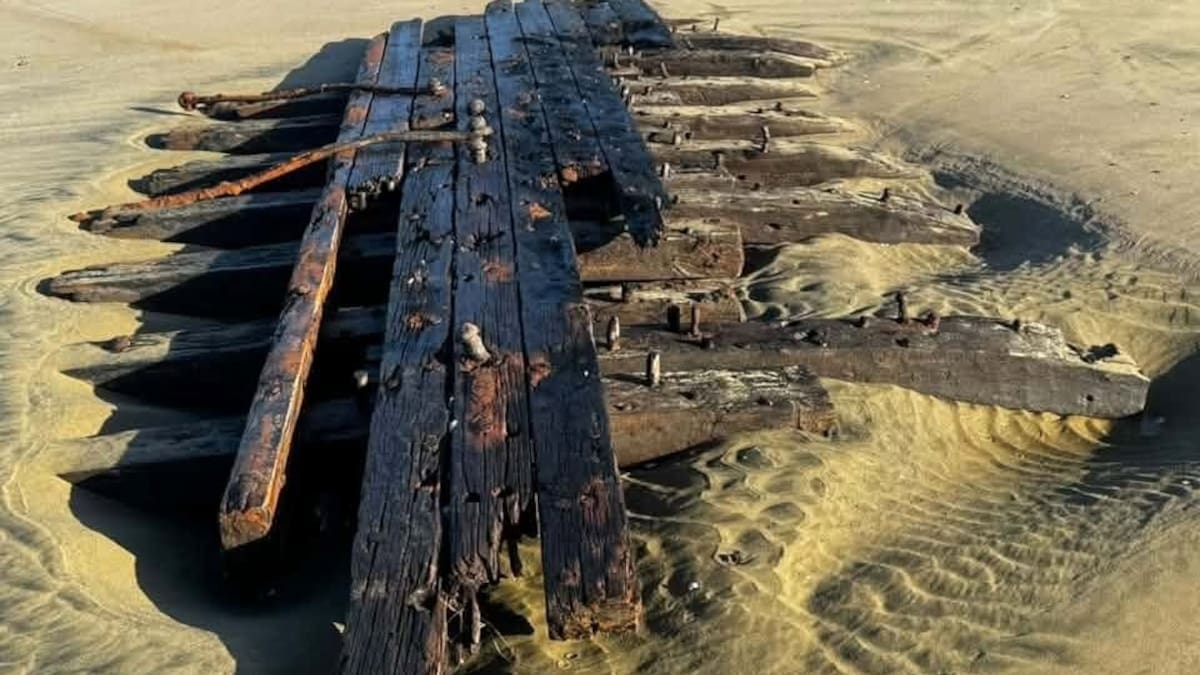
Scientist Dr Jonathan Palmer said it might be impossible to now work out what the ship might have been.
“Putting together the identification and timing of the wrecks helps enrich the history of that time period of New Zealand history.”
Palmer, a board member of the Kauri Museum in Matakohe, helped date the country’s oldest known European shipwreck, which was found at Pouto in 1982.
Assessing planks kept at the Dargaville Museum, Palmer and his team used radiocarbon dating and tree-ring growth patterns to calculate the shipwreck was from between 1696 and 1714.
It was the first shipwreck to be dated between the 1642 arrival of Dutch explorer Abel Tasman and the 1769 arrival of British Captain James Cook.
Pouto Lighthouse was built to help guide ships away from the dangerous Kaipara bar. Photo / NZME
It suggested that other European explorers tried to follow Tasman’s discovery before Cook landed, Palmer and his team said in a 2013 scientific paper.
While the ancient ship was about 1.2km east-northeast of the shipwreck uncovered last month, Palmer believed it helped tell the story of how difficult and dangerous the Kaipara Harbour entrance was to navigate.
“The number of wrecks scattered along that coastline over a long period also illustrates the importance of Kaipara in early European history – primarily for kauri timber and kauri gum.
“This shipping route was also vital for importing goods and machinery to the area for pastoral and agricultural development.”
Palmer said another thing not well known was how important the Kaipara Harbour was as a shipping hub to export native flax hemp.
Northlander Steven Cochrane, who allegedly witnessed the shipwreck being destroyed last month, said there should be blanket protection for all shipwrecks in the area.
While Palmer said the shipwrecks shouldn’t be collected for firewood, he admitted there was no easy solution to preserving them.
With the shipwrecks often rapidly exposed then reburied in sand, there was neither time nor funding for a team of archaeological investigators to get to the site and protect the wreck, he explained.
He would prefer shipwrecks were left to be reburied, so they could be unearthed at some point when there was funding available.
Palmer had done little more shipwreck investigation since 2013, because of a lack of funding.
His research since then included investigating swamp kauri for clues about past climate change.
Denise Piper is a news reporter for the Northern Advocate, focusing on health and business. She has more than 20 years in journalism and is passionate about covering stories that make a difference.