
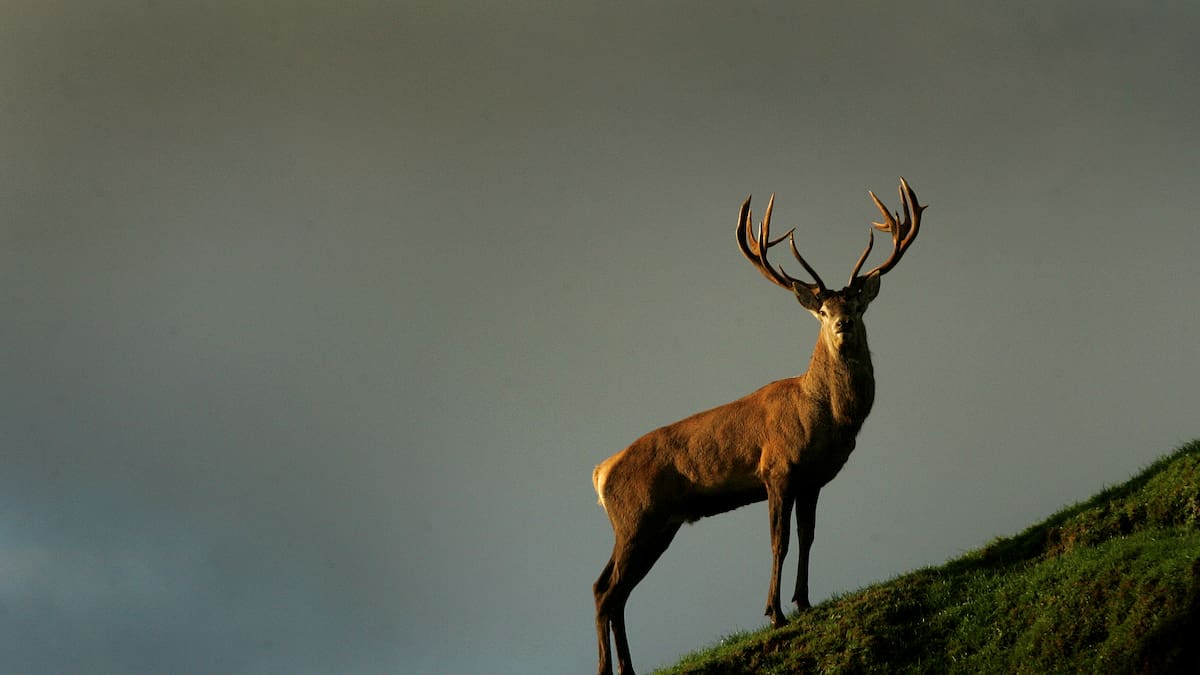
“Once deer numbers grow from 50 to 100 and more, the economic damage gets significant, more so if they are getting 100% of their feed from your property.”
Porangahau farmer Sam Stoddart is all too familiar with the problem, with 8000 hectares of bush on his farm boundary.
“There’d be, at an estimate … 800 plus deer right on our boundary, so a young kale crop will get pulled … plucked out before it’s had time to establish,” Stoddart said.
He said if those 800 deer grazed on his land, they’d eat about the same as 1200 sheep, which could be making him $145,000 a year.
Instead, with hundreds of wild deer on his land, the farmer has paddocks he can’t put into higher value crops, winter grass that’s being chewed up and native plants that are disappearing.
He said wild deer populations have ballooned over the past 10 years.
“The numbers have just exploded.
“They were released as a bit of game for hunters but were never really controlled, I don’t think by DoC [Department of Conservation] or anything … now it’s got to the stage where we need some sort of Government intervention.”
He’s one of 14 landowners MacIntyre talked to.
“It was a rather depressing story,” MacIntyre said.
“People had lost a lot of natives, people were losing forage crops.
“It was a pretty sobering story from everybody.”
The research was organised by Marie Taylor from Plant Hawke’s Bay and funded by the Hawke’s Bay Regional Council, the Joan Fernie Charitable Trust and the Pan Pac Environmental Trust.
During the study, a landowner who thought he had 50 deer on his property found nearly 300 with thermal imaging – and Taylor said this highlighted how huge the wild deer problem had become.
“Numbers have increased really exponentially,” she said.
“They are a real limiting factor for all things on-farm, including plantings; they’re also really totalling our biodiversity because they graze species by species, they take most palatable things out of the landscape first.
“Even though the canopy of the forest looks great, we are losing everything underneath.”
The study showed when 100 deer got half of their annual feed requirements from productive pasture, farmers lost more than $10,000 per year.
MacIntyre said over 10 years, using an 8.4% discount rate, that was more than $100,000 in lost value.
“If farmers are losing forage or won’t plant forage because of the likely damage, you can more than double the losses above.”
‘I want to see people working together’
MacIntyre said new deer fences cost about $40,000 per kilometre and sustained shooting programmes were costly and required ongoing effort.
He calculated that electric fencing added to existing fences would be about $8000 per kilometre.
However, he said accounting for the losses from deer grazing, it became more economically viable to fence.
“If you try to ring-fence your farm it’s going to cost you quite a lot … If you gang up with your neighbours and ring-fence off the problem area then it’s going to be a lot more cost effective for each farmer,” he said.
Taylor agreed.
“We need to work as catchment groups and put up deer fencing where we can defend the fence,” she said.
“I want to see people working together like they did with possum control areas – that was hugely successful in Hawke’s Bay.”
To achieve that, what is really needed is more funding for conservation and pest control, she said.
“There has been an uncontrolled invasion of feral deer into farmed land from the ranges in Hawke’s Bay with no co-ordinated control programmes and a consequent destruction of years of careful biodiversity planning, planting and management as well as economic loss to farmers.
“Unless DoC does its job properly this situation will only get worse with deer numbers increasing and environmental damage becoming even more significant and economic costs to farmers becoming unsustainable.”
DoC’s wild animals manager Mike Perry told RNZ that DoC actively managed deer in areas where they had the greatest impact on biodiversity, with about 200,000ha of deer management nationwide.
“We acknowledge that wild animal numbers are increasing,” Perry said.
“National monitoring shows ungulates – wild deer, goats, pigs, chamois and tahr – are present at approximately 83% of monitored sites on public conservation land, up from 63% in 2013.
“In response, DoC has significantly increased control efforts across the country in recent years through additional funding provided in Budget 2022, alongside more than $10 million received through the International Visitor Levy.”
DoC said deer management was carried out at several sites across Hawke’s Bay and surrounding areas, such as in the Ruahine Forest Park.
However, Perry said in Hawke’s Bay wild goats posed a greater ecological threat than deer in many conservation areas.
“DoC undertakes goat control across a range of sites in the region and is carrying out extensive work in the northeastern Ruahine Range with the goal of making that part of the park wild goat free.”
He said managing wild animals is a shared responsibility that extended beyond public conservation land.
“Iwi, landowners, hunters, councils, community groups and government agencies all have an important role to play in protecting biodiversity while ensuring sustainable management outcomes across the landscape.”