
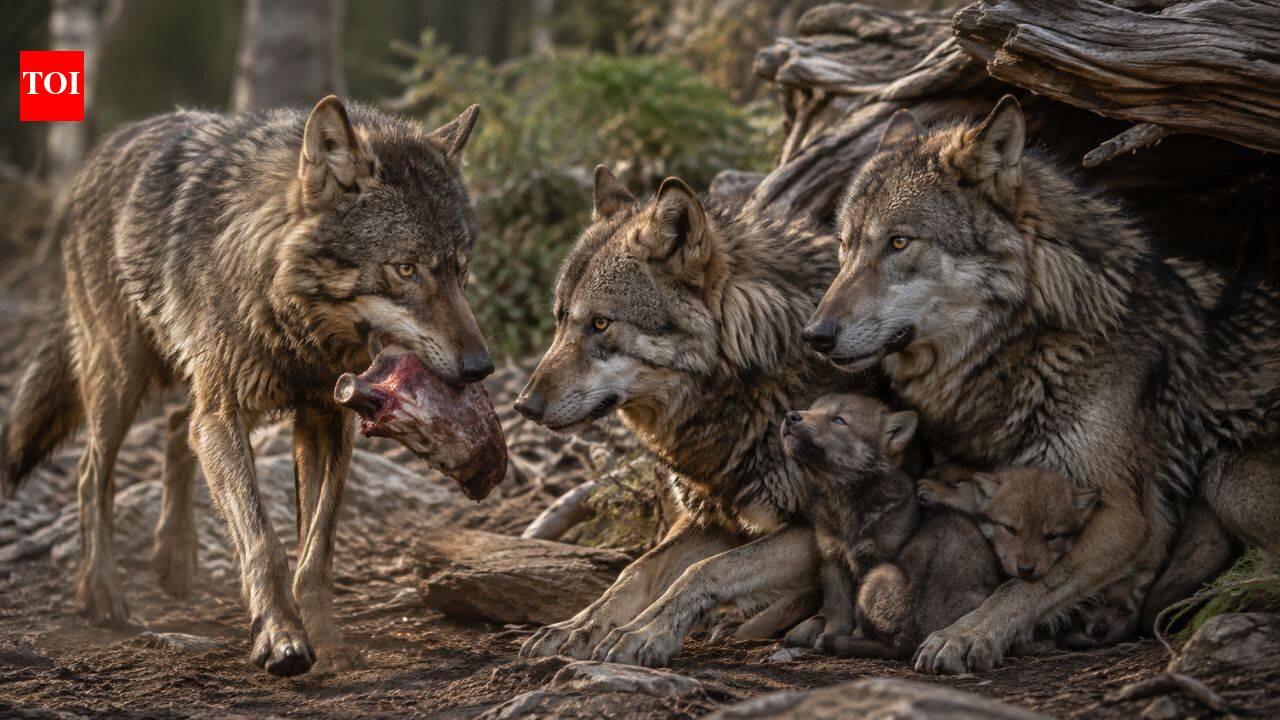
 A wolf pack is often imagined as a tightly organised hunting group moving across forests or open tundra. Yet much of its daily life revolves around something far less dramatic: looking after its youngest members. Newborn pups cannot travel with the adults for weeks, leaving them dependent on those that remain near the den while others search for food. That responsibility does not fall only on the breeding pair. Older brothers and sisters, along with other adult pack members, take on surprisingly active roles in feeding, guarding and caring for the next generation. A long-term field study of wild Arctic wolves suggests that this shared effort is more than simple family loyalty. It appears to be a practical system that helps young wolves through one of the most vulnerable stages of their lives.
How Arctic wolves transfer food to hungry wolf pups
For young wolf pups, survival depends on adults returning safely from hunting trips. While some pack members leave to search for prey, others stay close to the den, keeping watch over the litter until food arrives. According to the study published in the Journal of Zoology, titled “Regurgitative food transfer among wild wolves”, food is commonly transferred by regurgitation after hunting trips, allowing adults to deliver partially digested meals directly to pups that are still too young to travel or eat large prey themselves. This behaviour also supplements food that may be carried back in the mouth, creating several ways for adults to feed dependent young.The researchers observed a free-ranging wolf pack on Ellesmere Island in Arctic Canada over six summers between 1988 and 1996. Rather than relying on captive animals, they were able to watch naturally behaving wolves returning to their den sites throughout the breeding season.
How older wolves help parents care for newborn pups
The study offers a picture that differs from the idea that only parents care for offspring. Wolves born in previous years often remained with the family for a time, becoming what researchers described as auxiliary pack members.These older siblings were not simply waiting for their chance to breed. They also brought food back, regurgitated meals for the pups and shared responsibility with the breeding pair. Every adult wolf, including yearlings and even a post-reproductive female, participated in food transfer.That finding challenged an earlier suggestion that young adult wolves might take more from the family than they contribute. Instead, the field observations pointed in the opposite direction. As per the authors, “our auxiliaries appeared to have helped more than they hindered food transfer.”Most of the food reached the pups rather than other adults. Around 81% of recorded regurgitations went to the young, compared with 14% for the breeding female and only 6% for auxiliary wolves themselves.
How mother and father wolves divide parenting responsibilities
The work also showed that care inside a wolf pack is not evenly divided. Breeding females directed most of their food transfers towards pups, while breeding males split their efforts between feeding the pups and supporting the breeding female, particularly earlier in the summer when she was nursing. As the season progressed, males shifted a greater share of food towards the growing pups.When hunting wolves returned, they were usually met immediately by excited pups and often by other pack members. Most food transfers happened almost as soon as the adults reached the den, although recipients occasionally followed returning wolves for considerable distances before food was finally delivered. Some wolves regurgitated several times during a single visit rather than emptying everything at once.Breeding females increased their feeding effort when litters were larger. Having more helper wolves in the pack did not appear to reduce the mother’s own contribution, suggesting that cooperative care added to parental investment instead of replacing it.
Wolf packs work as extended families to raise vulnerable pups
Young wolves face weeks in which they depend entirely on adults for nourishment and protection. A system where several individuals share those responsibilities spreads the workload across the pack while ensuring that pups continue receiving food even when some adults are away hunting.Their observations did not support the idea that older offspring behave mainly as competitors. Instead, they found evidence that these family members contribute to raising the next litter during the first months of development. They also suggested that, over the life of a breeding pair, both males and females make comparable contributions to food transfer, even if their roles shift through the season.Wolf packs are extended families rather than collections of unrelated hunters. Parents remain central to raising pups, but older brothers, sisters and other adult relatives become part of the nursery as well. When one group is out searching for prey, another is often still at the den, guarding the litter until the next meal arrives.