
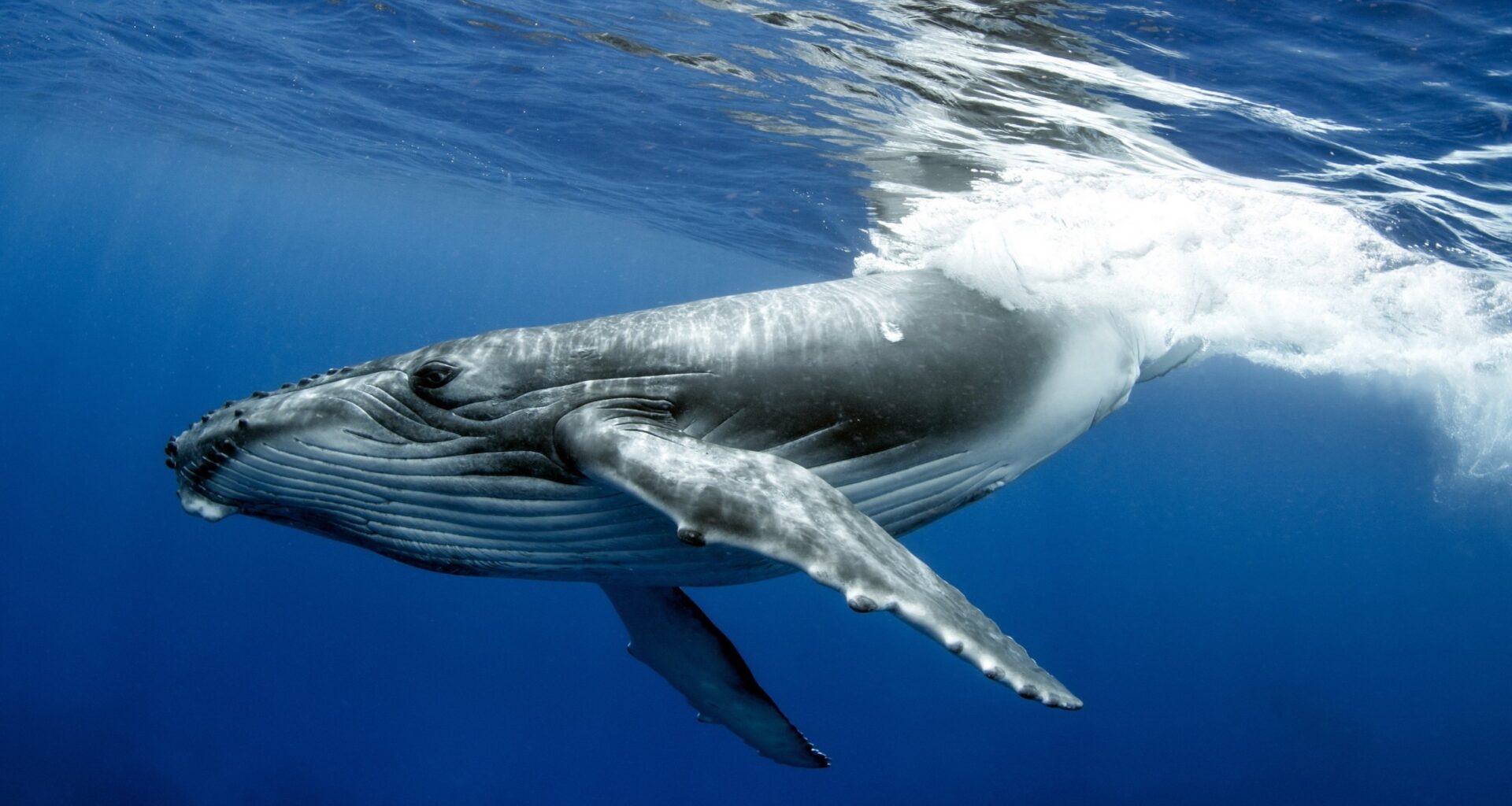
Male humpback whales can sing for hours without pause, their songs carrying for miles underwater during winter breeding season.
Researchers have studied what those songs sound like for decades. What they haven’t had, until now, is a clear picture of what the whale’s body is actually doing while it sings.

The research was led by Julia Zeh, a recent PhD graduate of Syracuse University’s College of Arts and Sciences and a member of biology professor Susan Parks’ Bioacoustics and Behavioral Ecology Lab.
The study uncovers a direct link between the structure of a humpback‘s song and its movement through the water, tying specific song sections to specific stages of a dive.
Tagging whales with waterproof microphones
To collect the data, Zeh and her collaborators temporarily attached sound-and-movement recording tags to singing humpbacks off the coast of Maui, part of a research effort that ran from 2018 to 2024.
The tags are small, non-invasive suction-cup devices roughly the size of a tablet, attached from small boats using long poles or, more recently, drones.
Once in place, the tags recorded both the whale’s sounds and its movements until suction eventually gave out and the device detached, letting researchers retrieve it and download everything it had captured.
The team ultimately tagged 16 whales, a solid sample by tagging standards and one chosen to represent Hawaii’s broader breeding population.
A 16-hour song and a surprising pattern
Some of the tagged whales kept singing the same song on repeat for up to 16 hours without stopping, a finding that alone caught the team off guard.
But the more significant discovery was what happened to the song’s structure as the whale moved through the water.
Recurring song elements known as themes consistently lined up with particular parts of a dive.
Earlier research had noticed certain themes tending to show up as a whale approached the surface, but nobody had connected an entire song’s structure to a complete dive cycle before.
The relation between song and depth
That connection between song and depth hints at something more than coincidence.
According to Zeh, themes sung while a whale held a relatively constant depth near the bottom of its dive showed different levels of variability than themes sung elsewhere.
This suggests those particular sections may be shaped more heavily by sexual selection, potentially functioning as signals of a male’s individual quality.
Themes tied to other parts of the dive, on the other hand, may be constrained by more practical demands, like managing oxygen and buoyancy while singing.
“This gives us direction for which parts of the song to investigate if we’re interested in variation, which is likely driven by sexual selection,” Zeh said.
The findings carry practical weight too. Acoustic monitoring is already a widely used method for tracking whale populations.
Understanding how song relates to movement could let researchers estimate a whale’s depth or position from a recording alone.
That capability could help establish a clearer baseline for what normal humpback behavior looks like, a reference point that matters when trying to detect when whales are being disturbed by vessel traffic or ocean noise.
Whether the same patterns show up in humpback populations outside Hawaii is still an open question.
Zeh expects similar physiological constraints to apply broadly, but documented differences in how song evolves between hemispheres leave open the possibility that different populations face different pressures on song structure.
Answering that would require gathering comparable tag data from singing whales on breeding grounds around the world.
A new way of listening
The work reflects years spent in Parks’ lab at Syracuse, where Zeh focused on the overlap between animal behavior, acoustics, and marine biology.
That time gave her the tools to pair bioacoustic analysis with biologging technology in a way nobody had applied to humpback song before, opening new questions about a subject long studied almost entirely through sound.
By reframing whale song through the lens of movement, Zeh’s work offers a new way of studying how physiology, environment, and the social transmission of song interact to shape one of nature’s most elaborate learned behaviors.
The approach could extend well beyond humpbacks, offering a model for studying complex acoustic communication across other species too.
“My time at Syracuse changed the way I think about what’s possible in this field,” Zeh said.
“Projects like this one, where we combined acoustics with movement data, gave me the tools to ask exciting questions about whale behavior and the opportunity to be creative in how we look at well-studied phenomena like humpback whale song.”
“These experiences inform how I conduct research and have given me the foundation for my current work in ecological monitoring and conservation.”
The study is published in the journal Current Biology.
—-
Like what you read? Subscribe to our newsletter for engaging articles, exclusive content, and the latest updates.
Check us out on EarthSnap, a free app brought to you by Eric Ralls and Earth.com.
——