
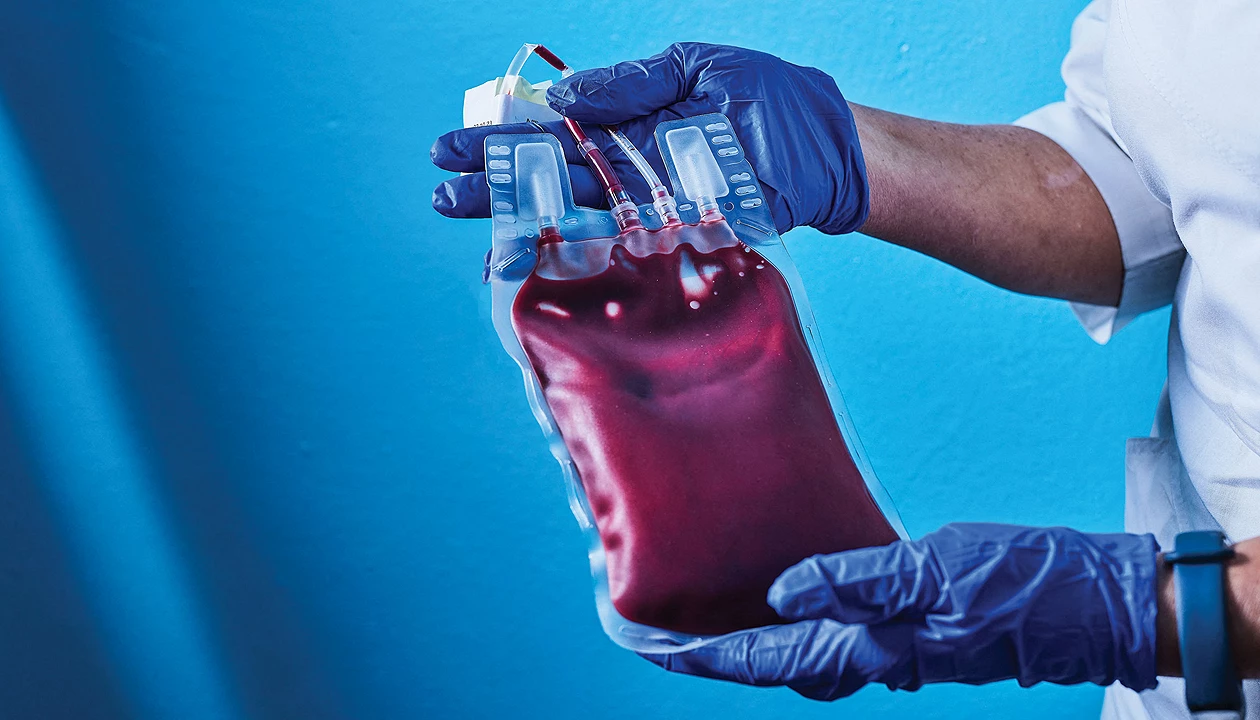
Plastic blood storage bags could be shedding microplastics into stored blood, and those particles may worsen the damage that red blood cells naturally accumulate during storage, according to a new study in Environment & Health (DOI: 10.1021/envhealth.6c00110). The findings suggest that blood storage systems could be a previously underappreciated source of microplastic exposure.
“This is the first study to directly visualize microplastic particles in stored red blood cell units using microscopy and to confirm their identity through analytical chemistry,” Angelo D’Alessandro, a University of Colorado Anschutz professor and expert in red blood cell storage who was not involved in the study, says in an email. “That is an important technical advance.”
In experiments, a team from China found that microplastic particle concentrations increased steadily over 30 days of storage. In that time, concentrations were between 7 and 20 times those found in freshly opened blood bags; the highest concentrations measured 22.3 ng/mL. Mechanical shaking and room temperature storage, which mimic improper storage or transportation, accelerated particle release by increasing degradation of the bags’ polymer surfaces.
“The concentrations reported are not trivial and deserve careful attention, particularly for patients who receive repeated or large-volume transfusions, such as children with inherited anemias or individuals with chronic transfusion needs,” D’Alessandro says. “At the same time, we do not yet know what level of exposure is sufficient to produce clinically meaningful effects in humans.”
While blood is in storage, biochemical and structural changes gradually reduce the integrity and function of red blood cells; these negative impacts are known as storage lesions. The researchers observed more storage lesion features in stored blood than in fresh blood from healthy donors.
Outside experts urge caution in interpreting these results, however, as the researchers did not establish a mechanism by which microplastic particles might be degrading blood cells.
“Storage lesions are well known to be driven by cell aging, metabolic exhaustion, and oxidative stress, so [without further evidence], it is [too soon] to conclude that particles are actively driving this damage rather than just being present,” Jordi Petriz, a group leader at the Germans Trias i Pujol Research Institute who was not involved in the study, says in an email. “Because medical-grade polymers have a long, proven safety record in saving lives, calling on manufacturers to overhaul blood storage materials would be premature.”
Particle release also varied depending on the solution used to preserve the blood. Ultrafiltration of the two tested preservation solutions before their incubation with whole blood and red blood cells removed 78–85% of detected microplastics and improved several measures of red blood cell integrity and function. These results suggest that microplastic particles could be damaging red blood cells, and filtering the preservation solutions before blood is added could mitigate some of the particles’ effects.
Petriz expresses doubt that plastic shedding from long-term storage was responsible for the storage lesions. “If 80% of the particles are present in the liquid before prolonged cell storage even takes place, attributing red blood cell ‘storage lesions’ . . . strictly to in situ bag shedding over 30 days becomes a shaky premise,” Petriz says. He adds that reported microplastic concentrations should be confirmed using standardized methods that rule out environmental contamination during sample preparation.
Other practical questions remain, including whether filtration could be incorporated into routine transfusion workflows, if alternative materials could reduce particle shedding from blood storage bags, and how microplastics in stored blood might impact transfusion recipients.
“Blood transfusion has always been and remains a safe and lifesaving procedure for millions of recipients worldwide,” D’Alessandro says. “That said, there exists ample room for improvement . . . to minimize [potential] recipient exposures.”