
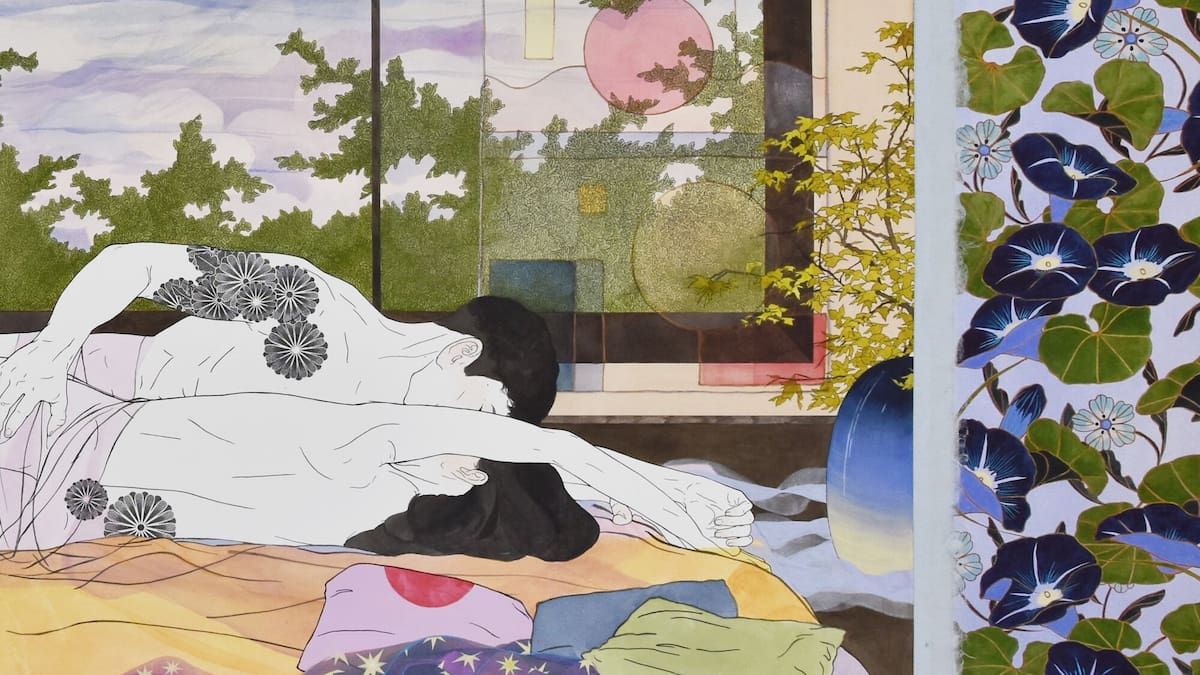
When a lecturer told Aiko Robinson her art was “too safe” she responded with pornography. More than a decade later, the Christchurch-born and Perth-based artist talks to Kim Knight about her latest exhibition.
Aiko Robinson has, by her own admission, a “very dodgy” internet search history.
She watches porn.
And not even the high-end variety.
“I’m like a 14-year-old boy. I haven’t actually paid for any pornography sites, so I’m not getting very quality stuff …”
She takes the sometimes crude and confronting and looks for moments she can redefine.
“It’s quite often the offensive stuff that I don’t like, but I find moments within these works, these videos, that I find beautiful. Or I try to make something that feels really confronting and crude, beautiful, in my own view.”
Art critics and collectors love it. Instagram? Not so much.
Robinson’s highly detailed watercolour and gouache paintings draw on the Japanese ukiyo-e tradition of shunga – a form of pornography, or erotica, from the 17th-19th century Edo period.
At an upcoming show with Auckland’s Gow Langsford, her newest works will sell for more than $10,000 apiece. But, back in March, the artist’s professional Instagram account was permanently deleted.
Robinson lost more than a decade of posts, 26,000 followers and, crucially, a platform for sharing her art outside traditional gallery walls.
It was not, she admits, an entirely unexpected outcome.
Warnings that she was breaching community guidelines had steadily increased over the preceding year. She suspects that while the social media platform had historically reacted to human complaints, it was now using artificial intelligence (AI) to determine which posts to take down.
“My understanding was that it made allowances for things like fine art and things that weren’t created digitally … and that, you know, maybe I was pushing it with genitalia, but maybe some breast was okay?”
Robinson says as her online audience had grown, so had the allure of the platform. In an era that requires artists to self-promote, it was a powerful tool.
“But what was happening was the more graphic the work, the more quickly it would be taken down. So then I was trying to censor work. It was painful. Cropping it in certain ways. At this point, what am I doing? You feel that urgency to continue posting, so you continue that momentum, continue that engagement. It can lure you into that sort of pattern. But the things I was posting were just censored versions of my work – and they were still getting taken down.”
The end came in stages. An age restriction, a block on new followers and, finally, news the account would be deleted.
“And you never, ever, in that whole process, talk to anyone in person.”
Robinson, 33, was born and raised in Christchurch. Her mother, Miwa, is from Osaka, Japan, and her father, Tim, is a New Zealander. She attended St Margaret’s College, but in 2011 decided to move north for tertiary study.
At the University of Auckland’s Elam School of Fine Arts, Robinson drew on her heritage and began exploring ukiyo-e – traditional Japanese woodblock prints.
“Imogen Taylor was one of the academic staff. She just straight up told me they were too cute, too safe. And I was like, ‘ooh, I’ll give you not cute and not safe’. I went to the library and learned about the subcategory shunga. Initially, it was for shock value.”
Later that same year, the British Museum held a major shunga exhibition. Then, in 2015, Japan mounted its first large-scale exhibition of a genre once gifted to newlyweds and brothel customers but, in modern times, largely hidden away.
Aiko Robinson began making shunga-inspired art at Auckland University’s Elam School of Fine Arts in reaction to criticism she was playing it “too safe”.
Meanwhile: “I’d gone from that initial shock factor to discovering that it’s really about beautiful works celebrating love and intimacy. Mutual pleasure, equality between lovers. In this current climate, where we can easily access online pornography, and a lot of it is quite problematic, I felt like this was quite an important message.”
In an artist’s statement, Robinson writes: “The desire to have sex is not only normal but something wonderful and to celebrate. The curiosity to look at sexual material is human and healthy … I want to provide a platform for people to talk about sex in an open and positive environment.”
And, on a Zoom call from Perth, she says that’s a conversation she’s found particularly interesting since she became a mother.
She recounts her experience speaking to other mothers about the exact age they would prefer their children – and especially their daughters – to first encounter sex.
“That is a very arbitrary number. Where does that come from? And why, specifically, your daughter and not your son?’ There’s a part of me that wants to talk about emotional and physical readiness and about being safe and knowing to respect your body and others’ … I think it’s all about having these conversations and being open, and trusting that people can make their own decisions.”
Shunga translates to “spring pictures”. Robinson notes that in the fine art world, sex is often legitimised or justified via an association with fertility.
“But I’m like, ‘Can we also talk about women’s pleasure?’
“If, for women, pornography or erotica felt hard to access, or was something they shied away from, I wanted my work to be something that was approachable to them.”
Robinson has previously placed copulating figures outdoors or in front of open curtains. Metaphors, she has said, for openness. Figures and body parts are depicted simply, against highly detailed backgrounds that echo fabrics from her mother’s extensive kimono collection and the ceramics and carved furniture of her Chinese Malaysian in-laws.
Look closely, however, and you might see the mundanity of a tissue box. The men will always be wearing condoms.
“I’ve had some pretty stupid comments on my social media … quite a lot of judgment … all these people saying, ‘Why are they wearing condoms?’ Do I have to do Sex 101 with you? This is encouraging safe sex. We don’t often see it in pornography, you know?”
Cropped detail from Aiko Robinson’s “Sweet mandarins fill me with another hunger”. The Christchurch-born, Perth-based artist is exhibiting at Gow Langsford’s Auckland city gallery from August 12 to September 12.
Online, via a new age-restricted account, Robinson asks those who don’t enjoy her art to at least respect it.
“Suppressing sexual feelings can be really harmful, often resulting in violent sexual fantasies and unrealistic and deluded ideas of sex,” she writes.
“Speaking openly about such issues can be really important in your understanding of how to relate to your romantic partner in a truly intimate, pleasurable and respectful way. The fact of the matter is that sex is really important.”
Robinson says one of the most empowering reactions to her work was a Japanese Government-funded scholarship to Tokyo University of the Arts, where she gained a master’s in printmaking.
“I was really transparent. I said I wanted to go over there and learn about shunga … it just felt so encouraging that I was actually accepted.”
On her second night in Japan, at a social event for Kiwis and Australians, she met Adrian, the medical registrar who became her husband. The couple have lived in Perth since 2021 and their daughter, Yuzuki, turned 2 on the day of this interview.
Robinson says she’s “slightly frazzled” after putting together a cake for daycare.
“I can draw, but I can’t make cakes … it’s just a chocolate sponge with some cream cheese icing and raspberries. Very rustic. Ideally, I would have quite liked to have done a Bluey-themed cake because she’s obsessed. Quite frankly, I’m a bit obsessed too!”
Motherhood has, she thinks, changed the way she works.
Seven works will feature in the Gow Langsford show. They took a year to make, after a maternity leave year away from the studio.
“I used to be like this,” she says, raising both hands and miming an uninterrupted tunnel focus where everything was a mistake and every mistake had to be fixed immediately.
“And I’d make things worse. I’d panic, or just not have enough time to breathe … balancing it with motherhood worked for me, because it’s not about making rash decisions. It’s just taking the space you need to return to it with fresh eyes.
“Now my life is dictated by my daughter’s schedule. I thought that would be trouble. If anything, it’s given me a new perspective. I’ve got a newfound passion and joy, because the time I do get to spend on it is quite precious.”
Aiko Robinson, My brush cannot begin to paint you a picture of my feelings, August 12-September 12, Gow Langsford, Auckland city gallery.
More boundary pushers