
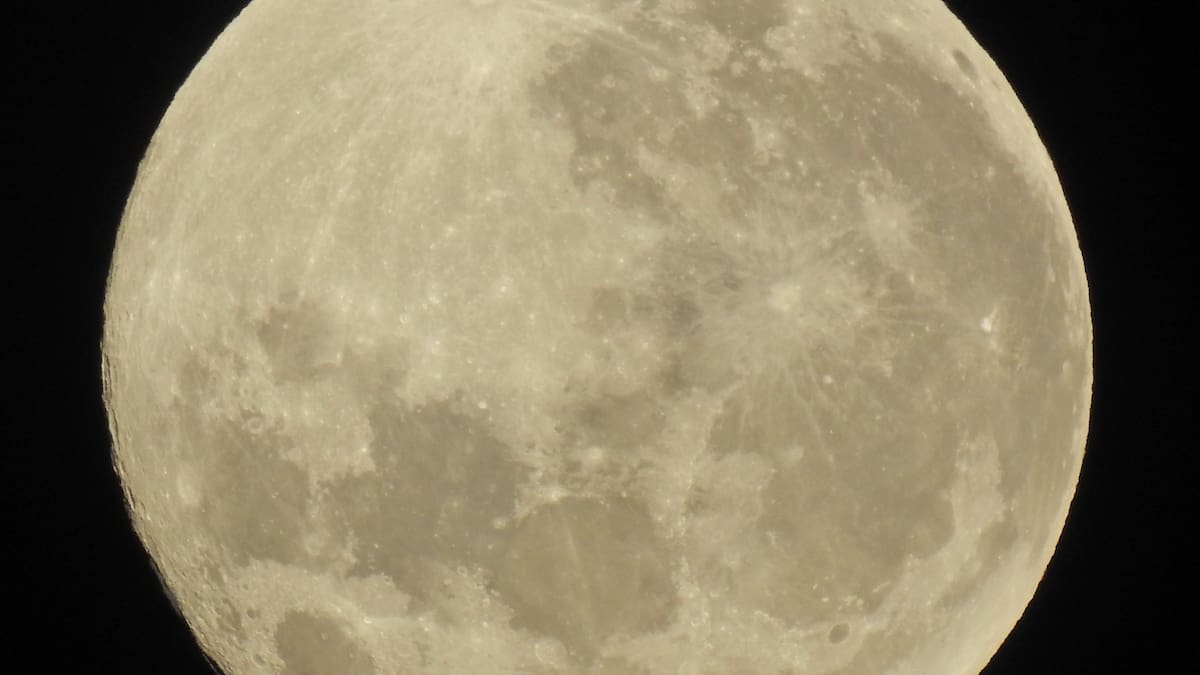
Benjamin Fernando, of Los Alamos National Laboratory in New Mexico, said: “It might be possible for folks with a telescope to observe the plume of ejecta created by the impact.
“It is unclear how bright it will be, which is one of the reasons why we are looking to study this event.”
Assuming all of the propellant is spent, the spacecraft part weighs approximately 4000kg, or four metric tons.
It was expected to slam into the moon’s northern hemisphere near the Einstein Crater, at more than 8500km/h.
Nasa spokesman Jimi Russell said in a statement: “There is no danger to Earth. Nasa will continue to track the booster for training purposes, as well as later observe the impact site for scientific purposes.”
The Falcon 9 rocket, made by Elon Musk’s SpaceX firm, took off in January 2025, carrying two lunar landers. The booster returned to Earth, but the upper stage stayed in space to push the landers onward.
Julianna Scheiman, director of Nasa Science and Dragon Programmes at SpaceX, said SpaceX performed a manoeuvre to make sure the second stage “is safe per the appropriate rules and regulations”.
But she said “a mixture of solar activity and gravity forces have put it on a path towards the Moon”.
She said that, like many scientists, she was “very excited” to see the impact.
It’s not the first piece of human “space junk” to strike the lunar surface. During the Apollo missions, Nasa intentionally aimed parts of rockets at the moon and studied seismic activity as a result of the impacts.
Nasa hopes to soon establish a sustained human presence on the moon, making it critical to better understand space debris in lunar orbit.
The moon routinely weathers impact from space debris including meteoroids. Artificial collisions are less common.
There are more than 46,000 pieces of space debris weighing a total of 17,000 tons currently in orbit, the European Space Agency said in late July.
Some experts have warned that amassing too much space junk around Earth could lead to a dangerous chain reaction known as the “Kessler syndrome” – where a collision of space debris creates an exponential cascade of collisions, creating more debris and more collisions.
– AFP