
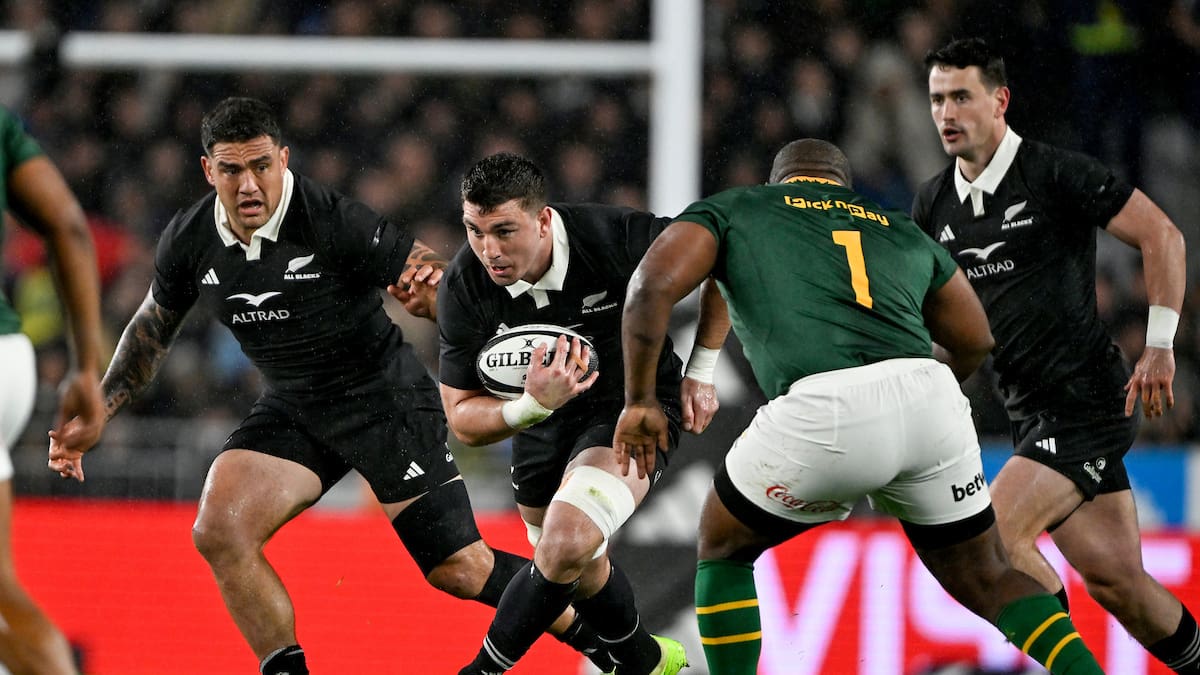
In came new coach Dave Rennie, who picked Parker in his 34-man squad for the Nations Championship, but didn’t give him any game time.
Parker was in limbo. The new regime obviously had an interest in him, but because Parker didn’t play against France, Italy or Ireland, it was unclear how strong that was.
First Peter Lakai, then Wallace Sititi, and for the final test of the year it was Tupou Vaa’i who played at blindside.
There was no, or at least there did not appear to be, preferred No 6 under Rennie. Now Parker is starting against the Stormers and while he likely currently sits some way down the pecking order, he’s the sort of athlete with the potential to climb up it quickly.
There has been a significant rewrite of what loose forwards are expected to do under Rennie and forwards coach Neil Barnes, and as much as that may be the reason Parker had drifted to the periphery, it could also become the reason he plays his way into the conversations around who to pick at six for the tests.
Rennie threw everyone when he picked Luke Jacobson to start at openside against France – a selection that was hard to understand until it became clear that his All Blacks are looking for weak seams in opposition defences that they will try to rip with the speed, agility and power of their ball carrying.
It’s a simple plan – the big men use their footwork and soft skills to get through the first line of defence and to build the continuity; there has to be a ruthless and effective cleanout at the tackled ball so that the next wave of runners can look to punch more holes.
It’s a game plan that demands ball carriers be agile and explosive and capable of winning post-contact metres. It means that accuracy at the cleanout is critical – technique has to be spot on so that bodies can be shifted.
Simon Parker talks to media at an All Blacks training session in South Africa. Photo / SmartFrame
And work rates have to be through the roof as the plan is most effective when it is conducted at speed and repeated relentlessly so that defences can’t reset.
All of which takes us back to Parker and the question of whether he can use his first selection under Rennie to prove that he is of value to the new regime and can deliver the skill sets that the coaching group are looking for.
He’s a big lad, a 1.97m, 117kg lump – and easily the largest of the eight loose forwards in the tour party. Basic physics comes into play in a collision sport that is set up for larger athletes to prevail.
But while Parker’s size excites the coaches – especially in South Africa where oversized humans are the norm – it’s not something of itself that is enough to convince Rennie that the Chiefs man is a bona fide keeper.
The tour of South Africa is serving as the ultimate trial for World Cup places next year, and with Parker having sat on the edge of the initial Nations Championship squad, and two more loose forwards – Ethan Blackadder and Semisi Ta’eiloa – having been added, he’s under pressure to deliver a performance against the Stormers that demonstrates he has the explosiveness to carry with genuine punch and the technical accuracy to wipe defenders of rucks.
All Black Simon Parker during last year’s defeat to the Springboks in Wellington. Photo / Photosport
Or, more succinctly, Parker is playing to prove he’s a potential World Cup candidate. The squad will eventually have to be trimmed to 33 for the tournament and the biggest squeeze will be felt in the back-row where competition for places is the most ferocious.
The new regime also has a strong focus on speed and intensity of movement and a requirement that players are able to repeat core functions.
This new world is all about measured impact and effectiveness, with the coaches keeping a close eye on metrics such as turnover ball won, penalties conceded, ruck arrival time, dominant tackles and cleanout effectiveness.
And this is where the doubt hangs over Parker. He proved himself to be solid and dependable last year, but there was often a lack of dynamism in his ball carrying.
It wasn’t passive, but it lacked the explosive energy and movement to blast past or through defenders.
And while Robertson was wedded to the “he’s a bigger body” narrative, there was never any demonstrable proof of how Parker’s size was manifesting and adding to the game plan.
The vagueness needs to be replaced with a sharper, universal understanding of what Parker brings to the table.
Listen to live commentary on Newstalk ZB Sport and iHeartRadio
Gregor Paul is one of New Zealand’s most respected rugby writers and columnists. He has won multiple awards for journalism and written several books about sport.