
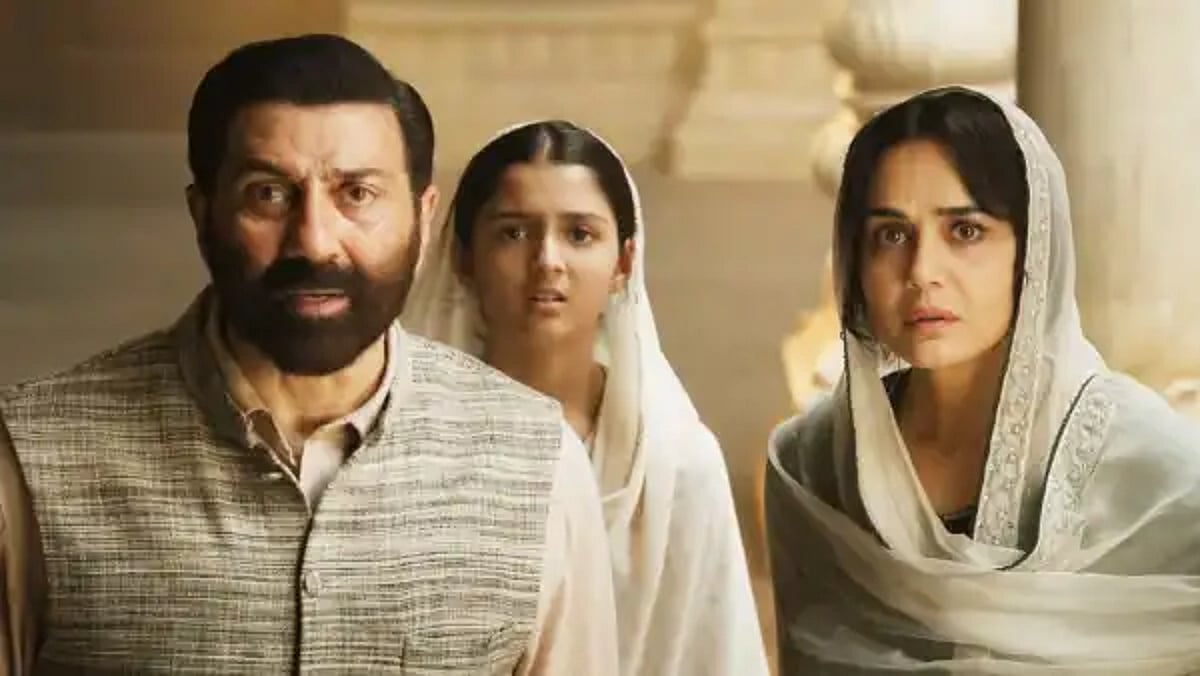
The call that brought Preity back
Preity’s return was not driven by a desire to chase a comeback moment. It began with a call from her Dil Chahta Hai co-star Aamir Khan.
The actor-producer approached her for Batwara 1947, a period drama directed by Rajkumar Santoshi — a filmmaker Preity had wanted to work with for years.
Initially, she expected something lighter. “I first thought it’d be some cool comedy,” she said.
But when Santoshi narrated the story of the Partition drama over a Zoom call, her reaction changed completely.
“I told them right after the narration, once the last dialogue was said, that I’d do it. They were quite surprised,” she recalled, before Santoshi responded, “Why surprised? We were happy.”
Stepping back onto set after 8 years
Returning to a film set after such a long gap wasn’t without its nerves, particularly working with Santoshi for the first time. Known for films like Ghayal, Damini, Ghatak and The Legend of Bhagat Singh, the director wasted no time easing her in gently, or rather, not easing her in at all.
“As soon as I landed and before I could even get my bags, they were done with my look test. A couple of readings the next day, and the shoot kicked off,” she recalled. To make matters more daunting, her very first day on set involved the film’s most demanding scene. “He decided to torture me by putting the most difficult scene of the film on the first day,” she said.
She found comfort, though, in reuniting with an old co-star. “I was just looking at Sunny that how do I do this? I love him! He’s a wonderful, big-hearted, kind, and decent human being to work with. He said, ‘Don’t worry, he likes retakes. Relax. Kuchh khayegi?’ Because main toh dheeli ho gayi thi,” she said, recalling Sunny Deol’s reassurance.
A period drama that reframed her perspective
While Batwara 1947 marked Preity’s return to acting, it also left her reflecting on just how much has changed for women since the era it depicts. She had long been drawn to period films, the costumes, the culture, the atmosphere, but the realities of 1947 turned out to be far more sobering than she’d imagined.
“I was dying to do a period film. I always romanticised with the kind of era it would’ve been, the clothes, and the food. You’re always curious,” she said. Santoshi, however, grounded her expectations early on. “When I used to ask Raj ji what to do in a scene, he’d say, ‘Preity, aap khana banao.’ Next scene, ‘Preity, aap safai karo.’ Next scene, ‘Preity, aap stitching karo.’ I said, ‘Raj ji, come on!’ He said, ‘This is 1947. The only career you can have is of a freedom fighter. There’s no other career. Your career is your husband, your children, and your home,'” she recalled.
The experience left her with a deeper appreciation for how far things have come. “Because when you look back at the pain and resilience people had, I’m only grateful, especially as a woman, that I can work and marry wherever I want. I have choice,” she said.