
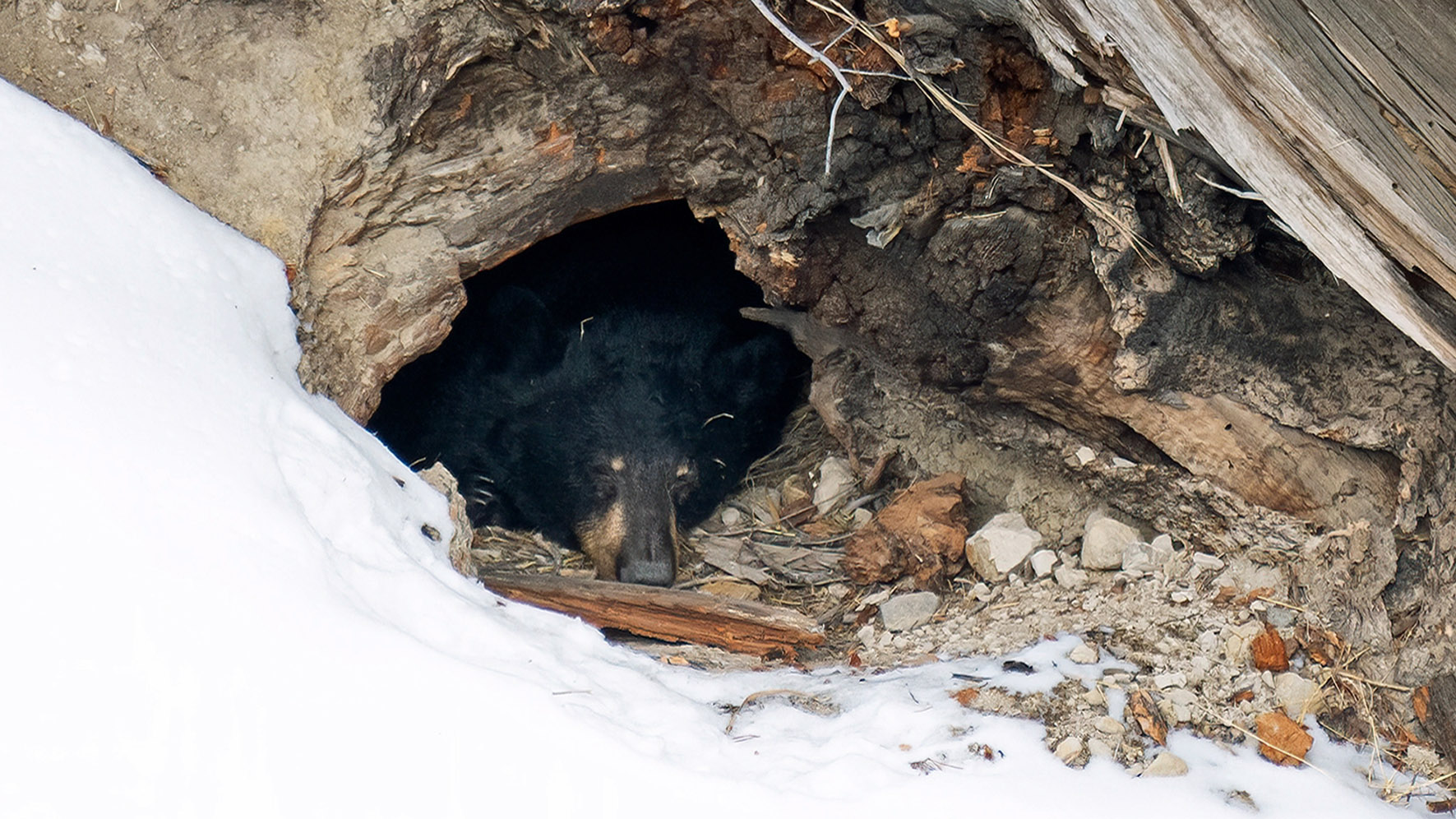
Winter sends American black bears into their dens for five to six months. Most people picture one long sleep. Brain recordings from Alaska show black bear hibernation is nothing like that.
The bears in this study slept about 65% of the day in the den. The rest of the time they were awake in the dark, curled up and doing very little.

That matters beyond bear biology. A hibernating bear cuts its metabolism by about 75%. It holds that state for months without wrecking its muscle or bone.
Researchers tracked bear brain activity
The recordings come from bears housed in outdoor enclosures in Fairbanks, Alaska. Implanted telemetry devices logged their brain waves, eye movements, and muscle activity.
The work was led by Øivind Tøien at the University of Alaska Fairbanks (UAF), with colleagues at Stanford. The team pulled three 24-hour recordings from each of six bears.
One recording came from mid-hibernation at the peak of a body temperature cycle, another from near the trough, and the third from summer.
Three experienced sleep experts independently scored every 10-second segment of the recordings. Their majority vote became the final result. They disagreed on only 0.5% of the segments, almost all of them when the bears were switching between sleep and wakefulness.
Black bears stay quietly awake
By that consensus, hibernating bears spent 42.9% of the day in non-REM sleep, 22% in REM sleep, and 34.6% awake.
Tøien, an affiliate senior research scientist at the university’s Institute of Arctic Biology, answered questions from Earth.com by email about what the bears were doing during the one-third of the day they were awake.
“While we will need a more systematic assessment, the initial impression is that most of those awake hours are what we call quiet wake, which means they are not quite asleep but hardly moving at all,” Tøien told Earth.com.
“If judged by video recording they will look like they are asleep most of that time, but brainwave activity tells otherwise,” he said.
Twice the sleep of summer
The same bears in summer looked very different. Non-REM sleep took 21.9% of the day and REM sleep 9.7%. The animals were awake 68% of the time.
Total sleep in the den ran 2.05 times the summer figure. REM sleep, the stage tied to dreaming, rose the most, at 2.26 times its summer share.
Wake time moved the other way, falling to about half the summer level. All of those gaps were statistically strong. The machine scores and the human scores agreed on every one.
Hibernation in a bear is not the deep freeze of a ground squirrel. Core temperature falls only about 10°F (5.5°C) on average. It slips from roughly 100°F (38°C) to between 86 and 95°F (30 to 35°C).
Metabolism tells a different story. It drops to roughly a quarter of the normal resting rate. That cut is far steeper than the small temperature change can explain.
Because the brain stays warm, a bear can be roused at any point in the winter. Smaller hibernators sink into torpor too cold for readable brain activity.
Their sleep can only be scored during the brief warm-ups between torpor bouts. Bears, black and brown alike, keep their brains talking through hibernation.
Five years of bear brain recordings
The Alaska group recorded more than 3,500 days of polysomnography from 16 black bears, in and out of hibernation, over five years. No comparable archive exists for any other large hibernator. Its sheer size is also the problem.
Scoring sleep by hand means judging every 10 seconds of every channel. No team can do that for a decade of recordings. So the researchers tested whether software could read the files instead.
The harder question was whether it could be trusted on a brain whose temperature drifts all winter.
Two AI systems scored bear sleep
Two classifiers went head to head. Somnotate is an open-source probabilistic scorer built at the University of Oxford. It was trained here on whole one-day recordings.
Somnivore is a commercial package from a University of Melbourne spinout. It learns from a small labeled slice of each file it scores.
Both landed close to the human consensus. F-measures, a strict accuracy score that punishes misses and false alarms alike, mostly fell between 0.90 and 0.98.
Overall accuracy reached 92% to 93.6% with the best training setups. Individual human scorers agreed with the group consensus 94.5% of the time.
AI nearly matched human experts
That puts the software within about two points of a trained person. In hibernation, its tallies of sleep and wake did not differ significantly from the human consensus at all.
That is the result the team did not expect, given how far the bears’ body temperature swings across a winter.
“We were actually surprised how well the machine learning worked compared to manual scoring even while body temperature was at quite different levels during the two days analyzed,” Tøien said.
The scores were close enough to the manual analysis of the same data, he said, that the software delivered no surprises about the biology itself.
Software struggled with summer sleep
Summer was harder than winter. Both programs slightly overestimated sleep there, by 2.4% for non-REM sleep, and undercounted wake by 4% to 5%.
The summer recordings were messier. Bears move, muscle signals bleed into the eye and brain channels, and telemetry drops out.
The animals also drift in and out of drowsiness rather than settling. Training has to be handled with care too.
When Somnivore was trained on a different bear than the one being scored, hibernation accuracy collapsed from 92.7% to 69.7%.
A handful of files defeated both programs, scoring between 0.67 and 0.88. They were the same files in each case, which the authors read as a sign the recordings themselves were ambiguous.
Study captured only mid-hibernation
The sleep totals rest on two days per bear in mid-hibernation. That is the coldest stretch of the season, when shivering can shape the record. Tøien says the paper is the first step in a longer effort, and that the numbers in it should be read that way.
“Thus the present analysis gives an early snapshot from the coldest period during mid-hibernation,” he says. “More extensive analysis will be needed forward for a better understanding of the sleep patterns and how they develop through hibernation.”
The authors want longer periods scored in more animals before the ratio is treated as fixed. These were also captive bears in insulated artificial dens, not wild animals in a hillside hole.
The paper warns against using automated scores alone to claim unusual state transitions. The software struggled most at the entry into REM sleep.
Bear sleep could help human medicine
With the method validated, the full archive can be scored automatically instead of sampled by hand. The payoff is a picture of sleep across a whole hibernation season. It would include the multi-day body temperature cycles bears run in the den.
Nobody has had that for a large hibernator. Researchers keep returning to bears because of therapeutic hypometabolism – deliberately slowing a body’s metabolism for medicine or long spaceflight. Bears manage it while staying warm and alert enough to wake.
Sleep now looks like part of that package rather than a side effect. A bear needs twice as much of it while running at a quarter speed.
For Tøien, the puzzle is how an animal endures months of sensory deprivation in a dark den while its brain stays warm enough for consciousness.
“While an answer to this is to sleep more during hibernation, it rather raises a question about sleep regulation,” he says. “The bears appear to be sleeping much more than expected from what we often call sleep need.”
Humans carry their own dormant hibernation genes. The bear archive may finally show what sleep is doing while a body idles.
The study is published in the journal PLOS One.
—–
Like what you read? Subscribe to our newsletter for engaging articles, exclusive content, and the latest updates.
Check us out on EarthSnap, a free app brought to you by Eric Ralls and Earth.com.
—–