
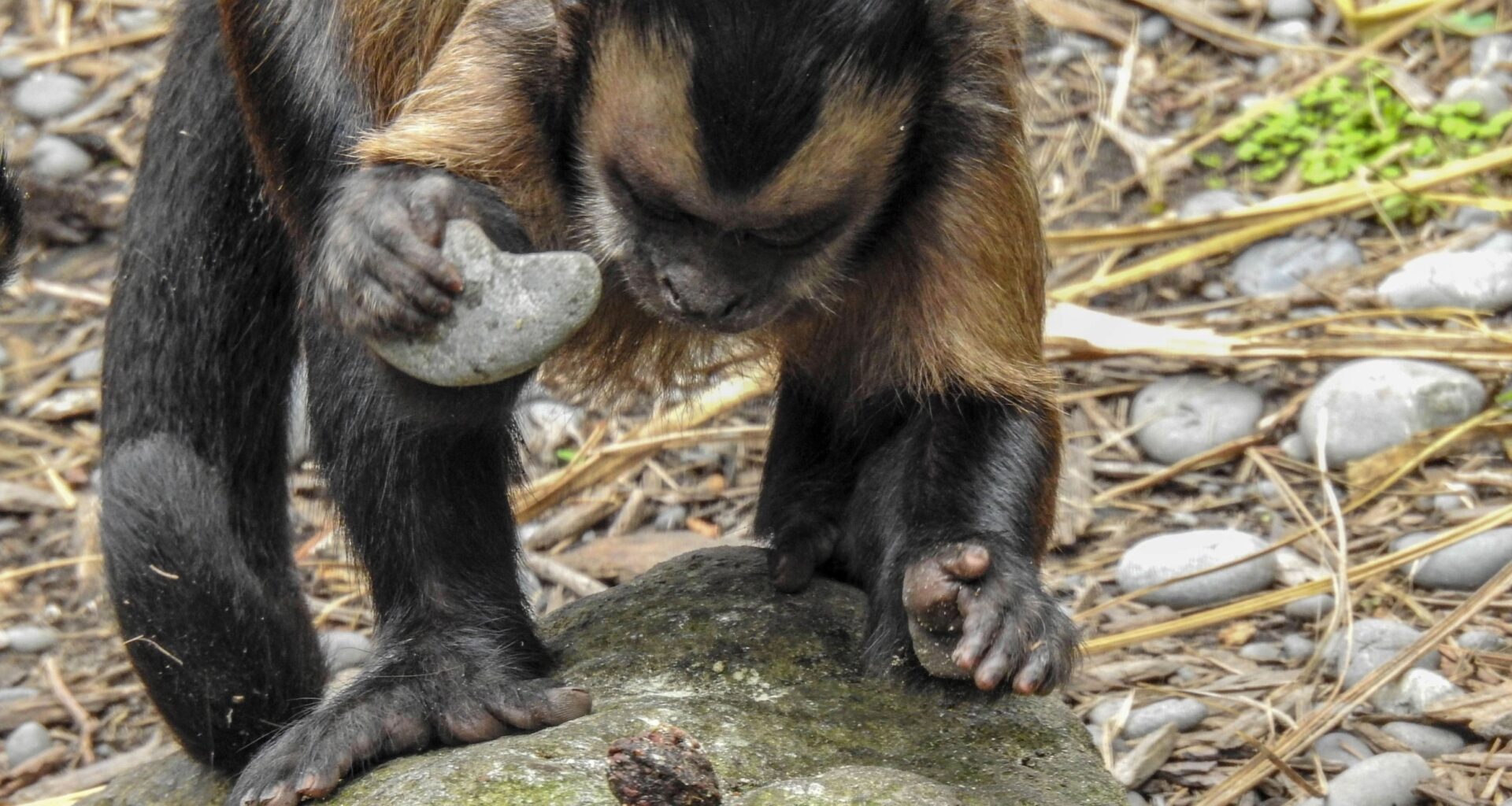
Tool use gives some animals access to foods that teeth, fingers, or claws cannot easily open.
Yet using a tool is only part of the challenge because the animal must also choose an object with the right qualities for the job.

Wild bearded capuchin monkeys in Brazil crack nuts by placing them on a flat stone, called an anvil, and striking them with another stone, called a hammerstone.
New findings show that these monkeys judge both stone hardness and visible signs that a tool has worked before.
The monkeys joined voluntarily, and each animal already knew how to crack nuts with stones. Researchers offered blocks of hard sandstone and softer limestone that matched in size and shape.
When the stones were clean and unused, the monkeys usually chose softer limestone as the anvil.
They preferred harder sandstone as the hammerstone, suggesting that they matched each material to a different function.
“What surprised us was how consistently the monkeys distinguished between stone types based purely on hardness, with no prior visible use,” said Johanna Henke-von der Malsburg, the first author.
“This suggests that functional stone selection is not just a habit; it demonstrates genuine awareness of the physical requirements of the task.”
Henke-von der Malsburg conducted the work at the Max Planck Institute for Evolutionary Anthropology.
Used stones attract monkeys
The second task offered a clean nut-cracking area and another area with battered stones and broken nutshells.
The monkeys strongly preferred the used area while still favoring softer anvils and harder hammerstones.
The marks and shells acted as indirect social information, meaning evidence left by other animals.
The capuchins did not need to witness another monkey cracking a nut to recognize that a place and its tools had worked before.
Learning from other monkeys
“This is a striking case where social information appears to override an individual’s assessment of physical properties,” said Lydia Lunz, the senior author of the study.
“The monkeys didn’t need to see another individual crack a nut. The traces left behind – the damage to the stone – were enough to guide their decision. This is a subtle yet powerful form of social learning.”
Lydia Lunz leads a group at the Max Planck Institute for Evolutionary Anthropology.
Visible wear changes decisions
The third task placed clean and battered stones together, allowing prior use and hardness to compete directly.
For anvils, the monkeys preferred stones that looked used, even when those stones were not the material favored in the first task.
The same pattern did not clearly appear for hammerstones. Once wear became visible, the monkeys showed no reliable preference for hammer hardness or previous use.
Repeated pounding can create shallow hollows in an anvil, which may help keep a round nut from rolling away. However, the experiment did not prove that useful hollows drove the monkeys’ choices.
The results suggest that capuchins can learn from changes that other tool users leave in the environment.
This process differs from direct copying because the learner encounters the evidence after the original action has ended.
A damaged stone or pile of nutshells may guide an animal toward a useful location. Repeated visits could help keep a local tool tradition going even when no teacher or demonstration is present.
This kind of learning may help behaviors pass between generations. Young animals can encounter old tools and food remains even when they miss the moment skilled group members created them.
The experiment could not separate the influence of broken shells from the influence of stone damage in the second task. Both clues appeared together, so further work must test them one at a time.
Although the monkeys showed clear preferences, their chosen materials did not measurably improve nut-cracking success.
Stone type also did not change how quickly successful monkeys opened nuts or how many strikes they used.
Success became more likely during later trials, suggesting the monkeys adjusted to unfamiliar materials.
However, every stone combination could open the nuts, and all participants were already experienced tool users.
The group at Serra da Capivara National Park succeeded more often. The monkeys at Parque Ecológico do Tietê faced different foods, local stones, and feeding conditions, which may have affected the comparison.
Limits shape the findings
The third task included only 73 trials, far fewer than the first two tasks. This smaller amount of evidence may have made subtle hammerstone preferences harder to detect.
The blocks were cubes, unlike many rounded stones at natural nut cracking sites. Researchers also created the wear marks, so the setup could not copy every detail of naturally used tools.
These limits mean the findings show strong selection patterns, not a complete account of decisions in the wild. They also do not prove that visible wear always outweighs stone quality in every setting.
Stone tools can remain in a landscape long after their users leave.
Their presence may influence where later animals stop, which objects they handle, and which places become centers of repeated activity.
“If modern wild primates can be guided by the accumulated evidence of past tool use, this raises important questions about how early hominins may have related to their discarded tools and worked stones,” said Lunz.
“The archaeological landscape itself may have functioned as a kind of external memory, influencing where and how tool traditions emerged and persisted.”
Early hominins were ancient members of the human family whose behavior is often reconstructed from stone remains.
The capuchins cannot reveal exactly why early hominins returned to particular places.
Still, the findings support the possibility that visibly used stones encouraged repeated visits because they carried evidence of earlier success.
Capuchins weigh physical properties when no signs of use are present, but old marks can become more important when they appear.
The findings show how skill and social information can work together without direct teaching or imitation.
The study is published in the journal Proceedings of the Royal Society B: Biological Sciences.
—–
Like what you read? Subscribe to our newsletter for engaging articles, exclusive content, and the latest updates.
Check us out on EarthSnap, a free app brought to you by Eric Ralls and Earth.com.
—–