
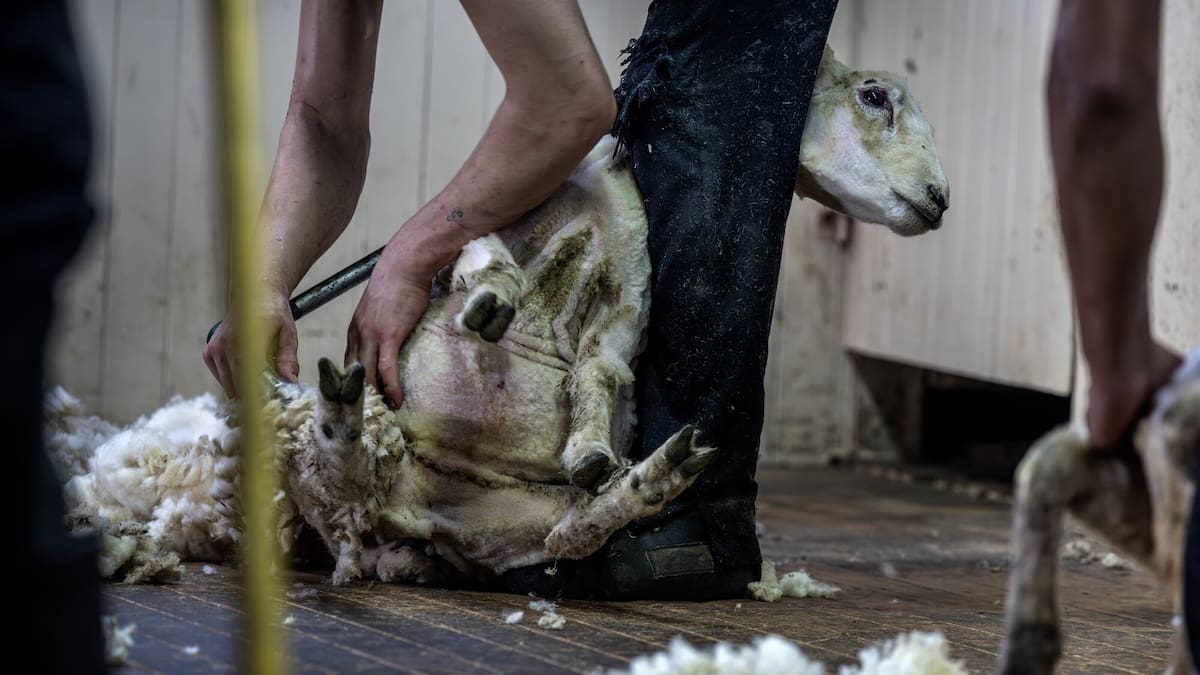
Later the same day, he grabbed another lamb by both front legs, swung it and threw it over a 1m-high wall into a pen of sheep behind him.
The following day, shearing at Hunter Hills, he grabbed a lamb by the back and neck and threw it face-first into wooden swing doors.
A vet who examined footage of each incident said the lambs would have suffered unnecessary pain and distress as a result of the violent impact against wooden doors, with bruising and inflammation causing ongoing pain for hours to days.
Manthey was sentenced to six months’ community detention and 12 months’ supervision after pleading guilty to three charges under the Animal Welfare Act.
The maximum penalty for each charge is 12 months’ imprisonment or a fine of $50,000.
The end sentence took into account two driving offences he was charged with by police.
Manthey had no previous record of animal-welfare offending.
The Herald can reveal that two other shearers also caught in the same Peta expose have both pleaded guilty but are yet to be sentenced.
One is due to appear at the Oamaru District Court on August 27 and another at the Hastings District Court on September 2.
A warrant has been issued for a fourth shearer who failed to appear in court and a fifth shearer, a foreign national not currently in New Zealand, remains under investigation.
Sheep farming contributes billions in export earnings to New Zealand’s economy. Photo / Mike Scott
‘Deliberate abuse’
The Peta operation was an 11-month undercover investigation involving 34 New Zealand sheep farms and a slaughterhouse between November 2023 and October 2024.
The group handed more than 230 video files to the Ministry for Primary Industries (MPI) in December 2024.
After Manthey’s sentencing, MPI director of investigations and compliance support Gary Orr said staff spent thousands of hours studying 560 hours of video evidence to identify shearers abusing sheep.
“This is unacceptable and falls well short of our expectations,” Orr said.
“We know the vast majority of shearers don’t resort to abusing an animal when the work is challenging. When we find evidence of deliberate abuse, we take action.”
Peta claimed the animal abuse, which included beating, kicking, and throwing petrified sheep down chutes and slamming them into floors, happened on farms throughout the country.
It urged the courts to impose maximum sentences on offenders.
The animal rights group was also highly critical of the NZ Merino Company – since renamed Zentera Wool.
Some of the farms included in the Peta filming were certified under the organisation’s wool standard, ZQ, which adheres to ethical animal handling.
Zentera launched independent investigations, implemented welfare-focused spot inspections and instigated a 24-month in-shed camera trial across a number of its ZQ-certified properties – a measure it says it would have pursued regardless of Peta’s intervention.
The expose sparked calls for mandatory cameras in shearing sheds, similar to those already required on commercial fishing vessels to monitor compliance at sea.
New Zealand’s meat and wool sector was forecast to earn $13.2 billion in exports in the year to June 2026, according to MPI’s Situation and Outlook for Primary Industries report.
Wool contributes a small share of the total earnings – about $460 million in forecast export revenue – as most sheep shorn in New Zealand are destined for meat processing.
Sheep meat is forecast to earn $4.4b this year.
Mike Scott is a senior visual journalist at the New Zealand Herald. His work spans writing, photography and video and he has won numerous journalism awards, including Videographer of the Year and Best Documentary. He has worked in media for more than 25 years, producing stories across New Zealand and internationally.
Sign up to The Daily H, a free newsletter curated by our editors and delivered straight to your inbox every weekday.