
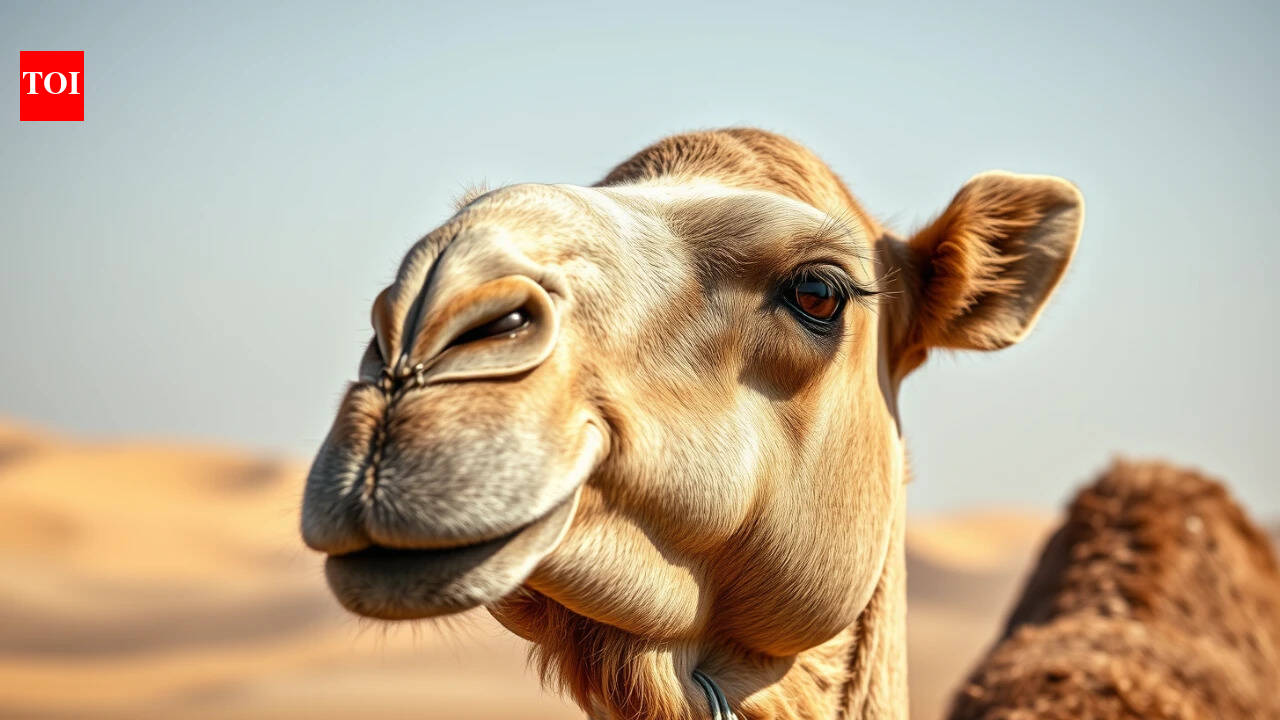
 Bactrian Camel (AI-generated image) In the remote Gobi Desert spanning northwestern China and southwestern Mongolia, a critically endangered animal survives by drinking water saltier than the ocean itself, a level of salinity that would be intolerable to almost any other mammal. The wild Bactrian camel, known scientifically as Camelus ferus, is genetically distinct from its domesticated two-humped relatives and remains the only truly wild camel species left on Earth. Fewer than 1,000 individuals are now thought to survive, scattered across some of the most inhospitable terrain on the planet, and despite decades of research, scientists still cannot fully explain how these camels process water that would overwhelm the kidneys of virtually any other large mammal.
Why the wild Bactrian camel is a genuinely separate species
Genetic testing has confirmed that the wild Bactrian camel is not simply a feral population descended from domesticated animals that escaped into the desert. According to conservation groups tracking the species, skin samples taken from dead wild camels showed a base genetic variation of around 3 per cent when compared to domestic Bactrian camels, supporting the conclusion that surviving wild herds represent genuine remnants of the original wild population rather than domesticated escapees. In Mongolia, the species is known as the havtgai, or flathead, a name referring to its distinctive forehead shape.This genetic distinction carries real conservation weight, since interbreeding between wild and domestic camels can dilute the genetic integrity of an already small and fragile wild population. Wild camels living in China’s Gashun Gobi region remain completely isolated from domestic herds, making these particular animals especially valuable to the species’ long-term survival.
Why its saltwater tolerance remains scientifically unexplained
According to the EDGE of Existence programme, run by the Zoological Society of London, wild camels in parts of the Chinese Gobi survive by drinking salty slush, since no fresh water source is available to them at all; water researchers have described it as intolerable to any other mammal. This tolerance is not simply a trait shared broadly across all two-humped camels; domesticated Bactrian camels cannot process water with anywhere near the same extreme salt content the wild species regularly consumes.Exactly how the wild camel absorbs this water and expels the excess salt without suffering apparent harm remains unresolved, a genuine open question in the scientific understanding of the species that ongoing research has yet to fully answer.
Why population estimates remain difficult to pin down
According to the Zoological Society of London’s own conservation project, current estimates place roughly 600 wild camels in China and around 450 in Mongolia, while describing the total global population as fewer than 1,000 animals, figures that do not always align neatly across different surveys and sources. Producing a fully reliable count has proven genuinely difficult given how scarce, widely dispersed and remote the species’ habitat is, compounded by harsh weather conditions and logistical challenges that have complicated previous survey efforts.A pilot camera trap study launched in April 2019 placed 180 camera traps across Mongolia’s Great Gobi Special Protected Area A, with scientists, rangers and border patrol officers monitoring the area through October 2021 as part of a collaboration involving the Wild Camel Protection Foundation, ZSL and Prague Zoo, gathering imagery intended to support more accurate population modelling going forward.
How the camels survived decades inside a former nuclear test zone
Part of the wild camel’s remaining range in China’s Gashun Gobi overlaps with a former nuclear weapons testing area, where the animals endured more than 43 atmospheric nuclear tests. There is no evidence the species evolved any specific radiation resistance as a result, but the site’s extreme isolation likely offered indirect protection, since testing-era restrictions kept most human activity out of the area, limiting hunting and disturbance during that period.That protection did not last. John Hare, founder of the Wild Camel Protection Foundation, told BBC News in 2001 that the area’s remoteness had helped preserve the camels, while also noting that hunters and miners had increasingly begun entering the former test zone once nuclear testing stopped, with land mines subsequently found placed near saltwater springs the camels depend on for survival.
What continues to threaten the species today
Threats to the wild Bactrian camel vary across its range. Wolves remain a significant predator in the Mongolian Gobi, while illegal hunting and mining pose greater risks further south in China. Broader pressures affecting the entire population include habitat loss, land degradation, climate-driven desertification and ongoing hybridisation risk from contact with domestic camels. The IUCN listed the wild camel as critically endangered in 2002, and ZSL describes it as the eighth most endangered large mammal alive today.
What conservation efforts are currently underway
The Wild Camel Protection Foundation has helped establish the 175,000 square kilometre Lop Nur Wild Camel National Nature Reserve in China, alongside a captive breeding programme at Zakhyn Us in Mongolia designed to maintain a protected population insulated from immediate threats in the wild. Current research in Mongolia, carried out through a partnership between ZSL’s Institute of Zoology, the Wild Camel Protection Foundation, the University of Kent and the University of Veterinary Medicine Vienna, is examining inbreeding within the captive population, remaining genetic diversity among wild camels, and the extent of hybridisation between wild and domestic herds, work intended to inform a national management plan for the species going forward.t data remains genuinely difficult across such an immense and remote stretch of desert.