
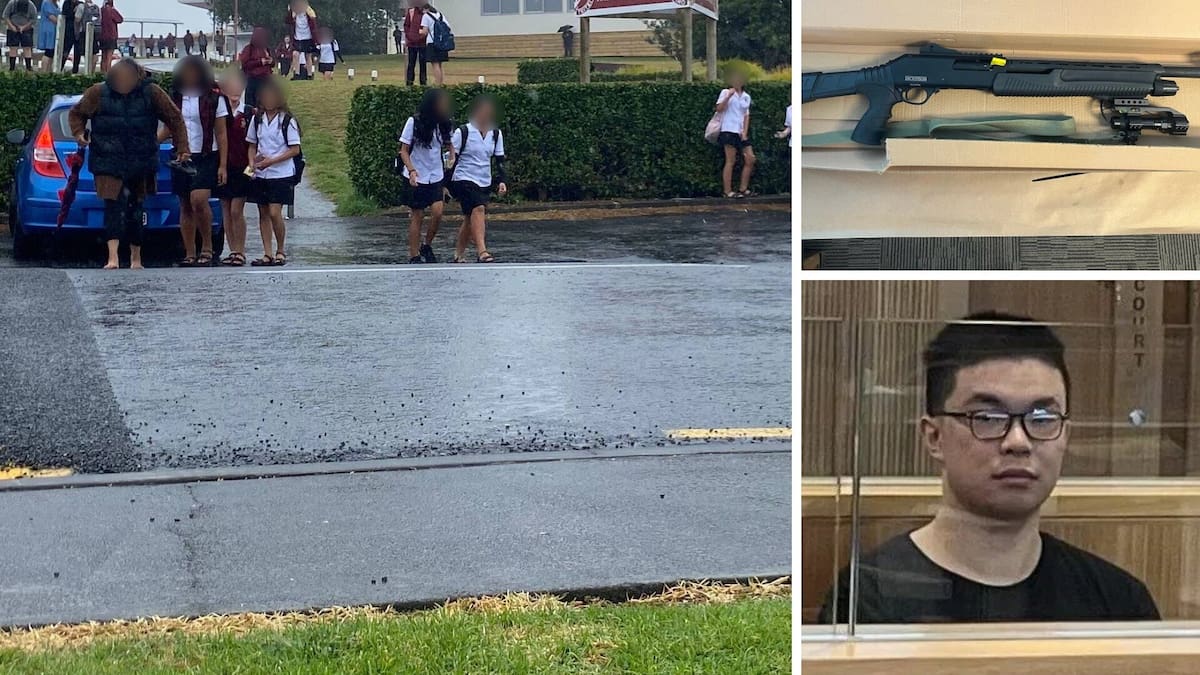
Homemade, 3D printed weapons were mentioned in a “manifesto” threatening a mass shooting that was emailed to two schools last March, causing one to go into lockdown.
Huo, 22, is on trial in Manukau District Court, defending 12 charges relating to the threats and possessing a shotgun, ammunition and objectionable publications – including notorious mass shooter manifestos.
Yesterday, in the second week of the trial, the court heard from the detective who first spoke to Huo after his arrest.
A video of the accused’s police interview was also played.
Detective Martin Robinson told the court that on March 13, 2025, the day after the threats were sent, police searched Huo’s South Auckland home.
Robinson said Huo was taken into the backseat of his car, put under arrest and read his bill of rights.
The detective believed Huo could see some printouts of his Facebook account in the front seat and therefore offered up some information.
“Can I just say something about my account?” Robinson recalled Huo asking. “I had political stuff on it about a year ago.”
Later that morning, Robinson took Huo to the Manukau Police Station and began a video interview that was played in court.
In the interview, Huo corrected what Robinson had recorded in his notebook from the car about him saying he only heard about 3D guns “in the movies”.
Huo said the detective was mistaken, that he had actually made two statements in the car: one that he had seen them on the news and secondly that he had seen “something about ammunition” in a movie.
He also clarified comments he made in the car that Facebook had “dropped off” since Brenton Tarrant’s 2019 mosque terror attack.
He said he meant “no disrespect” to the victims of the attack, but the social media site “dropping off” post-tragedy was one of the “biggest reasons” he didn’t use it any more.
“I’m assuming it’s something to do with the bad publicity due to Facebook allowing the video to stay up for a bit too long,” Huo said in the interview.
It is the Crown’s case that two laptops and a USB stick found in Huo’s home all had Tarrant’s manifesto and footage of the massacre on them.
Huo also said in the interview that the “political stuff” he had on his Facebook was just “random”, as well as a collage he made of the Tiananmen Square massacre.
He said it was mostly “s***posting” and memes on his account, but nothing “harmful in its own right”.
Tiedan Huo on the first day of his trial at Manukau District Court. Photo / Ella Scott-Fleming
Empty shotgun shells
As the interview was progressing, Robinson told the court, he was learning of things found in the search of Huo’s South Auckland home, including many empty shotgun shells.
He asked Huo about them.
Huo said his mother had several tenants who were sometimes in trouble with the law and could have left the empty cartridges behind.
He was also asked about a press that was found at the home that could be used to make bullets.
Huo said he had previously studied mechanical engineering and had built the press as part of his schooling.
He also said he had a phone but no laptop and used his mum’s desktop computer when he needed to.
“I’ll tell you one thing though, the tenants, they love leaving old laptops.”
In the video, they talked about how Huo had handed his phone over to police, but that the password he had given them didn’t work.
Huo explained he must have changed his password and forgotten it, which Robinson commented was “strange”.
A modified 12-gauge pump-action Dickenson shotgun found at one of the homes of Tiedan Huo.
Sender: unknown
The court has heard over the past two weeks that the school shooting “manifesto” had the name of a teenage girl listed as the sender, but it was sent from an encrypted, untraceable email address.
The initial investigation led police to the girl, a former student of one of the schools targeted by the threats, but she pointed them to Huo, telling them that she, her father, the defendant and his mother had lived together in 2024.
Huo’s mother told the court this week she was in a relationship with the girl’s father for about 10 months until it soured after he stole more than $200,000 from her.
When talking to Robinson at first, Huo said he didn’t know the girl. He later said they might have seen each other but he’d never been introduced.
Questioning moved on to the encrypted email server where the “manifesto” was sent from. There was evidence of that server being accessed on the mother’s desktop too, the detective said.
Huo asked Robinson if the encrypted email account belonged to “that ‘K’ person”. Robinson said he was confused and Huo explained, “that person who sent the threats”.
The Chinese name of the girl, which the detective had given to Huo, did not have a “K” in it but her English name, which was used in the email, did.
“I never told you that, but I believe that you know that,” Robinson told Huo in the interview. “I believe you are the person who sent that threat.
“I believe you’re changing your story every time I present new information to you.”
Huo said he knew it would look “objectively better” if he admitted to living with the girl and her father, but he said he had not.
“I’m not changing my story on that one,” he said. “Even though it sounds weird.”
The detective brought out the manifesto to show Huo.
“Holy, that is long,” Huo said.
The loaded Dickinson shotgun as it was found in a bed in a room in Tiedan Huo’s mother’s Waikato home. Huo denies the bedroom and gun were his.
In the video, Robinson began to be updated on the search of Huo’s mother’s other home, in rural Waikato, where the detective told him they found a knife, a 3D printer and a loaded shotgun in his bedroom.
Huo said it wasn’t really his bedroom anymore and was more used for storage.
“Why would a shotgun be wrapped in a blanket in your bedroom?” Robinson asked.
“My guess is because I wasn’t staying there any more,” Huo replied.
Robinson again pointed out Huo’s inconsistencies, claiming to not know about guns, 3D printing and the teenage girl, despite others saying he had lived with her.
“I know,” Huo responded. “Unfortunately, I’m not going to change my story just because it might be objectively better for me.”
The trial continues.
Ella Scott-Fleming has been a journalist for three years and previously worked at the Otago Daily Times, Gore Ensign and Metro Magazine. She has an interest in court and general reporting. She’s currently based in Auckland covering justice-related stories.
Join the NZ Herald’s Open Justice team for Case by Case, a video and podcast series examining the disputes and decisions making headlines across New Zealand.