
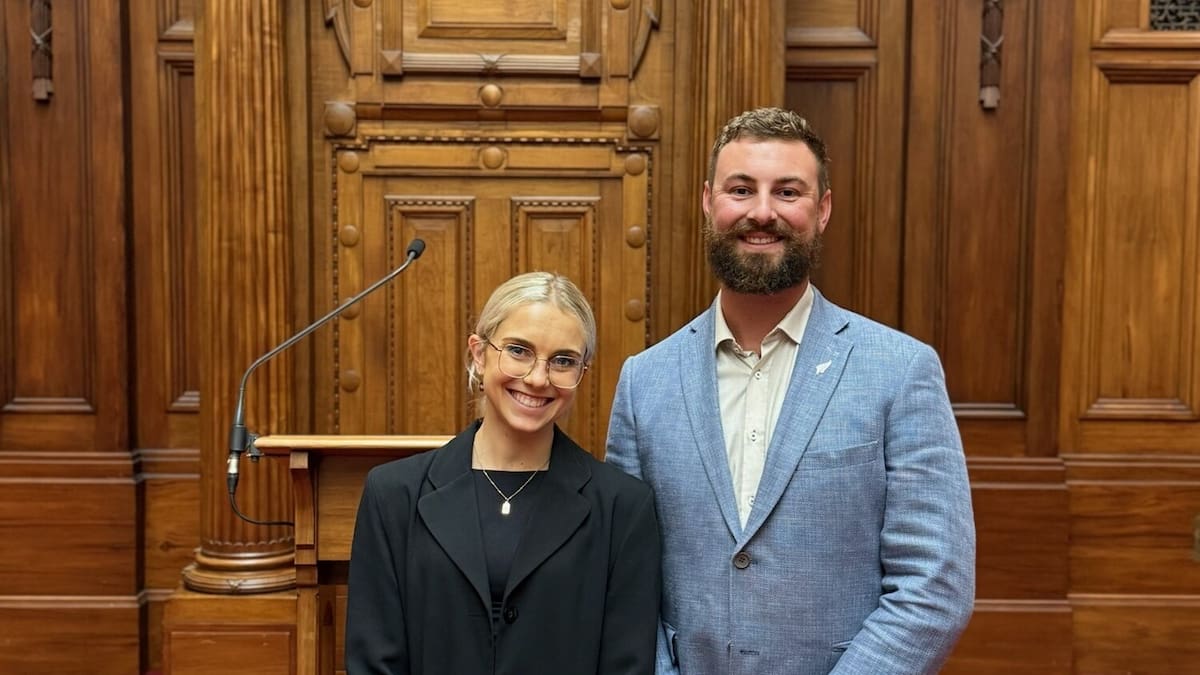
“Our food and fibre sector has been built on resilience, ingenuity and an unshakeable connection to the land,” co-chair Aimee Blake, a sixth-generation dairy farmer from Clarks Beach in South Auckland, said.
“Kiwi farmers and growers have always adapted to pressures and found opportunities in times of change.
“We believe we are at another pivotal moment where New Zealand can lead the world in sustainable, high-value food production.”
Blake said members shared the belief that agriculture had an important role in solving many of the challenges facing society.
“Across six key recommendations, we are calling for the sector to embrace the future and evolve again.
“Together, we can shape what comes next.”
She shares the co-chair role with Katikati kiwifruit grower Daniel Kenna.
Together, they help lead an organisation driven entirely by volunteers.
Future Farmers NZ is governed by a volunteer board and supported by members who contribute in a variety of areas, from executive leadership and event organisation to communications and social media.
“Our members are involved because they genuinely care about the future of the sector,” Blake said.
“The group has been supported by volunteers, grants, sponsors and donations, and there is a lot of interest and excitement about what we are trying to achieve.”
Today, the organisation includes around 50 active members within a broader network of more than 150 people from across New Zealand’s food and fibre value chain.
Future Farmers NZ member William Kenna, hosting and facilitating the resilient landscapes modules at the AgriFutures clash of the colleges event.
The membership reflects the diversity of modern agriculture, bringing together farmers, growers, researchers, agronomists, consultants, industry professionals, entrepreneurs and university students.
“Despite having varied political and professional backgrounds, our members recognise the need for greater unity and positive change across the food and fibre system,” Blake said.
Conversations about agriculture can often become politically charged, but she said the organisation prides itself on maintaining a constructive and solutions-focused approach.
Future Farmers NZ April Hui 2026: Daniel Judd, left, Jon Pemberton, moderator Eve McCallum and scientists Anna Earl and Nick Kirk.
“We are a non-partisan group. The conversations are curious, respectful and often challenging.
“We have a lot of academics involved, which adds rigour to our discussions, while our farmers and growers bring practical experience.
“There is always debate and a testing of ideas.”
Alongside networking and professional development opportunities, Future Farmers NZ places a strong emphasis on collaboration.
The organisation works alongside industry partners including AgriFutures, which helps introduce young people to careers in agriculture through practical, on-farm experiences.
Future Farmers NZ co-chair Daniel Kenna, right, discussing the FFNZ Manifesto with an interested visitor at Fieldays.
A major focus has been developing its manifesto, a living document that outlines key priorities for the future of New Zealand’s food and fibre sector.
The manifesto is built around seven themes the group believes are critical to creating a resilient and prosperous agricultural future: land use design and management, forestry and carbon credits, knowledge and education, farm management, hauora and wellbeing, supply chain and innovation, and markets and finance.
Within each theme are recommendations aimed at encouraging discussion, innovation and long-term planning.
“The manifesto is designed to spark conversations and help identify practical ways New Zealand can build a stronger and more resilient food future,” Blake said.
Over the coming months, Coast & Country News will explore several of these themes in greater depth with representatives from Future Farmers NZ.
Those interested in helping shape the future of New Zealand’s food and fibre sector can learn more or become involved through the Future Farmers New Zealand website.