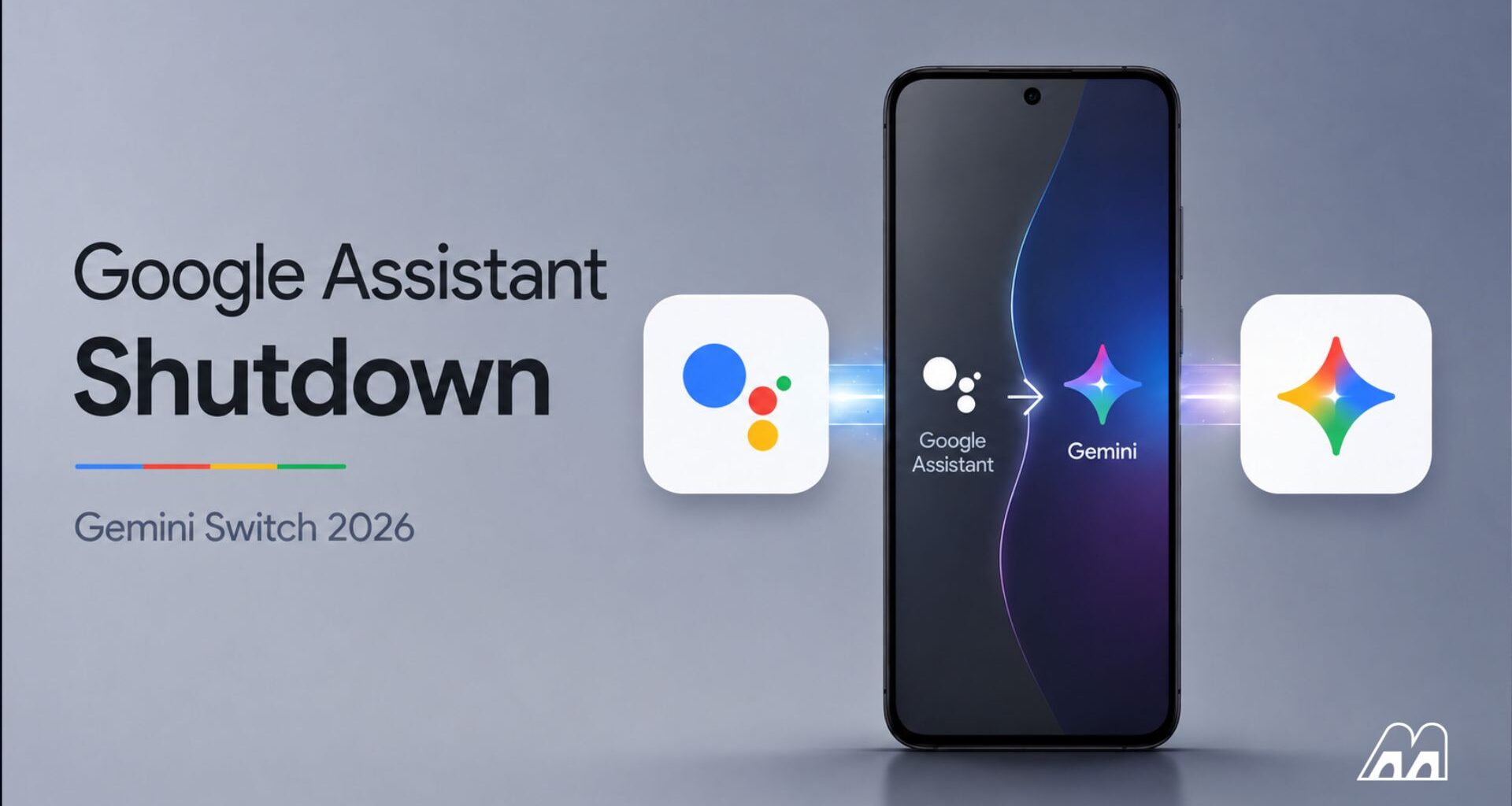
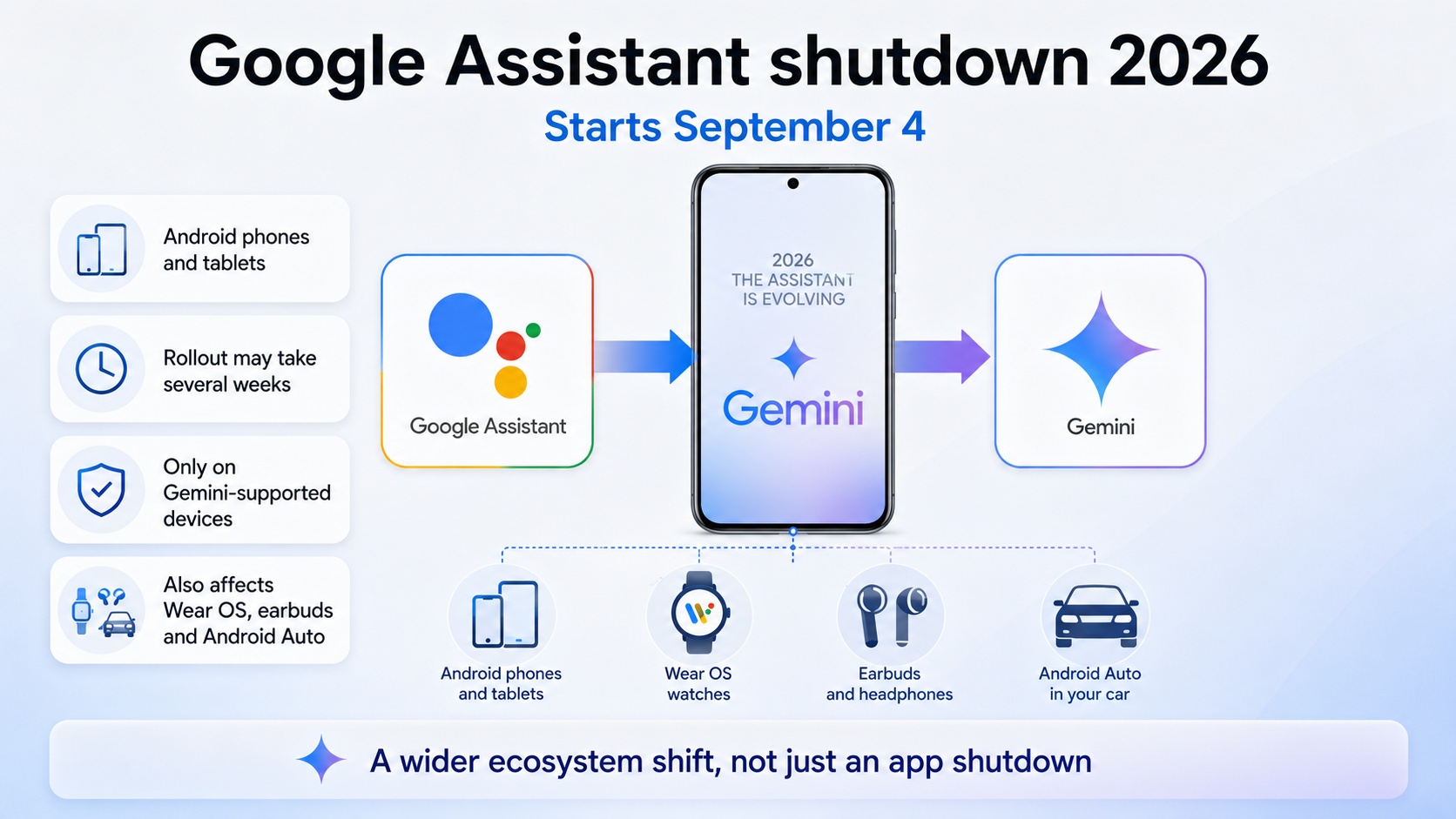
The Google Assistant shutdown 2026 will begin on September 4, when Google starts removing the legacy voice assistant from Android phones, tablets and connected devices. Gemini will take over as the default assistant on compatible devices in regions where Google’s AI service is available.
Google has started notifying users by email, according to The Verge and 9to5Google. The process may take several weeks to reach everyone. Once the change reaches a device, users will no longer be able to switch back to Google Assistant.
The deadline marks the end of Google’s long transition from a command-based voice assistant to a more capable AI system built around Gemini.
Google Assistant shutdown 2026 begins on September 4
Google will start removing Assistant from Android phones and tablets on September 4. The change will not necessarily happen on every device at the same time, since Google says the rollout may continue for several weeks.
The transition applies to users whose devices meet Gemini’s minimum requirements and whose region supports the service. Devices that do not support Gemini may not receive the same experience immediately, although Google has not provided a complete public list of exceptions.
The move also affects paired devices. Wear OS smartwatches, headphones, earbuds and vehicles using Android Auto will gradually move away from Assistant as Gemini becomes the main mobile assistant.
That makes the change larger than a normal app shutdown. Google is removing one assistant from several connected products at the same time and replacing it with a system that depends more heavily on AI model access, device compatibility and Google account integration.
Gemini will replace Assistant across Android devices
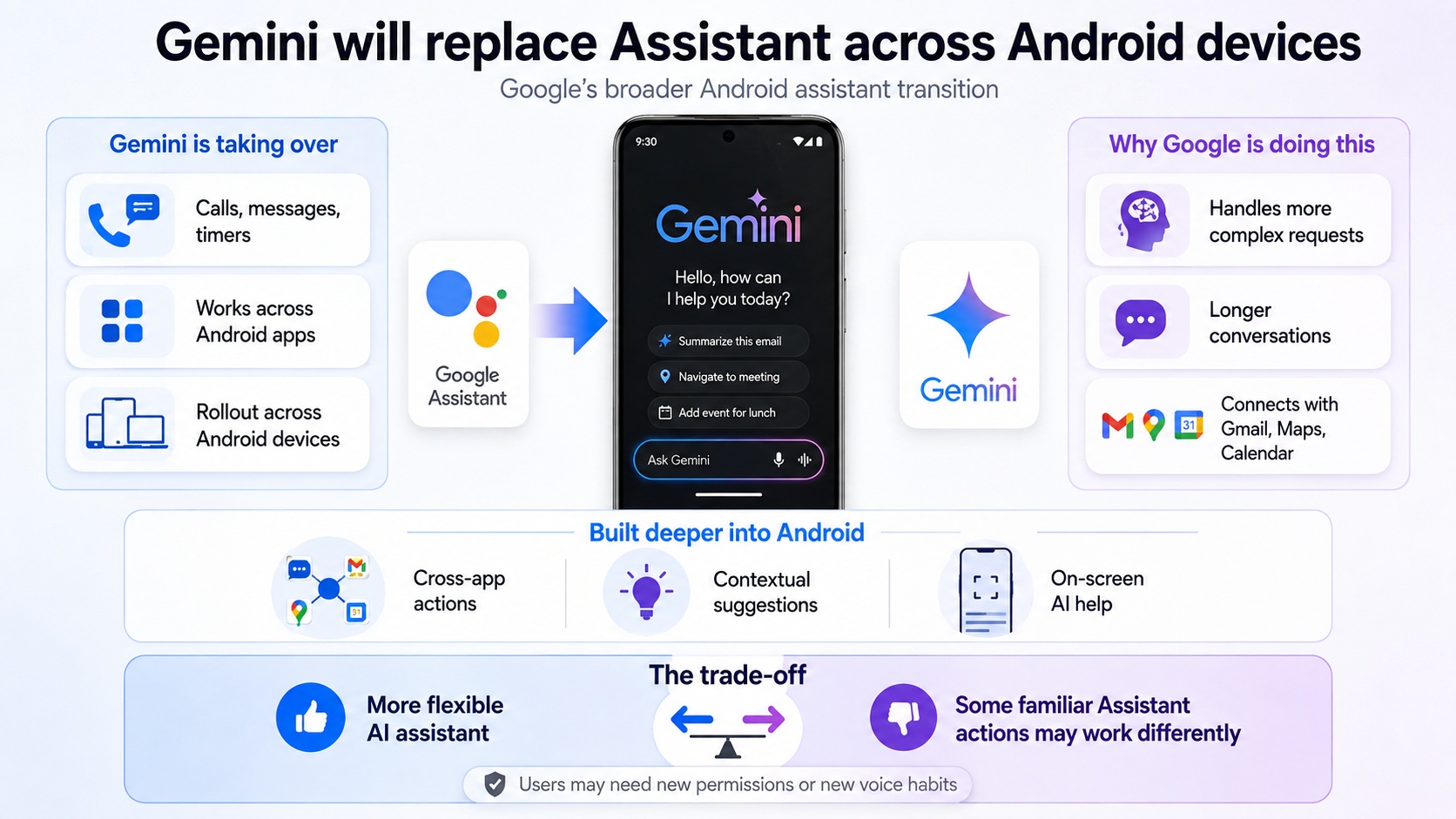
Google has spent the past year adding traditional assistant functions to Gemini. The company has been expanding Gemini’s ability to make calls, send messages, set timers and interact with other applications.
The broader plan is visible in Google’s earlier mobile Gemini transition announcement. Gemini is designed to answer more complex requests, understand longer conversations and connect with services such as Gmail, Maps and Calendar.
Google is also building Gemini into Android as a wider software layer. Recent features include cross-app actions, contextual suggestions and AI tools that can work with information already visible on the screen. This direction is consistent with the company’s broader push toward Gemini Intelligence on Android.
Still, Gemini is not a perfect replacement for every Assistant function. Some users may find that basic commands work differently, while others may need to grant new permissions or change how they trigger voice actions.
The transition therefore involves a trade-off. Users gain access to a more flexible AI assistant, but they lose the ability to keep using the older tool they already understand.
Google Home and Google TV are not affected
The shutdown is focused on mobile and mobile-connected products. Google Assistant will continue to operate on Google Home and Google TV devices for now.
Cars with Google built-in will also keep Assistant beyond September 4, according to the company’s notice. That is different from vehicles using Android Auto, which mirrors services from a connected phone and will be part of the transition.
The split suggests that Google is not retiring the Assistant brand everywhere at once. Instead, it is prioritising the areas where Gemini can directly replace voice interaction on a personal device.
That may also help Google manage compatibility problems. Smart speakers, televisions and built-in car systems have different hardware requirements and usage patterns from smartphones. Keeping Assistant active on those products gives Google more time to adjust the experience.
Android users should check Gemini compatibility
The most important question for users is not whether Google Assistant is disappearing. That part is now clear. The question is whether their current device can run Gemini properly.
Memeburn’s guide on checking Gemini support on Android phones explains which recent devices qualify and what hardware requirements matter.
Users who depend on Assistant for calls, reminders or navigation should also review Gemini’s permissions before the September rollout. They may need to update the Gemini app, choose it as the default assistant and confirm access to contacts, messages or location services.
Google’s decision also creates a clearer dividing line between older Android devices and newer AI-focused phones. Newer models are being designed around on-device AI features, larger memory configurations and tighter integration with Google’s services. Older phones may still receive Gemini, but the experience could vary depending on hardware and software support.
The Google Assistant shutdown 2026 is therefore more than the retirement of a familiar voice tool. It is Google’s attempt to make Gemini the main interaction layer across Android. The success of that strategy will depend on whether Gemini can perform everyday tasks with the same reliability and simplicity that made Assistant useful in the first place.
FAQsWhen will Google Assistant disappear from Android phones?
Google will begin removing access on September 4, 2026. The rollout may take several weeks to reach all supported devices.
Will Gemini replace Google Assistant?
Yes. Gemini will become the default assistant on compatible Android phones and tablets in regions where the service is available.
Will Google Assistant still work on Google Home?
Google Assistant will continue to work on Google Home and Google TV devices for now. Cars with Google built-in will also keep the service beyond September 4.
Can users switch back to Google Assistant?
Once Google removes Assistant from a device, users will no longer be able to switch back to it.
Marko is a tech journalist covering AI, consumer technology, crypto, and digital innovation. His work focuses on clear, accessible reporting that helps readers understand how new technologies are shaping business, finance, and everyday life.