
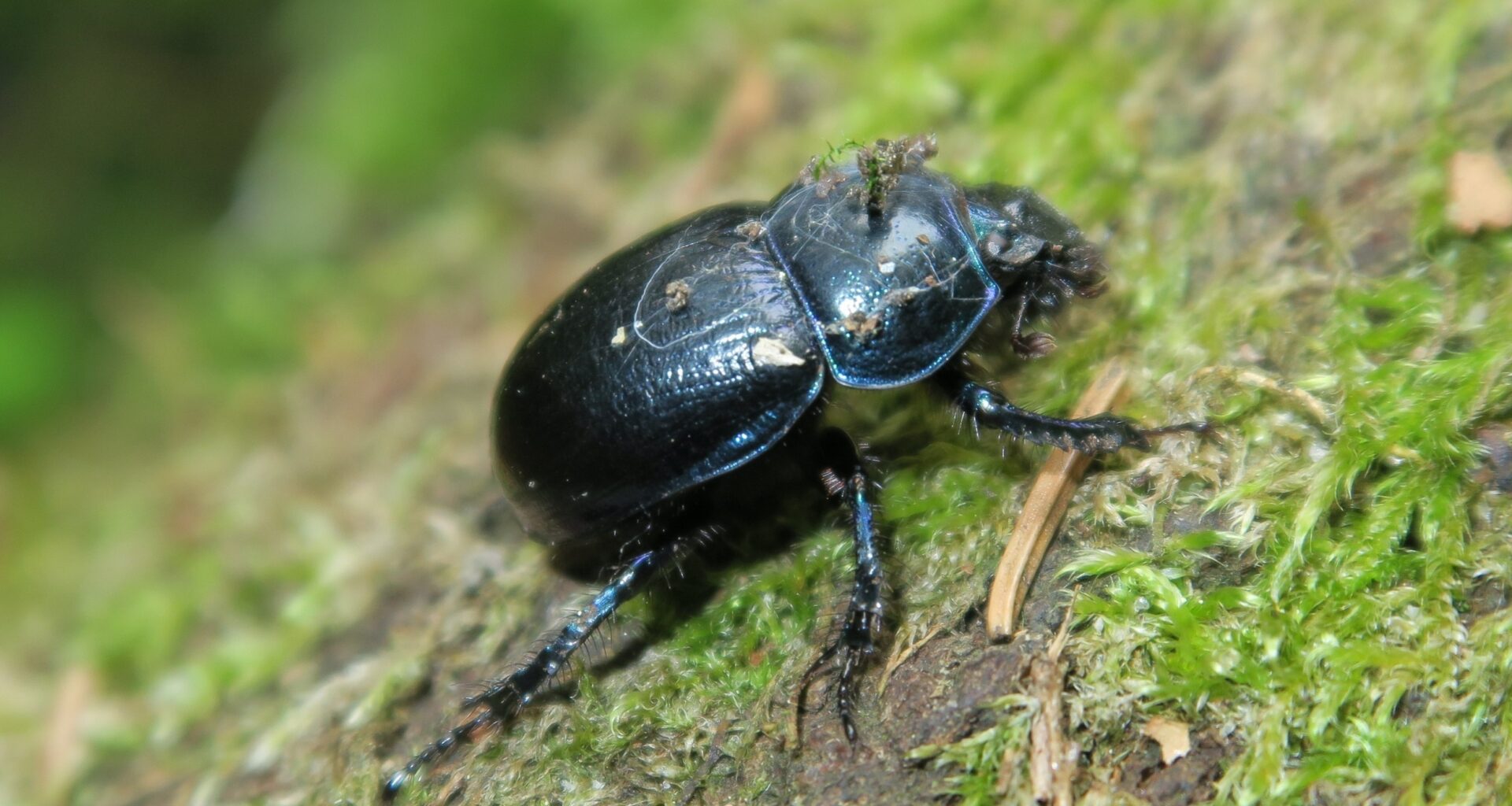
A seed doesn’t need wings to travel, just something willing to eat it. Most people picture a bird doing that job, swallowing a berry and flying off before the seed drops somewhere new.
Slugs and beetles do the same thing at ground level, and a new review makes the case that nobody’s been giving them credit for it.
Si-Chong Chen, a professor at the University of Hong Kong’s School of Biological Sciences, led the team behind it.
She worked with researchers from the Chinese Academy of Sciences, Durham University in the United Kingdom, and Kobe University in Japan.
Tiny animals spread seeds underground
None of the animals in this review are the ones you’d expect: slugs, earthworms, beetles, crickets, and crabs, all eating seeds along with the fruit or plant matter around them.
The seeds don’t die in the process. They pass through the gut and come out able to sprout.
Kenji Suetsugu, a professor at Kobe University and a co-author on the review, pointed to one example.
“A single crab can ingest over a thousand tiny seeds in a single night and later deposit them inside underground burrows,” he said.
“These humid burrows can protect the seeds from being eaten by rodents or drying out, giving them a better chance to grow.”
Hidden seed dispersers underground
Bird and mammal seed dispersal has received decades of attention for good reason.
A monkey or a toucan can carry a seed a long way from the tree it fell off. That distance cuts down competition between a seedling and its parent, and it can push a species into new territory.
Chen’s team looked for the version that happens underground, a pathway scientists call invertebrate endozoochory. In practice, that means a seed passes through a small animal’s gut and comes out alive.
Across the 43 studies the team reviewed, they found this process in at least 51 invertebrate species and 186 different plants, with records from Oceania, Asia, Europe, and North America.
“If you walk through a forest, you might think only birds or monkeys are spreading seeds,” Suetsugu said. “But beneath our feet, a hidden group of gardeners is also at work.”
Plants evolved for tiny dispersers
Chen’s team noticed something else, too. Plants that depend on ground-dwelling invertebrates tend to grow small, tough seeds tucked inside dull, plain fruit that sits close to the soil.
Bright fruit up in a tree canopy is a billboard for birds. Dull fruit down in the leaf litter is easy to miss unless you’re a slug or a beetle crawling right past it.
There may be a small bonus, too. A seed’s coat can wear down on the way through a gut, and a worn coat sometimes sprouts more easily than one that never got touched.
The seed lands afterward in soil, leaf litter, or a burrow, all places with moisture and cover.
A slug isn’t hauling a seed across a mountain range, and no invertebrate on this list gets close to what a bird can manage.
Chen said that was never really the point. “Tiny invertebrates like beetles or slugs cannot carry seeds for kilometres, but their ability to place seeds precisely at fine spatial scales is incredibly important,” she said.
“They reduce competition near the parent tree and deliver seeds into favourable micro-niches.”
Small size hid big impact
Chen thinks the field undercounted these animals for a simple reason. Each one is tiny, and one slug eating a few seeds looks like nothing next to a monkey stripping a whole fruiting tree.
“These interactions have long been treated as ecological anecdotes rather than as part of a wider framework,” she said.
“Because of size bias, invertebrates were traditionally viewed as minor players compared with mammals or birds,” she added.
“But when we look at their abundance and the number of documented interactions, their cumulative contribution to ecosystems can be substantial.”
Multiply one small act by millions of animals doing it constantly, and the total stops looking small.
“Changing our perspective helps us recognize that plant-animal partnerships are more diverse and interwoven than previously assumed,” Chen said.
Small animals fill the gap
None of this diminishes birds and mammals, and Chen’s team isn’t arguing that it should.
Long-distance dispersal still needs an animal big enough to travel far. What this review adds is a second, smaller-scale system that keeps working even when larger animals don’t.
Large mammals and birds are thinning out worldwide, squeezed by hunting, habitat fragmentation, and other human pressures. A plant that depended entirely on those animals loses its ride when they disappear.
“We are losing large mammals and birds at an alarming rate globally, which threatens the future of many plant species,” Chen said.
“In an increasingly fragmented world, these small-bodied partners offer a vital safety net, helping forest regeneration persist even as larger animals decline.”
What scientists need next
Chen’s team added no new field data of its own. Instead, the researchers went back through decades of scattered records and found a real pattern instead of a stack of one-off curiosities.
What Chen’s group wants next is a count: how often this actually happens across different habitats and how much it changes a seed’s odds of surviving and sprouting.
Nobody has measured invertebrates spreading seeds against bird and mammal dispersal across an entire forest over a season.
That number doesn’t exist yet, but it would tell conservation planners how much this smaller seed spreading system really contributes.
The full study was published in the journal Trends in Plant Science.
—–
Like what you read? Subscribe to our newsletter for engaging articles, exclusive content, and the latest updates.
Check us out on EarthSnap, a free app brought to you by Eric Ralls and Earth.com.
—–