
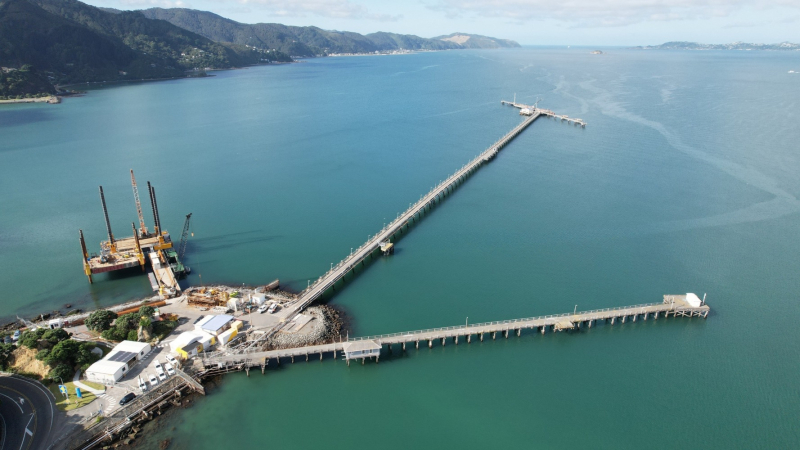
The critical pipeline supports more than 10% of New Zealand’s fuel supply.
Prime Minister Christopher Luxon doesn’t often don a hard hat and high-vis to celebrate a fuel pipeline.
But that’s exactly what happened last week on Wellington Harbour’s Seaview Wharf, where Z is nearing completion of one of the country’s most significant energy resilience investments in decades.
Alongside key delivery partners, Z welcomed the Prime Minister and Chris Bishop, MP for Hutt South, to showcase the progress made to date on this monumental project.
The Seaview Energy Resilience Project* is easy to miss, even for Wellingtonians with views across the harbour at the tank farms and tugs guiding tankers in and out every day.
Yet this industrial precinct supports about 110 million litres of fuel storage and roughly 900 million litres of annual regional fuel demand, making it a critical supply route that supports more than 10% of New Zealand’s fuel supply.
“It’s a really important piece of infrastructure and hub of fuel infrastructure for the country,” says Julian Hughes, Z’s general manager of supply.
“Our job is to make sure we’ve got the capacity to serve that into the future and withstand the sorts of shocks we’re seeing now.”
Those shocks are increasingly front-of-mind – from the Middle East conflict and Red Sea disruption to the seismic risk sitting literally beneath Wellington’s feet. That combination has sharpened public and political interest in the resilience of the country’s critical fuel routes.
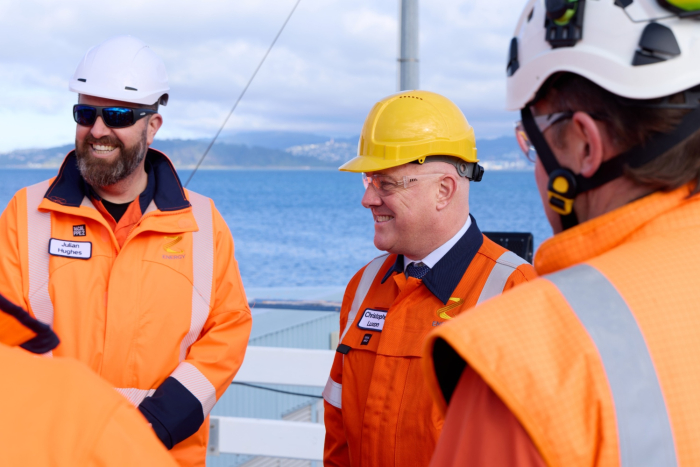 Jason Mann Photography.
Investing ahead of the crisis
At the heart of the Seaview project is a long-term bet: that liquid fuels will remain a crucial part of New Zealand’s energy mix for decades, even as the energy transition accelerates.
“Projects like this always start with ‘what if you did nothing?’” says Hughes.
“Z sees that energy precinct as a really important part of our ongoing fuel resilience, and therefore it’s a worthwhile investment because of a belief it’s going to be needed into the future.”
That belief has translated into a major upgrade of core infrastructure – a strengthened wharf led by CentrePort, a new 590m subsea pipeline laid on the harbour floor, and around 3km of onshore pipeline connecting Seaview Wharf to the fuel storage facilities in the Seaview industrial area, which is shared with other fuel importers.
Led by Z on behalf of the fuel industry, in partnership with CentrePort and delivery partner Brian Perry Civil, the total precinct investment in the Seaview Energy Resilience Project is $100 million-plus.
Building for earthquakes – and everyday shocks
The energy precinct at Seaview is located adjacent to known active fault lines, and some of its infrastructure dates back 50 years or more. The previous pipeline was physically attached to the wharf – meaning its strength and resilience were only as good as the structure it was mounted on.
A key design decision, says Hughes, was to separate the new subsea pipeline from the upgraded wharf and place it on the harbour floor. New Zealand has very few subsea fuel pipelines, so Z and its partners brought in specialist engineering expertise from Western Australia and engaged commercial divers to complete placement and connection in the water.
The pipeline is also designed to “rest on product” – always containing diesel or petrol so that incoming shipments can be efficiently discharged, which in turn demands higher inspection requirements and careful risk management. The result is infrastructure built to better withstand earthquakes as well as routine operational stresses, reducing the likelihood of disruption to Wellington and the wider lower North Island.
Partnership, penguins and community trust
This isn’t just a story of steel and concrete. Z’s long-term view has extended to community relationships and environmental stewardship, which were crucial to gaining support for such an extensive project in a sensitive coastal environment.
Z has worked closely with mana whenua, and a local ecologist to help protect kororā/little blue penguins and the local environment during construction. Measures have included exclusion zones, monitoring with Department of Conservation detection dogs, construction of kororā nesting boxes and the creation of new nesting habitats away from construction activity.
Z also worked closely with Kōkiri Marae, with the original pipeline running directly underneath the carpark. Following discussions with the marae, and after exploring alternate options, it was agreed to re-route the pipeline with a new 1.9km pipeline installed in Port Rd, so as to avoid the marae on Barnes St.
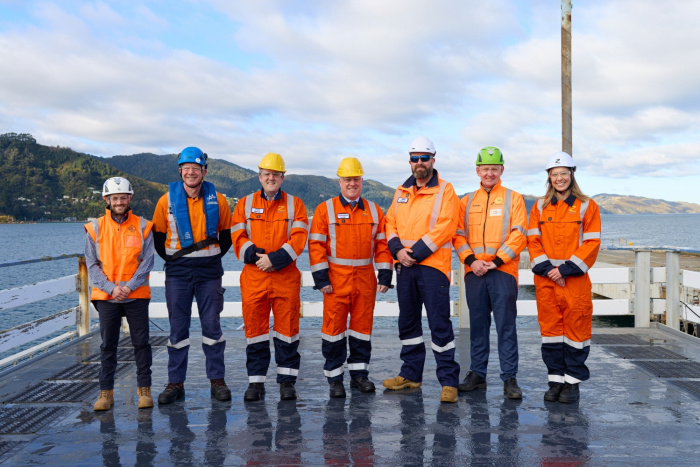 Jason Mann Photography.
A long-term signal from Z
The Prime Minister’s and Hon Chris Bishop’s visit to Seaview comes as other big-ticket infrastructure schemes around the country face delays, and some industrial operators pull back in the face of high energy costs and global volatility. Against that backdrop, Z’s strategy stands out for its combination of future‑proofing and pragmatism.
Z invests $80-100 million every year maintaining existing fuel infrastructure nationwide. At the same time, it is supporting customers on their transport energy transition journeys, with its public EV charging network covering a total of 213 bays across 63 sites, and commissioning new jet fuel storage at Marsden Point – a 30 million-litre tank opened only weeks before the Seaview visit.
“Fuel is still the largest energy source consumed in New Zealand – about 50%, with electricity around 25%,” Hughes notes.
“Fuel use will decline over time, but it’s still decades in the making. It feels pretty good to be part of a business that sees a future and is investing in that future.”
The Seaview Energy Resilience Project, now in its final stretch with completion expected later in 2026, is a tangible demonstration of that conviction. After eight years of planning and construction, Z and its partners are preparing to commission a pipeline and wharf upgrade that will have “another 50+ years’ life in it,” says Hughes.
For Wellington, the lower North Island and the national economy, it signals that, even amid volatility and transition, some companies are willing to put a stake in the ground – and invest in the infrastructure that will keep New Zealand moving for generations to come.
To find out more, visit The Seaview Energy Resilience Project.