
Credit: Far Out / Alamy / Album Booklet
Sat 8 August 2026 19:30, UK
By 1987, U2 had transcended the status of being just another rock band from Dublin when their fifth album, The Joshua Tree, turned them into one of the biggest bands on the planet.
Live Aid had cemented Bono as one of rock’s defining frontmen, and the group suddenly found themselves on the precipice of something much bigger, where the question was no longer whether U2 could conquer America, but about what would come next.
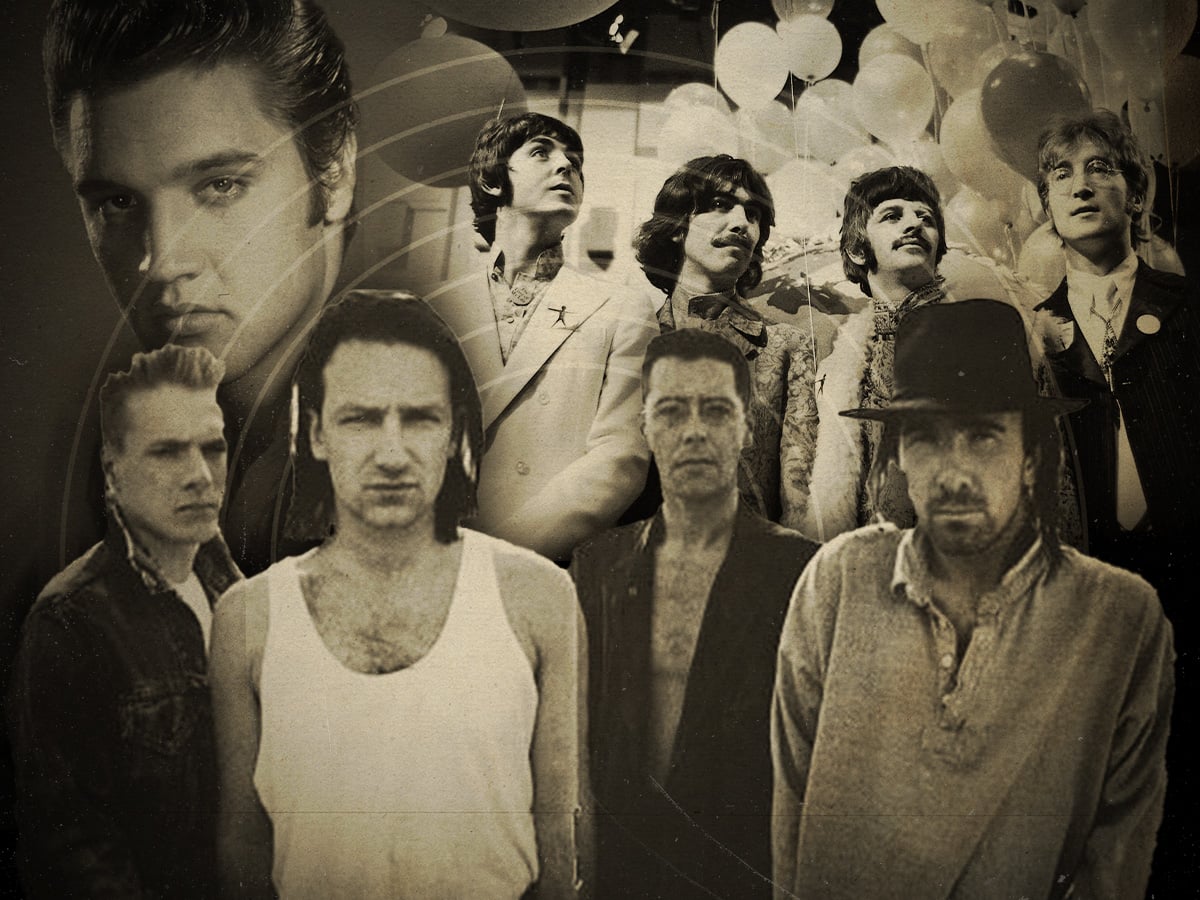
For manager Paul McGuinness, the answer lay in music history and looking at two men he admired above almost anyone else: Elvis Presley’s manager Colonel Tom Parker and The Beatles’ Brian Epstein. Both had the foresight to understand that music could be something bigger than simply records and concerts, as McGuinness explained, “I was very keen on the idea of going wide at a time like that, just seeing how big this thing could get. I had always admired Colonel Parker and Brian Epstein for realising that music could capture the imagination of the whole world.”
That ambition eventually became 1988’s Rattle and Hum, the concert documentary that attempted to capture U2 at the precise moment of their entry into the big leagues, and to that end, while touring America in 1987, filmmaker Phil Joanou was invited to meet the band in Hartford, Connecticut, through a mutual connection of McGuinness.
However, despite pitching the idea for a tour documentary, he suggested they hire established directors such as Martin Scorsese, Jonathan Demme or George Miller instead, but the band liked Joanou and wanted to see more of him, so they disagreed and subsequently invited him to travel with them to Dublin the following day.
 Credit: Far Out / Orion Pictures
Joanou, who at the time was in post-production on his debut feature film, Three O’Clock High, reluctantly said yes, and over the course of the next five days, Bono and The Edge repeatedly left him to fend for himself, dropping him at dinner parties with unknown people, abandoning him at an Irish wedding and even leaving him alone in pubs, expecting him to make conversation with complete strangers before finding his own way home.
Regardless, the band’s obscure approach to an interview worked somehow, and by the end of the week, they decided Joanou was the right person to tell their story. Initially titled U2 in the Americas, the film was eventually conceived as a document of the band’s relationship with the country that had embraced them, but production was hardly a straightforward affair.
Original plans to film in Chicago and Buenos Aires were abandoned due to budgetary and production issues, with the shoot relocated to Sun Devil Stadium in Tempe, Arizona, while Joanou operated the camera himself and sifted through more than one million feet of film to assemble the finished documentary, which was ultimately picked up by Paramount Pictures for a worldwide release.
When Rattle and Hum finally arrived in 1988, the response was far colder than anyone expected, with critics dismissing the film as self-important and accusing U2 of disappearing beneath the weight of their own ambitions. Even members of the band later admitted they felt uncomfortable with the scale of the release and Paramount’s involvement, but time has since softened those opinions, according to Joanou, who recalled to Money Into Light that Bono called him years later after catching the film on television, saying, “Hey, Phil… I caught a bit of Rattle and Hum on TV the other day, and wow… I’d forgotten how great the film was”.
In many ways, that reassessment actually mirrors the film itself. Rattle and Hum represented U2 attempting to follow the path laid down by Elvis Presley and The Beatles, wanting to prove that a rock band could capture the imagination of “the whole world”, and while whether they could remains open to debate, the fact that they were bold enough to try is, in many ways, an achievement unto itself.
ADD AS A PREFERRED SOURCE ON GOOGLE  The Far Out Beatles Newsletter
All the latest stories about The Beatles from the independent voice of culture.
Straight to your inbox.