
Her mother baked. She watched.
Annabel Langbein, the free-range cook, loved watching her mother bake when she was a little girl.
Long before television cameras or bestselling cookbooks, there was a little girl pressing mud into muffin tins, decorating her pies with flowers and berries picked from the garden.
They weren’t much good to eat. But they were beautiful to look at.
Langbein, the self-styled free-range cook, would rather invite you into the kitchen than show it off.
The bestselling author and television personality – who now calls the southwest of France home – has made a career of stripping away the fuss, making food that looks as though anyone could cook it.
And, more importantly, making you want to.
Annabel Langbein’s 17th-century home near Bordeaux.
Langbein and her husband, Ted Hewetson, have done what plenty of Kiwis dream about in the middle of winter.
They’ve swapped the Wānaka winter for summer in the southwest of France, buying a rambling 17th-century farmhouse near Bergerac.
“We looked at 84 houses, and we love this one,” Langbein told the Herald.
“But this building doesn’t have foundations. It’s built straight onto rock, limestone, so it breathes. We’ve had so much dry weather that cracks have appeared in the walls — cracks so big you can slide your hand through them.
“It’s quite disconcerting because you look at them and think, ‘Oh my goodness, is this thing actually going to fall?’ Then you remember it’s been standing here for more than 500 years, so hopefully not.”
‘Surreal and apocalyptic’: Langbein’s sadness about nearby wildfire
Sadly, many other homes of a similar vintage were destroyed in recent weeks by the wildfire that erupted during a heatwave about 120km around Bordeaux.
Annabel Langbein says the raging fires were 120km from her French farm house.
“The day the fires near Bordeaux broke out, our son Sean was flying in to visit from Berlin,” she said.
“I made the hour and 20-minute drive to pick him up. The streets were hazy and choked with smoke, and the ceaseless wail of fire truck sirens filled the air.
“It felt surreal and apocalyptic. I learned later that two firemen had lost their lives fighting this blaze.
“Even though we were about 120km from the actual fires, we woke to the acrid smell of smoke in the air. A thick pall of smoke hung around the house. You couldn’t even see down into the valley; the smoke sat like a dense winter fog.”
Everything was unsettled and jittery, Langbein said.
“The roe deer who usually come to graze contentedly at our pond overflow were flighty and restless.”
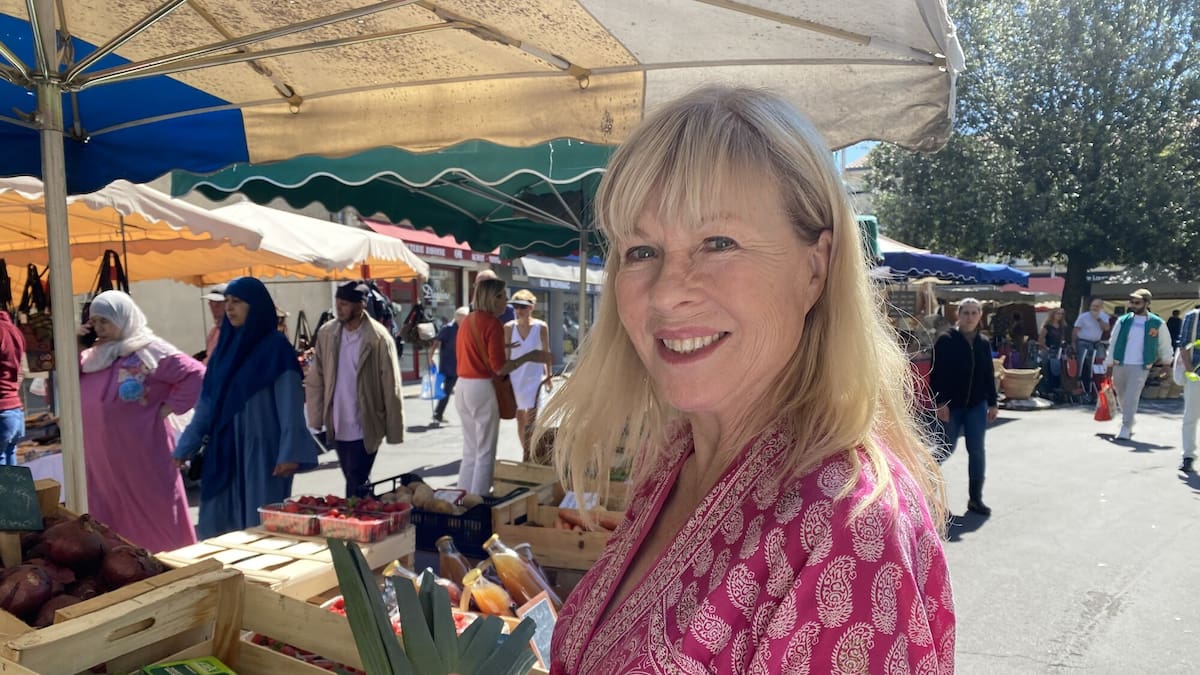
Annabel Langbein surveys the produce at a French market.
The blaze near Bordeaux impacted about 42ha of land; the biggest wildfire in France since 1949.
The fire – which continues to burn but is now contained – led to about 240,000 people being evacuated from their homes.
Langbein says she’s thankful the wildfires stopped short of her slice of French paradise; almost 20,000km from her previous Wānaka base.
The less romantic side of the French dream includes plumbing woes, electrical nightmares and cars that break down only to languish for weeks in repair shops while everything — from spare parts to conversations — gets a little lost in translation.
Langbein said she is enjoying cooking again after seven weeks without a kitchen.
Her husband ripped out the kitchen and replaced it with, she says, the carcass of new drawers, shelves and a new oven.
“We pre-ordered everything six months ago. Ted was quite clever. He found an old kitchen bench, re-plumbed it and hooked up an old dishwasher, so at least we had running water.
“The old oven was f***ed — it burnt everything. An electrician eventually got the stovetop going, so at least I could boil potatoes and put on a pot roast.
“I didn’t want to cook any more. If you put anything in the oven, it would incinerate it. It became hard work to put something on the table that you felt good about.”
Annabel Langbein says she enjoys foraging for antiques to furnish her house at the Brocante French markets.
The foraging has become more French.
Instead of combing through the bush, Langbein prowls through the brocantes, emerging with China plates, paintings, furnishings and silverware – whatever catches her eye to fill her 17th-century, seven-bedroom house with objects that look as though they have always been part of the furniture.
“It’s funny that we got rid of our old junk and replaced it with other people’s junk; it’s a great way of recycling.”
Langbein, now in her 60s, has just finished feeding friends: a shoulder of lamb, sausages, Romesco sauce, basil aioli, Greek salad, crispy roasted potatoes and wedges of chilled watermelon.
Everything was sourced from neighbouring farms.
Annabel Langbein with her daughter Rose at French markets. Langbein says food should be fresh and uncomplicated.
“When you cook, you bring people together; people are nourished on so many levels. It doesn’t have to be complicated. You’re creating a moment in someone’s day where they can laugh and be present.
“Let the produce speak for itself. You’re not running a restaurant. It’s about uncomplicated food, cooked well, and great conversation.”
Her husband Ted’s advice for anyone lucky enough to find themselves at their table is simple: arrive hungry and have something to say.
Annabel Langbein with the late Sir Sam Neill; they joined forces about sustainability and opposed gold mining in Otago.
Remembering Sir Sam Neill
One conversation matters more than most.
It’s the long one Langbein had been having with her late friend Sir Sam Neill about the future of Central Otago.
Neill died on July 13, aged 78, after contracting pneumonia.
Four years earlier he had been diagnosed with angioimmunoblastic T-cell lymphoma; a rare blood cancer.
The actor was a strong proponent for sustainability in New Zealand, supporting a number of environmental causes.
The latter included opposing a proposed – and controversial – gold mine development in Central Otago.
Neill and Langbein were both founding board members of the Sustainability Council of New Zealand; a group whose mission includes protecting and enhancing New Zealand’s ecosystems.
“Our work was ensuring New Zealand maintains its GMO-free food producer status, which is under threat with the proposed new legislation,” Langbein said.
“I think some decisions are made with vested interests.”
Sir Sam Neill and Annabel Langbein were both founding board members of the Sustainability Council of New Zealand.
“Also, Sam was a high-profile opponent of Sanatana’s mine project.”
So too is Langbein.
“I also put my name on the list of thousands of people opposing Australian mining company Sanatana’s controversial fast-track gold mine in Central Otago.”
The proposed Bendigo-Ophir gold mine near Cromwell is among the highest-profile projects being considered under the Government’s fast-track consenting regime.
It has faced strong opposition from some locals and environmentalists.
A decision on whether fast-track approval is granted could come by the end of 2026.
Before his death, Neill made a social media post where he described the proposed mine as a potential “environmental catastrophe” that could threaten “Central Otago’s pristine landscapes”.
Langbein and Neill first met through mutual Queenstown connections.
Neill also appeared in an episode of The Free Range Cook.
Each summer, Langbein says, Neill would invite her to his farm to pick saffron, berries and pears – a small seasonal ritual that became part of their friendship.
“I was hugely shocked; you don’t expect people like Sam to die.”
Every year, Annabel Langbein would pick saffron and pears at Sam Neill’s in Central Otago.
Special times in the southwest of France
It has been quite a summer for Langbein.
As well as celebrating the purchase of her dream home in Europe, she opened her doors at her Wānaka home to host daughter Rose’s wedding to her longtime partner.
Rose, 32, and Hamish, 33, live in Lisbon, while Langbein’s son, Sean, 34, is in London.
In her current slice of French paradise, Langbein looks out her window and sees a Cezanne painting.
“The land folds and rolls into the valley. Pockets of forest. Fields of sunflowers. On the horizon, an inky blue sky.”
Annabel Langbein says her view from her French house is like a Cezanne painting.
She says Bordeaux has a smell all its own: freshly cut hay, Mara des Bois strawberries with their faint scent of violets, and white nectarines ripened in the sun.
“There’s no need for a vegetable garden,” she says.
“The landscape provides its own offerings; on the table there’s a huge bowl of white onions, nectarines, cherry tomatoes, enormous purple garlic, peppers – and in the fridge there are eggs and cucumbers. It has inspired me to cook again.”
Langbein says the quality comes at a price. A whole sea bass costs around €68 ($136), while an organic chicken is €45 ($90).
Even corn is a luxury by everyday standards, at about $4 a cob.
Langbein was born in Mangakino but grew up in Karori, Wellington, the youngest of three children.
Timothy came first, then Prue.
Her father, Fred, was an engineer who loved his garden and kept bees. Her mother, Anne, was a cook and artist and made pottery.
Annabel Langbein says that after her brother took his own life, she felt reckless and became a hippie.
Her brother Tim sadly took his own life. He was 22. It was a loss that was hard for her to make sense of as a 14-year-old.
Langbein left Wellington Girls’ College after sixth form and went to Europe with her mother.
By 16 she was living in a rundown farmhouse on the Whanganui River with her boyfriend. Off the grid. No running water. No electricity. They hunted and fished. Grew vegetables.
“I think I was reckless when I was young because my brother took his own life,” she says.
“You felt nothing could hurt you. You did stupid things because you didn’t value yourself.
“I was an earnest hippie. We never took drugs. We did good work. We cleaned cemeteries and painted the marae. I turned to nature. It was incredibly healing. You can resolve a lot of things by being part of nature.”
Annabel Langbein lived near the Whanganui River without electricity and running water.
Then Langbein worked as a possum trapper in Gisborne, where she met her husband, Ted Hewetson. They married in 1991.
“When we met, I told him we’d never grow out of each other,” she says.
“He is incredibly bright, funny and curious – and he adores me. He can occasionally drive me mad, but he has always got my back. We still can’t believe how happy we are together.”
While backpacking in South America, she ran her own bar in Brazil and made croissants.
Annabel Langbein with her husband Ted Hewetson. She says he is bright, funny and curious.
In Buzios, a beach town in Brazil, Langbein discovered that all she really wanted to do was cook.
Someone asked for croissants. She phoned her mother in New Zealand – an expensive call in those days – and learned to make them from hand-drawn instructions that arrived in the post. There was no butter, so she rendered her own lard.
It was a revelation. The croissants paid for the next leg of the journey. She realised she didn’t have to choose between making a living and doing what she loved.
She could do both. And she could see the world while she was at it.
Awarded the New Zealand Order of Merit in 2018, Langbein has never received formal chef training.
She holds an honorary Diploma of Horticulture with Distinction from Lincoln University and completed a cooking course in New York.
Over the years she has written 30 books, and her television series The Free-Range Cook has been broadcast in 90 countries.
Annabel Langbein says she is more Julia Child than Nigella Lawson.
Langbein says she is more Julia Child: adorable and quirky than Nigella Lawson and admires Jamie Oliver enormously.
“He’s been a voice for change. An advocate for healthy school lunches and empowering everybody with food that is easily accessible – not trendy.”
Langbein isn’t convinced another book, or TV series featuring herself, are in the mix.
She’s content with 300,000 followers of her French life from afar, living it second-hand through her social media posts.
Lately, though, another idea has begun to simmer: a cooking school.
“I have a pointy bottom – I’m not good at doing nothing. Life is just warming up.”
Carolyne Meng-Yee is an Auckland-based investigative journalist who won Best Documentary at the Voyager Media Awards. She worked for the Herald on Sunday from 2007-2011 and rejoined the Herald in 2016 after working as an award-winning current affairs producer at TVNZ’s 60 Minutes, 20/20 and Sunday.
Tags:
- 17thcentury
- 300000
- about
- and
- annabel
- became
- been
- Bordeaux
- carolyne
- celebrity
- close
- cook
- Entertainment
- environmentalist'
- fellow
- followers
- food
- France
- french
- friend
- grief
- home
- house
- in
- its
- journey
- langbein
- Life
- loss
- mengyee
- more
- near
- neill
- New Zealand
- NewZealand
- NZ
- on
- over
- paradise
- recent
- sam
- shared
- since
- sir
- slice
- stone
- talked
- than
- wildfire
- Wildfires
- with
- writer
- year