
The announcement was a bit strange. The idea of Budget Responsibility Rules was a contrivance of Labour’s Grant Robertson and the Greens’ James Shaw, the former quite hyperbolically dubbed the “worst Finance Minister of all time” by Luxon.
But the real strangeness came from the fact that National was drawing attention to its fiscal strategy (the more formal and legal name for Budget Responsibility Rules) at all.
In 2023, National campaigned on bending the debt curve, getting expenses below 30% of GDP and, most importantly, returning to surplus by the end of the current financial year.
That last goal has been missed so spectacularly that even after changing the way in which the operating balance is measured, the coalition will still miss the original target, which has had to be pushed back.
Usually, a party tries to hide its failures and broken promises. Why, in re-announcing these rules, has National drawn attention to its own failure?
Because it quite clearly wants to force Labour to make the difficult choices it has made and start to break some promises.
Willis, on coming into office, was presented with a rather unfortunate downgrade of the economic outlook, which corresponded to a downgrade in the tax revenue she was likely to receive. These downgrades have occurred in basically every economic outlook Treasury has published in this term.
Faced with these downgrades, Willis had basically two choices: break her promise of tax cuts and prioritise cutting public spending so she could meet her surplus promise – or do the opposite, keep her tax-cut promise, cutting public spending to serve that, but missing her fiscal promise. She could not keep both her promise of tax cuts and her fiscal promise.
Wills chose the latter, keeping her tax pledge and breaking her fiscal one – and has copped considerable political flak for doing so ever since.
Labour is in a similar bind. It’s enjoying the thing all Oppositions enjoy, which is being able to promise quite a lot without having to spell out how you pay for it. In politics, life tends to be a bit easier for the Government; it has more information and resources – this is one of the few things that go in favour of the Opposition.
You can, for a time, be all things to all people, and win considerable public support in the process.
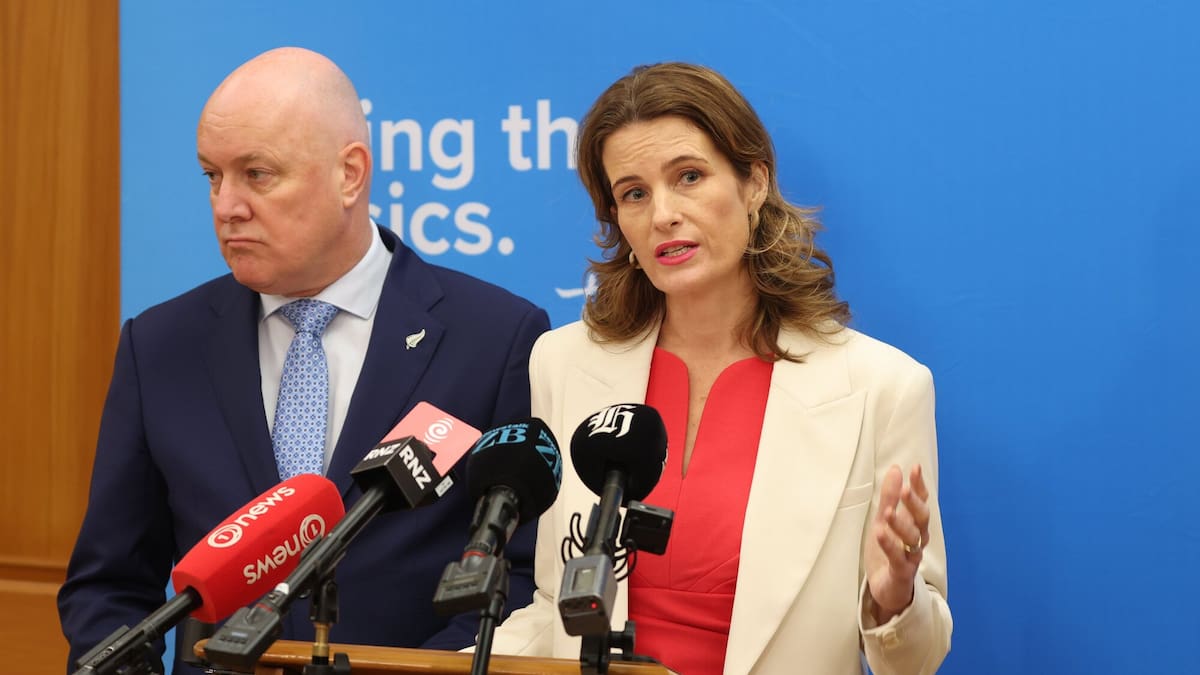
National urged Labour to commit to its budget rules. Photo / Sylvie Whinray
National is a little sick of this, arguing that Labour has an $18.2 billion “hidden bill”, which is the difference between the cost of what Labour says it will do and the new taxes Labour has announced to pay for it (the “bill” is closer to $13b now Labour has said it would scrap the Investment Boost tax credit).
Willis and National had not unfairly argued that Labour will need to hike taxes, borrow more, or break some promises to pay for all of this. In reality, Labour is likely to announce some other tax changes (changing the interest deduction regime for some property investors) and break some promises (reducing its pay equity commitment) in order to make its plan add up.
Labour clearly wants to delay this reckoning for as long as possible, prolonging the period in which it can be everything to everyone.
Everyone knows something has to give and it’s in Labour’s interest that it “gives” as close to polling day as possible. National wants to bring that forward, forcing Labour to disappoint some of its supporters and perhaps see them flee to the Greens or back to National itself.
No one feels particularly sorry for National because it used precisely the same trick before the last election, delaying its fiscal plan until literally days before early voting began.
The question of what Budget Responsibility Rules actually are is an interesting one. They’re the catchy campaign name given to something called a Fiscal Strategy.
While there is no requirement for a political party to publish Budget Responsibility Rules, the Public Finance Act does require a Government to publish a Fiscal Strategy, which sets out short- and long-term goals for things like achieving surplus and keeping debt manageable.
What tends to happen is that what are called Budget Responsibility Rules on the campaign become the Fiscal Strategy in government.
Prime Minister Jim Bolger (left) and his Finance Minister Ruth Richardson are all smiles as they enter Bowen House to present the 1991 Budget. Photo / Mark Hunter
The Taxpayers’ Union today pointed out the fact that Willis’ rules did not bind the Government to actually follow through on them, saying that if she was really serious about hitting them, she should legislate them: putting the rules in primary legislation would, potentially, force the Government to hit them.
Ironically, the whole reason we have a Fiscal Strategy to begin with is that Parliament, three decades ago, pondered doing much the same thing in a fit of pique after successive governments had left the country with an unsustainable debt burden.
Parliament debated the Fiscal Responsibility Bill, later act, which created the requirement for a government to publish a Fiscal Strategy (Sir Michael Cullen oversaw the law’s repeal, but kept the Fiscal Strategy requirement alive by putting it into the Public Finance Act).
Back then, the finance and expenditure select committee pondered whether Parliament should legislate an explicit debt target that the Government would be forced to hit.
Economist Gareth Morgan submitted that the law should target achieving a AAA credit rating over a particular period. The Business Roundtable suggested the law include a specific requirement that debt be reduced to the OECD average by the year 2000.
These suggestions, had they been followed up on, raised the spectre of the Government being taken to court for failing to meet its fiscal goals and potentially being forced by the court to do so, given the requirement was in primary legislation.
However, other submitters thought this was a bit iffy. Budgets – the thing that creates borrowing – are passed by Parliament and it is a constitutional convention that one Parliament cannot bind another.
If tomorrow’s Parliament, elected by tomorrow’s voters, wants to borrow billions and billions of dollars, today’s Parliament has no right to stop it (the bond market may have different ideas). Imagine a court ordering a Government to take a Budget to Parliament that cut spending so that it met the legislated rules of the Fiscal Responsibility Act.
The finance and expenditure committee in 1994 ultimately said it did not “favour including explicit fiscal targets in legislation”, taking the side of submitters on the “principle that governments should not legislate to bind future governments”. The requirements that ended up in legislation were sufficiently vague that governments have quite a bit of wriggle room about how they meet their targets.
Ironically, the person who chaired that committee is the same person who currently chairs the Taxpayers’ Union: Ruth Richardson.