
The Milky Way galaxy’s disk of stars may once have flipped onto its side. If it did, the Sun turned with it, along with the rest of the disk.
So far, though, only galaxies grown inside a computer have flipped.

Kirill Batrakov of Durham University was not looking for a flip. He set out to explain why the old stars scattered around the Milky Way barely turn as a group.
“Stellar halo and stellar disc are two distinct components of the Milky Way, which differ in many ways, so finding a link between them was genuinely exciting,” Batrakov told Earth.com.
A halo that barely turns
Most of the galaxy’s stars travel inside its flat spiral disk. Around that disk is a much larger, much emptier ball of stars.
They were born mostly in smaller galaxies that our own pulled in long ago, and astronomers call the whole cloud the stellar halo.
In 2017, Alis Deason, now one of Batrakov’s two co-authors, measured how little that halo turns.
Deason and six colleagues combined the first data release from the European Space Agency’s Gaia spacecraft with Sloan Digital Sky Survey images taken 10 to 15 years earlier.
Across three kinds of old stars, the halo circled the galaxy at about 9 miles per second (14 km/s). The Sun travels more than 15 times faster, at about 148 miles per second (238 km/s).
In the simulations Deason’s team checked, few galaxies had halos turning that slowly. No one had explained why.
Galaxy collisions and disk flips
Batrakov followed 25 galaxies like the Milky Way through the Auriga simulations, which run from the early universe to the present day.
He worked with Deason and Francesca Fragkoudi of Durham’s Institute for Computational Cosmology.
The team found three things in common among the galaxies whose halos turn slowest today. They formed early, collided head-on with another galaxy, and their disks flipped.
Batrakov explained what a disk really is: “Most of the stars in the disc rotate in the same direction. Together these stars form the plane of the disc.”
The researchers tracked the tilt of each disk across billions of years of simulated time.
In some galaxies, the disk ended up more than 90 degrees from where it started. Batrakov counts anything that big as a flip, and most of the disk’s stars end up traveling at a new angle.
Small galaxies did not fall into the Milky Way evenly from all sides, he noted.
Batrakov thinks those uneven arrivals help explain the halo’s slow rotation. The galaxies that later flipped had pulled in their smaller companions along tilted, highly elongated orbits rather than nearly circular ones.
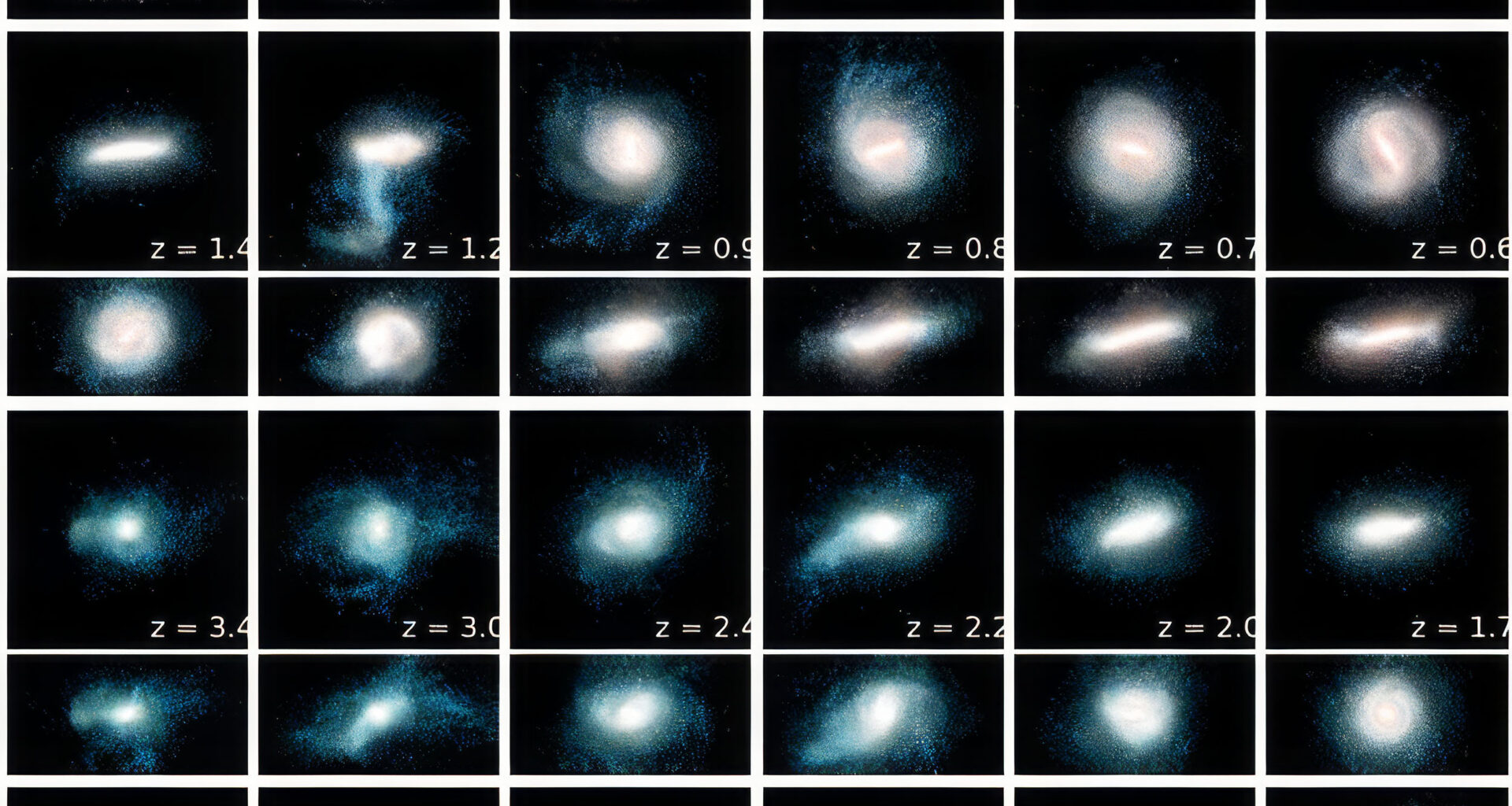
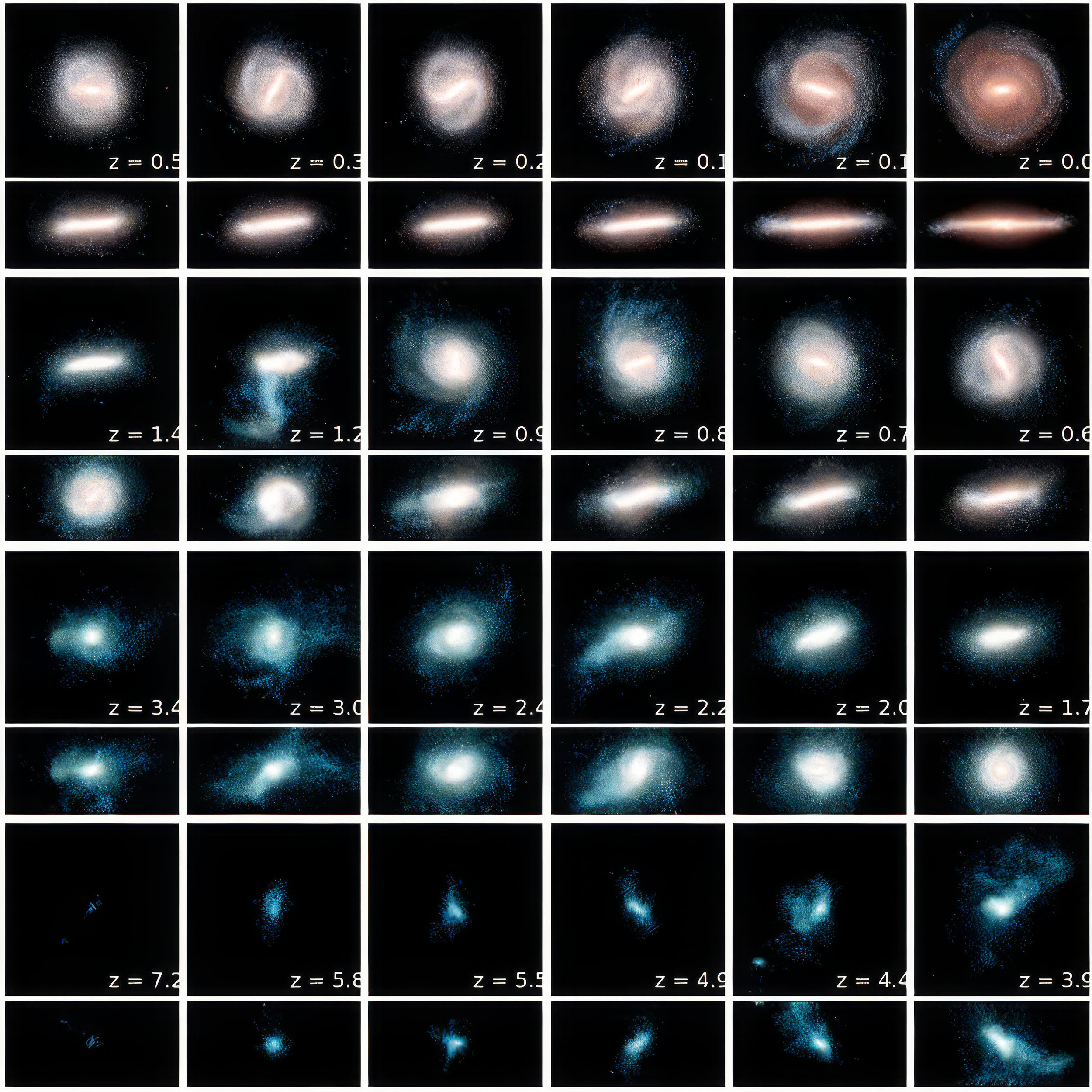 Halo 18 is an example of a galaxy that had a head-on collision (see the panel at z=1.2) and had a disk flip (you can see this by comparing the disc orientation at z=1.4 and z=0). Credit: Auriga Project. Click image to enlarge.The Sun did not stand out
The Milky Way took a head-on hit of its own. A large dwarf galaxy called Gaia-Sausage-Enceladus ran into the young Milky Way 10 to 11 billion years ago, and the bigger galaxy absorbed it.
Billions of its stars still travel on long, stretched-out orbits. Batrakov thinks our galaxy flipped for the same reason.
“A disc flip also means most of the Milky Way’s stars once moved on very different trajectories than they do today,” he said.
Our own spot in the galaxy, he added, may not have been stable for the whole life of the solar system.
Asked by Earth.com about the Sun, Batrakov said it travels inside the disk and does not stand out from the stars around it. This suggests that it very likely followed the rest of them through the flip.
He attached one condition. The Sun is a relatively young star, so it only turned with the disk if the flip came after the Sun formed.
Dark matter may turn slowly too
Most of the matter in the Milky Way never shines, and astronomers know it only by its pull on everything else. That unseen material forms the dark matter halo.
“We found a correlation between the velocity of rotation of the stellar halo and that of the dark matter halo,” Batrakov told Earth.com.
Starlight can be seen. Dark matter cannot. Astronomers can measure how fast the halo of old stars turns today, he said, and in principle they can then estimate the dark matter turning with it.
A disk that tips that far probably disturbs the shape of that invisible halo as well, he said. He is not claiming that yet.
No trace yet in real stars
All of those flips happened inside computer simulations, not in the real sky. But the Milky Way resembles the galaxies that flipped: it has the same slow-turning halo and a history of the same kind of head-on collision.
“We believe it is likely that the Milky Way experienced a disc flip – but this is still not 100% confirmed,” Batrakov said.
Not one trace of the old flip has turned up in the stars we can see today. Before anyone makes a stronger claim, he said, astronomers would have to find more of those traces.
Gaia’s fourth data release is due in December 2026, built from 66 months of the spacecraft’s work.
Th research was presented on July 21 at the Royal Astronomical Society’s National Astronomy Meeting in Birmingham, and the presentation appears in the meeting’s abstract record.
—–
Like what you read? Subscribe to our newsletter for engaging articles, exclusive content, and the latest updates.
Check us out on EarthSnap, a free app brought to you by Eric Ralls and Earth.com.
—–