
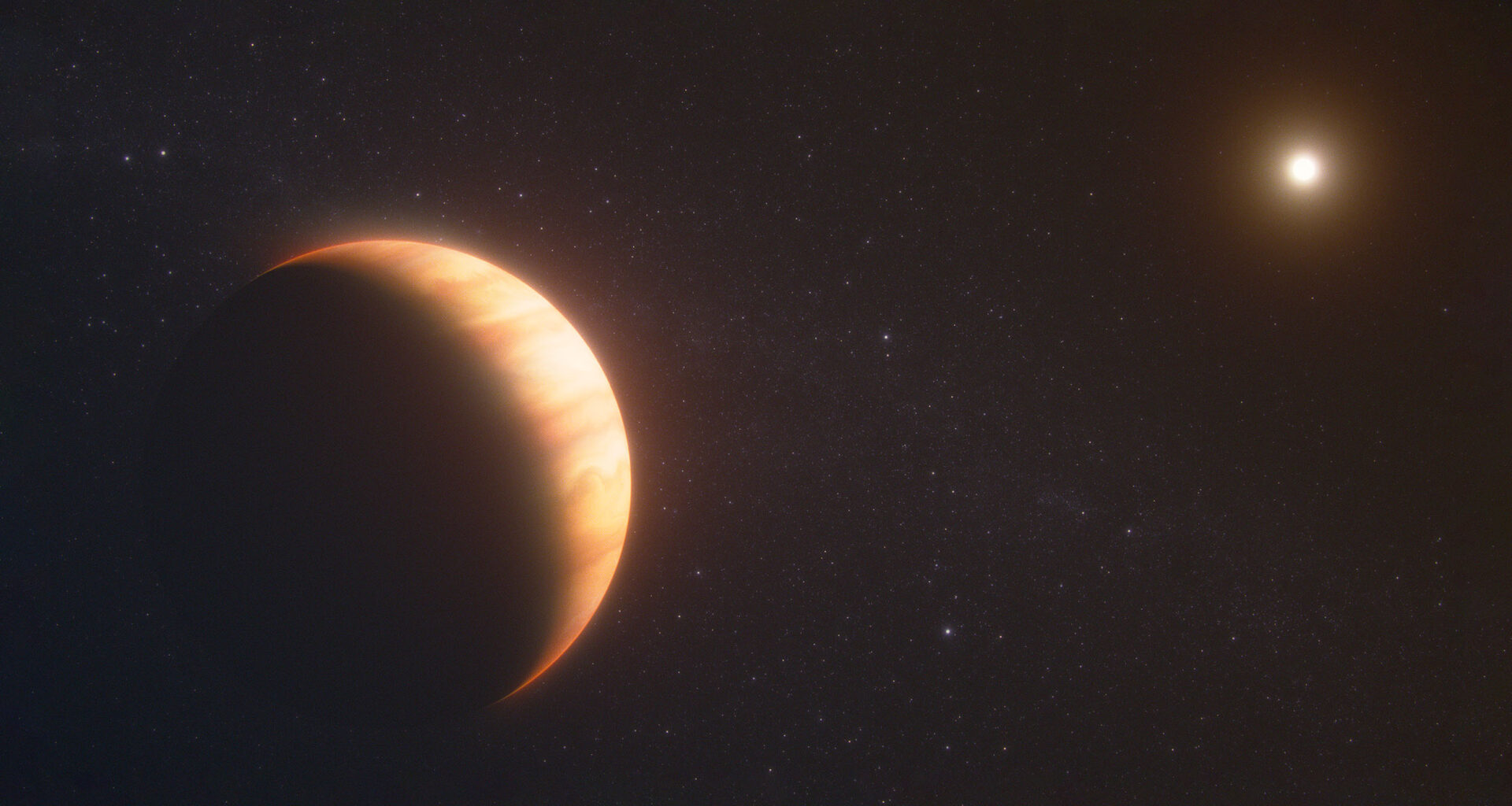
A Jupiter-sized planet that survived the death of its star is about 260°F, hotter than boiling water. The burned-out star it circles is far too faint to warm it past about -172°F.
This means that the extra heat came from something other than the star, and the question is what.

That planet is WD 1856 b, about 80 light-years away, and it circles a white dwarf a little bigger than Earth every 1.4 days.
Ryan MacDonald, an astronomer at the University of St. Andrews, led the observation with the James Webb Space Telescope.
The planet gives off its own glow in infrared light, the kind that usually comes from giant planets beside living stars.
“Seeing thermal emission from the planet was very surprising,” MacDonald told Earth.com.
Eight minutes, and half the starlight
MacDonald’s team watched the system with Webb for just under two hours on April 27, 2023. The planet took eight minutes to cross the star.
It is seven times larger than the white dwarf. He said that size difference is why Webb could pick up the glow.
The planet blocks more than half the starlight on the way past, and only its upper edge covers the star, a graze rather than a full crossing.
Victoria Boehm of Cornell University measured how much light arrived at each wavelength. Astronomers call that breakdown a spectrum.
The white dwarf is faint. “If you blink you miss it,” Boehm said of the crossing.
In near-infrared light the star dimmed about 3% less than it did in visible light. The planet’s own glow fills in that gap, and it comes from the side facing Earth halfway through, the night side.
Methane and a haze above the clouds
No one had measured an atmosphere on a planet crossing a dead star before this. MacDonald’s team found methane at three separate wavelengths, near 1.75, 2.3, and 3.3 micrometers.
Methane makes up roughly 7% of that air, in the same range as the 4% measured deep inside Neptune. The planet’s carbon comes to about 100 times the Sun’s share.
A thick cloud layer begins near 100 millibars, about a tenth of the air pressure at sea level on Earth.
Above that layer, much finer particles scatter short wavelengths of light. Those particles are the haze.
The team also got a better fit by adding ethane and phosphine, and neither counts as a detection. Neither ammonia nor water turns up anywhere in the spectrum.
WD 1856 b can’t make its own heat
From that same spectrum, the team measured the planet’s mass for the first time, at 4.3 to 10.9 times the mass of Jupiter.
Nothing inside the planet makes that heat today. To stay this warm on its own for 10 billion years it would have to weigh about 24 Jupiters, and it is nowhere near that heavy.
Tides could supply the heat if the orbit were 2% off a circle. They would also have rounded that orbit out within about 75 million years, too early to leave the planet warm now.
A cooling planet keeps a rough clock: the hotter it still is, the more recently something heated it.
Christopher O’Connor of Northwestern University used cooling models to work out when that happened.
The planet arrived billions of years late
The planet was last heated 3.0 to 5.5 billion years after the star finished dying.
While it was dying, that star swelled into a red giant and could have swallowed the planet whole. But it spent under 2 million years at that size, billions of years too early.
So the planet arrived late instead, on a long, stretched orbit. Tidal friction then pulled it into the tight circle it follows today, one-fiftieth of the way from Earth to the Sun.
The planet now orbits about eight times farther from its star than the Moon is from Earth.
Two red dwarf stars circle the white dwarf about 1,000 times farther out than Earth is from the Sun. MacDonald said their gravity most likely started the move.
Earth.com asked him what that means for Jupiter. The Sun will lose mass, and Jupiter will first move outward, to about twice its present distance, said Macdonald.
“This tells us that a potential fate for Jupiter could be it moving close in to the white dwarf remnant of our Sun.”
He added that many things become possible when you have billions of years to play with.
The haze could be three things
The team could not separate three candidates for the haze: potassium chloride, ammonia ice, and a water-rich organic haze made in a laboratory.
A plain grey cloud with haze above it still fits the data better than any of them.
Astronomers measured this same system in 2025, at longer wavelengths and at a different point in the orbit. The planet looked far cooler then, near -118°F.
The cloud tops may shift between the two sides of the planet, or over time. One of the two instruments could also be out of calibration.
In many of those simulations, the planet comes out wider than the 0.91 Jupiter widths measured today.
No one has published a set of models for an object this heavy and this rich in heavy elements.
Four more crossings already recorded
MacDonald’s team has already recorded four more crossings with Webb, and two more are scheduled past 5 micrometers, where most of the planet’s remaining heat escapes.
“We are also hoping to measure what the haze in WD 1856b’s atmosphere is made of,” he said.
The researchers will also look for ammonia and phosphine, and for clues to how the planet formed 10 billion years ago.
White dwarfs are small, and the team showed in 2020 that an Earth-sized planet around one would make the signs of life relatively easy to detect.
No one has found one of those planets yet. “We just need to find those planets first!” said MacDonald.
The full study was published in the journal Nature.
—–
Like what you read? Subscribe to our newsletter for engaging articles, exclusive content, and the latest updates.
Check us out on EarthSnap, a free app brought to you by Eric Ralls and Earth.com.
—–