
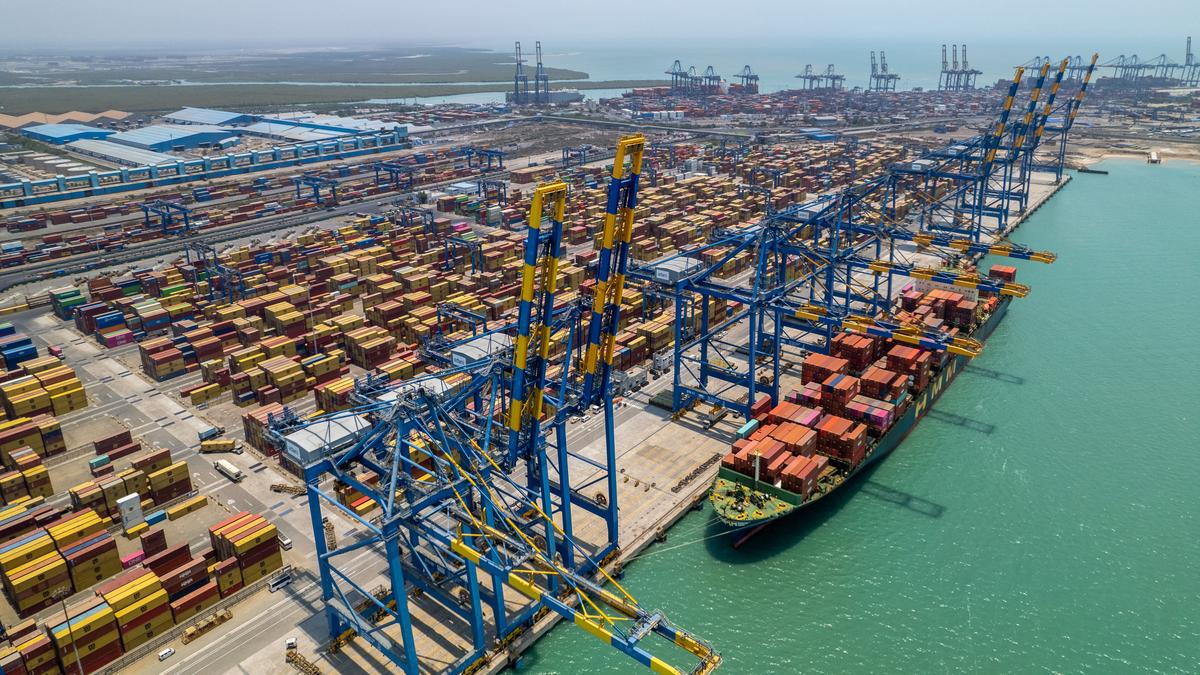

MULTICRORE ASSET. Adani Ports and Special Economic Zone’s right to operate Mundra port ends on February 16, 2031
| Photo Credit:
Sumit Dayal
When Gujarat opened its coastline to private investors in the late 1990s, it had a straightforward proposition: Build world-class ports, operate them for 30 years and help transform the State into India’s maritime gateway. Nearly three decades later, that proposition is approaching its first real test.
The operating rights for Gujarat’s first generation of privately developed ports — Pipavav and Mundra — are entering the final stretch of their concession period, putting the State’s next phase of port policy under the spotlight. With newer maritime projects in States such as Andhra Pradesh, Odisha and Kerala moving towards longer concessions, Gujarat’s approach to future port agreements could shape the next cycle of private investments along its coastline.
The first major private port concession agreement set to expire in Gujarat belongs to APM Terminals Pipavav, part of the Netherlands-based APM Terminals group. The port’s 30-year build-own-operate-transfer, or BOOT, concession agreement was signed in 1998 and is valid till September 29, 2028.
Next up is Mundra port, operated by Adani Ports and Special Economic Zone (APSEZ), with the concession expiring on February 16, 2031. Collectively, these assets have attracted billions of dollars in investments and helped Gujarat emerge as India’s largest maritime State, handling a substantial share of the country’s cargo traffic.
In a limbo
However, despite the looming deadlines, the State government is yet to announce a policy framework for extending the operating rights for the existing ports. According to the Gujarat Maritime Board (GMB), APM Terminals Pipavav has twice sought an extension of its concession for Pipavav port — in 2011 and 2021. APSEZ submitted similar applications for Mundra port in 2015 and 2021.
The GMB acknowledged that discussions have been underway for several years now. “The Gujarat government had sought the approval of the Union government in this regard. However, a formal announcement is yet to be made,” a senior GMB official told businessline.
The absence of clarity is increasingly viewed as an investment issue rather than merely a contractual one.
Port infrastructure requires continuous investments in dredging, mechanisation, deepening of berths, rail connectivity and cargo handling facilities. Without knowing whether they will continue to operate beyond the original concession period, developers could become more cautious about committing fresh capital entailing long payback periods.
This concern surfaced publicly in October 2025, when APM Terminals Pipavav signed a non-binding ₹17,000-crore investment memorandum with the Gujarat government, but indicated that major investment decisions would await clarity on the concession period.
APSEZ also indicated that the industry is closely watching how the Pipavav case unfolds. After announcing the company’s first-quarter FY27 results recently, Chief Executive Officer Ashwani Gupta told investors that the company expects the Pipavav decision to precede Mundra’s.
He added that discussions were underway and the company would announce developments once they became official. On whether Mundra could receive a similar treatment, he said it was too early to comment but stressed that preserving the port’s scale, efficiency and competitiveness would remain important.
Gujarat was among the first States to invite private investment in port development. Its 1997 BOOT framework gave private developers the right to build and operate ports for 30 years, after which the assets would revert to the government unless the concession agreement was extended.
Evolving sector
Meanwhile, as private participation in the maritime sector evolved, newer port projects in other States offered longer concession periods.
In Andhra Pradesh, ports such as Gangavaram and Krishnapatnam were structured with 30-year concessions and provisions for a 20-year extension. Both ports are now part of the APSEZ’s portfolio after the Adani Group acquired controlling stakes.
Kerala’s Vizhinjam International Deepwater Multipurpose Seaport Project was structured with an initial concession period of 40 years, and a 20-year extension under specified conditions.
Odisha, too, adopted longer concession structures for private port development. The Dhamra port concession agreement is valid for 34 years initially, including the construction period, and provides for an extension of the operating period.
A new shipbuilding policy unveiled recently by the Gujarat government may have offered the clearest indication yet of the direction the State could take. While the policy is aimed at promoting shipbuilding, one provision caught the attention of the maritime industry. Developers setting up new shipyards can now secure waterfront concessions of up to 50 years, replacing the older 30-year tenure.
Industry executives say the move reflects the State’s realisation that large maritime infrastructure requires long-term policy certainty to justify multibillion-rupee investments.
For the six greenfield ports proposed along the State’s coastline, the GMB indicated that the concession period could be 30-50 years.
Balancing interests
The proposed ports — Nana Layja (Kutch), Vadhera (Amreli), Vadodra Jhala (Gir Somnath), Damka (Surat), Lakhanka (Bhavnagar) and Bhogat (Devbhumi Dwarka) — will be developed under the BOOT model. Comprising 3,200 hectares in all, these projects are expected to expand Gujarat’s cargo-handling capacity and attract an initial investment of around ₹10,000 crore.
How Gujarat balances investor certainty with public ownership of strategic coastal assets will shape the future of maritime infrastructure development not just in the State but across the country too.
Published on August 10, 2026