
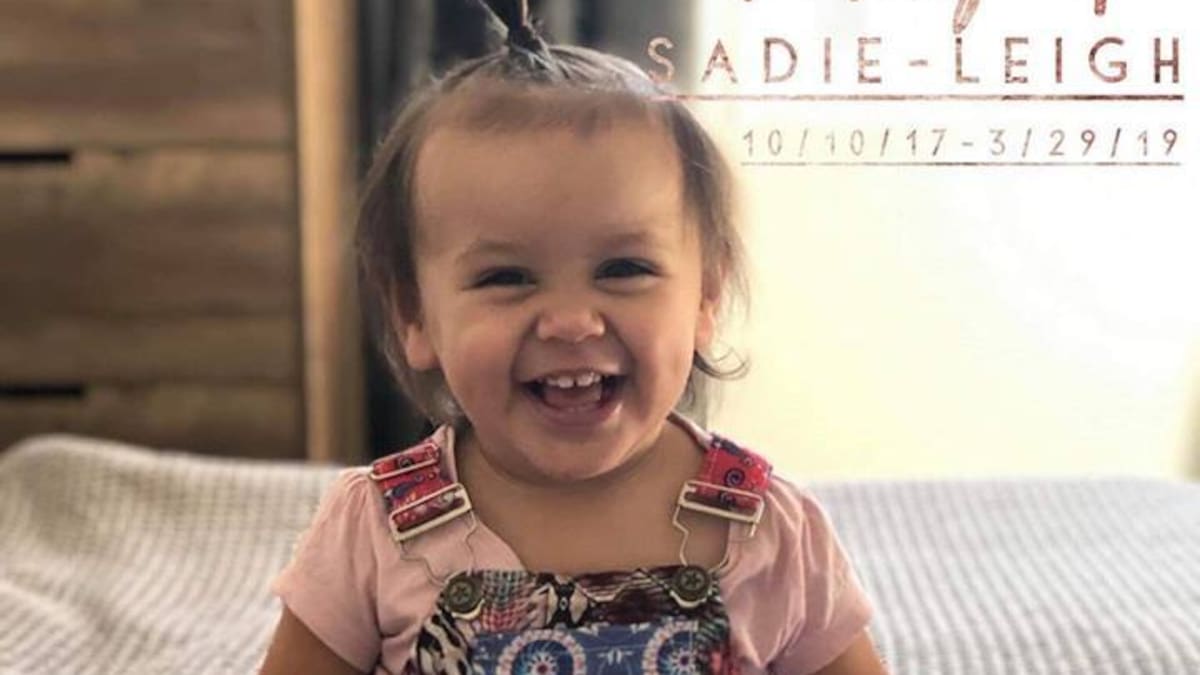
Today, an inquest began into Sadie-Leigh’s death.
The toddler died on March 29, 2019, from what pathologist Dr Kilak Kesha termed “blunt force head injuries”.
Her death was the subject of two earlier jury trials, after her mother’s former partner Adrian Clancy was charged with murder.
He was found guilty at the first trial in 2021, but the Court of Appeal quashed that conviction and he underwent a retrial.
He was acquitted at the second trial in 2024.
The coronial process was on hold while criminal proceedings were underway, but has now commenced in the Tauranga District Court.
Coroner Tracey Fitzgibbon opened the inquest with a karakia before outlining its scope.
The inquest will attempt to answer how Sadie-Leigh sustained the fatal injury, whether it was accidental or non-accidental, and when it happened.
“The inquiry is a genuine search for the truth as to what occurred prior to Sadie Lee’s death,” Coroner Fitzgibbon said.
The coroner said she was not there to “determine civil, criminal, or disciplinary liability”.
While the standard of proof in criminal trials is beyond a reasonable doubt, in the Coroner’s Court it is on the balance of probabilities.
“What I’ll be doing during this hearing is listening to evidence from witnesses which is relevant to Sadie Lee’s death,” Coroner Fitzgibbon said.
“I also have written documents such as reports and statements to assist me.”
Before evidence began, Sadie-Leigh’s mother, who has interim name suppression, read a statement about her daughter.
In it, she shared how loved her daughter was.
“I knew her little ways, her expressions, the things she loved, and the things that made her happy,” she said.
“I knew when she wanted a cuddle, and when she was being cheeky.
“Those ordinary little moments are some of the most precious memories I have of her because they are things that made her Sadie-Leigh.”
Those are the things she hopes her daughter was remembered by, not just “what happened to her”.
Sadie-Leigh was just 17-months-old when she died.
Sadie-Leigh’s mother is represented by lawyer Ben Smith.
Clancy is represented by Rob Stevens, who acted for him in the second jury trial.
Clancy and Sadie-Leigh’s mother will give evidence later in the week.
After Sadie-Leigh’s mother’s statement, Dr Kilak Kesha – who conducted the autopsy – was the first witness.
The toddler had brain haematomas and swelling, with Kesha concluding she’d died from a non-accidental head injury.
There were several areas of bleeding, including behind the eyes, and a linear skull fracture.
During questioning by Stevens, Kesha agreed there appeared to have been “one major blow to the head” that caused the catastrophic brain injury.
This led to bleeding and swelling that caused the brain to shut down.
Stevens asked him if the injury could have been caused by the toddler striking her head on the side of the cot, as she was put to bed forcefully.
Kesha agreed that was a possibility, though couldn’t be specific about what level of force would have been needed to cause the injury.
However, the injury was not consistent with normal child play, and would have needed “significant” force.
Kesha could also not be specific about the timing of the injury, but said the child would likely have had “neurological deficit” – indicated by things such as vomiting, seizures, or passing out – within “minutes” of the injury.
Coroner Tracey Fitzgibbon.
The inquest then heard from Detective Inspector Lindsay Pilbrow, who led the police investigation.
He stepped the coroner through an investigation overview, outlining timelines and events described by Clancy and Sadie-Leigh’s mother.
It doesn’t appear to be in dispute that on the day Sadie-Leigh suffered the fatal head injury – March 27, 2019 – she’d spent the morning with her maternal grandmother, who will also give evidence.
Sadie-Leigh had a cold, and was grizzly and unsettled.
Her mother collected her in the middle of the day, stopped at Burger King to get lunch, and headed home.
A neighbour visited, and Sadie-Leigh was behaving normally – active and mobile.
Clancy was on his phone, placing bets on tennis matches, and Sadie-Leigh’s mum was preparing for a beauty appointment at Mount Maunganui.
Clancy put Sadie-Leigh to bed. However, she was soon coughing and upset again. Her mother attempted to give her Irish Cough medicine, which Sadie-Leigh spat out.
She was put back in bed, but started coughing and was unsettled again, and Sadie-Leigh’s mother said Clancy resettled her.
Before she left at 3.31pm, she checked on her daughter, who was sleeping and breathing normally.
Clancy said at some point after Sadie-Leigh’s mum left for the appointment, he heard Sadie-Leigh coughing, and about five minutes later, found her struggling to breathe.
Emergency services were called at 3.49pm by a neighbour, and when paramedics arrived, they quickly realised she was in a dire way.
She was taken to Tauranga Hospital, and later transferred to Starship Children’s Hospital, where her injuries were found to be inoperable and non-survivable.
The police concluded Clancy inflicted a fatal blow, as he’d been left alone with the child.
The order of events, who went into the room and when, is the major point of contention.
Stevens suggested Sadie-Leigh’s mother inflicted the injury in frustration before leaving for her appointment.
The police position is any assault would have been heard by Clancy, however.
Stevens told the pathologist the key competing timeframes were between 3pm and 3.30pm, or between 3.31pm and 3.49pm.
It is agreed that the medical evidence cannot, on its own, determine the specific timing of the injury.
Stevens cross-examined Pilbrow about why Sadie-Leigh’s mother was discounted as a suspect, given neighbours told police they had observed her swearing and calling her daughter a “little freak”, describing how she would “lose her rag”.
There was also a suggestion the mother had confided in her neighbour about hitting Sadie-Leigh “over the head” before.
Pilbrow said there was no evidence neighbours observed anything like that on the day in question, or that the mother was having difficulty coping that day.
During questions from counsel for the police, Richard Jenson, Pilbrow confirmed their charging decision had been informed by what medical experts said about how Sadie-Leigh would have presented after the injury.
“These injuries were catastrophic, in their terms,” he said.
She would likely have been unconscious and blind “almost immediately” and, for anybody caring for her at that time, “it would have become very apparent that she was a very sick and unwell young lady”.
The inquest is expected to run until the end of the week.
Hannah Bartlett is a Tauranga-based Open Justice reporter at NZME. She previously covered court and local government for the Nelson Mail, and before that was a radio reporter at Newstalk ZB.
Join the NZ Herald’s Open Justice team for Case by Case, a video and podcast series examining the disputes and decisions making headlines across New Zealand.