
Lahoz-Monfort, J. J. & Magrath, M. J. L. A comprehensive overview of technologies for species and habitat monitoring and conservation. BioScience 71, 1038–1062 (2021).
Grinfeder, E., Lorenzi, C., Haupert, S. & Sueur, J. What do we mean by “Soundscape”? A functional description. Front. Ecol. Evol. 10, 894232 (2022).
Pijanowski, B. C. et al. Soundscape ecology: the science of sound in the landscape. BioScience 61, 203–216 (2011).
Farina, A. Soundscape Ecology: Principles, Patterns, Methods and Applications (Springer, 2014).
Rice, A. N. Conservation bioacoustics: listening to the heartbeat of the earth. Acoust. Today 19, 46 (2023).
Convention on Biological Diversity. Decision 15/4. Kunming-Montreal Global Biodiversity Framework (Convention on Biological Diversity, 2022).
Watson, J. E. M. et al. Priorities for protected area expansion so nations can meet their Kunming-Montreal Global Biodiversity Framework commitments. Integr. Conserv. 2, 140–155 (2023).
International Union for Conservation of Nature. Nature-Based Solutions to Address Global Societal Challenges (International Union for Conservation of Nature, 2016).
Seddon, N. et al. Understanding the value and limits of nature-based solutions to climate change and other global challenges. Philos. Trans. R. Soc. B 375, 20190120 (2020).
Directorate General for Research and Innovation (European Commission). Nature-Based Solutions: State of the Art in EU-Funded Projects (Publications Office, 2020).
Eggermont, H. et al. Nature-based solutions: new influence for environmental management and research in Europe. GAIA – Ecol. Perspect. Sci. Soc. 24, 243–248 (2015).
Ford, H. V. et al. A technological biodiversity monitoring toolkit for biocredits. J. Appl. Ecol. 61, 2007–2019 (2024).
Sugai, L. S. M., Silva, T. S. F., Ribeiro, J. W. & Llusia, D. Terrestrial passive acoustic monitoring: review and perspectives. BioScience 69, 15–25 (2019).
Ross, S. R. P.-J. et al. Passive acoustic monitoring provides a fresh perspective on fundamental ecological questions. Funct. Ecol. 37, 959–975 (2023).
Desjonquères, C., Gifford, T. & Linke, S. Passive acoustic monitoring as a potential tool to survey animal and ecosystem processes in freshwater environments. Freshw. Biol. 65, 7–19 (2020).
Linke, S., Gifford, T. & Desjonquères, C. Six steps towards operationalising freshwater ecoacoustic monitoring. Freshw. Biol. 65, 1–6 (2020).
Duarte, C. M. et al. The soundscape of the Anthropocene ocean. Science 371, eaba4658 (2021).
Williams, D. R., Balmford, A. & Wilcove, D. S. The past and future role of conservation science in saving biodiversity. Conserv. Lett. 13, e12720 (2020).
Sloyan, B. M., Roughan, M. & Hill, K. in New Frontiers in Operational Oceanography (eds Chassignet, E. P. et al.) 75–89 (GODAE OceanView, 2018).
Howe, B. M. et al. Observing the oceans acoustically. Front. Mar. Sci. 6, 426 (2019).
Roe, P. et al. The Australian acoustic observatory. Methods Ecol. Evol. 12, 1802–1808 (2021).
Delory, E., Širovic, A. & Jesus, S. Editorial: observing ocean sound. Front. Mar. Sci. 10, 1205835 (2023).
Buřivalová, Z. et al. Bioacoustic baselines for intact forests. Glob. Change Biol. 32, e70917 (2026).
Astaras, C. et al. Boots on the ground: the role of passive acoustic monitoring in evaluating anti-poaching patrols. Environ. Conserv. 47, 213–216 (2020).
Pardo, J. M. et al. Predicting poaching hotspots in the largest remnant of the Atlantic Forest by combining passive acoustic monitoring and occupancy models. Biol. Conserv. 272, 109600 (2022).
Braulik, G. et al. Acoustic monitoring to document the spatial distribution and hotspots of blast fishing in Tanzania. Mar. Pollut. Bull. 125, 360–366 (2017).
Kline, L. R. et al. Sleuthing with sound: understanding vessel activity in marine protected areas using passive acoustic monitoring. Mar. Policy 120, 104138 (2020).
Mariani, A. C. B., Godoy, S. N. & Santos, M. C. D. O. The use of passive acoustic monitoring as an auxiliary tool for monitoring marine protected areas. Ocean Coast. Res. 72, e24081 (2024).
Simiyu, D., Vikiru, A., Muchiri, H., Gu, F. & Butime, J. A chainsaw-sound recognition model for detecting illegal logging activities in forests. In Proc. Unified Conference of DAMAS, Income and TEPEN Conferences (UNIfied 2023) Vol. 152 (eds Ball, A. D. et al.) 797–806 (Springer, 2024).
Rajesh, M. et al. Preventing illegal deforestation using acoustic surveillance. Int. J. Comput. Inf. Syst. Ind. Manag. Appl. 16, 70–86 (2024).
Schrodt, F. et al. Advancing causal inference in ecology: pathways for biodiversity change detection and attribution. Methods Ecol. Evol. 16, 2276–2304 (2025).
Siegel, K. & Dee, L. E. Foundations and future directions for causal inference in ecological research. Ecol. Lett. 28, e70053 (2025).
Sagar, H. S. S. C. et al. Carbon finance initiatives can provide biodiversity benefits. Conserv. Sci. Pract. 8, e70254 (2026).
Showen, R. et al. Locating fish bomb blasts in real-time using a networked acoustic system. Mar. Pollut. Bull. 128, 496–507 (2018).
Hedley, R. W., Joubert, B., Bains, H. K. & Bayne, E. M. Acoustic detection of gunshots to improve measurement and mapping of hunting activity. Wildl. Soc. Bull. 46, e1370 (2022).
Vu, T. T., Phan, D. V., Le, T. S. & Clink, D. J. Investigating hunting in a protected area in Southeast Asia using passive acoustic monitoring with mobile smartphones and deep learning. Ecol. Indic. 167, 112501 (2024).
Yoh, N. et al. Impacts of logging, hunting, and conservation on vocalizing biodiversity in Gabon. Biol. Conserv. 296, 110726 (2024).
Huang, Z. et al. TinyChirp: bird song recognition using TinyML models on low-power wireless acoustic sensors. In 2024 IEEE 5th International Symposium on the Internet of Sounds (IS2) 1–10 (IEEE, 2024).
Froese, G. Z. L. et al. Coupling paraecology and hunter GPS self-follows to quantify village bushmeat hunting dynamics across the landscape scale. Afr. J. Ecol. 60, 229–249 (2022).
Sandbrook, C. et al. Principles for the socially responsible use of conservation monitoring technology and data. Conserv. Sci. Pract. 3, e374 (2021).
Strong, M. & Silva, J. A. Impacts of hunting prohibitions on multidimensional well-being. Biol. Conserv. 243, 108451 (2020).
Leung, F. K. W., Schwarzkopf, L. & Allen-Ankins, S. Advancing invasive species monitoring: a free tool for detecting invasive cane toads using continental-scale data. Ecol. Inform. 89, 103172 (2025).
Amorim, M. C. P. et al. Detection of invasive fish species with passive acoustics: discriminating between native and non-indigenous sciaenids. Mar. Environ. Res. 188, 106017 (2023).
Bota, G. et al. Passive acoustic monitoring and automated detection of the American bullfrog. Biol. Invasions 26, 1269–1279 (2024).
Ribeiro, J. W. et al. Passive acoustic monitoring as a tool to investigate the spatial distribution of invasive alien species. Remote Sens. 14, 4565 (2022).
Hofstadter, D. F. et al. Arresting the spread of invasive species in continental systems. Front. Ecol. Environ. 20, 278–284 (2022).
Wood, C. M. et al. Real-time acoustic monitoring facilitates the proactive management of biological invasions. Biol. Invasions 26, 3989–3996 (2024).
Mankin, R. W., Hagstrum, D. W., Smith, M. T., Roda, A. L. & Kairo, M. T. K. Perspective and promise: a century of insect acoustic detection and monitoring. Am. Entomol. 57, 30–44 (2011).
Kohlberg, A. B., Myers, C. R. & Figueroa, L. L. From buzzes to bytes: a systematic review of automated bioacoustics models used to detect, classify and monitor insects. J. Appl. Ecol. 61, 1199–1211 (2024).
Bota, G., Traba, J., Sardà-Palomera, F., Giralt, D. & Pérez-Granados, C. Passive acoustic monitoring for estimating human-wildlife conflicts: the case of bee-eaters and apiculture. Ecol. Indic. 142, 109158 (2022).
Pérez-Granados, C. & Schuchmann, K.-L. The sound of the illegal: applying bioacoustics for long-term monitoring of illegal cattle in protected areas. Ecol. Inform. 74, 101981 (2023).
Reo, N. J. & Ogden, L. A. Anishnaabe Aki: an indigenous perspective on the global threat of invasive species. Sustain. Sci. 13, 1443–1452 (2018).
Jarić, I. et al. Bridging worlds: exploring synergies between the arts and biodiversity conservation. Front. Ecol. Environ. 23, e70012 (2025).
Tsujii, K. et al. Change in singing behavior of humpback whales caused by shipping noise. PLoS ONE 13, e0204112 (2018).
Erbe, C. et al. The effects of ship noise on marine mammals—a review. Front. Mar. Sci. 6, 606 (2019).
Wrege, P. H., Bambi, F. B.-D., Malonga, P. J. F., Samba, O. J. & Brncic, T. Early detection of human impacts using acoustic monitoring: an example with forest elephants. PLoS ONE 19, e0306932 (2024).
Gordon, T. A. C. et al. Habitat degradation negatively affects auditory settlement behavior of coral reef fishes. Proc. Natl Acad. Sci. USA 115, 5193–5198 (2018).
Rossi, T., Connell, S. D. & Nagelkerken, I. Silent oceans: ocean acidification impoverishes natural soundscapes by altering sound production of the world’s noisiest marine invertebrate. Proc. R. Soc. B 283, 20153046 (2016).
Wiens, J. A. & Hobbs, R. J. Integrating conservation and restoration in a changing world. BioScience 65, 302–312 (2015).
Belote, R. T. et al. Options for prioritizing sites for biodiversity conservation with implications for “30 by 30”. Biol. Conserv. 264, 109378 (2021).
Wyborn, C. & Evans, M. C. Conservation needs to break free from global priority mapping. Nat. Ecol. Evol. 5, 1322–1324 (2021).
Potapov, P. et al. The last frontiers of wilderness: tracking loss of intact forest landscapes from 2000 to 2013. Sci. Adv. 3, e1600821 (2017).
Grinfeder, E. et al. Soundscape dynamics of a cold protected forest: dominance of aircraft noise. Landsc. Ecol. 37, 567–582 (2022).
Kleinschroth, F., Healey, J. R., Gourlet-Fleury, S., Mortier, F. & Stoica, R. S. Effects of logging on roadless space in intact forest landscapes of the Congo Basin. Conserv. Biol. 31, 469–480 (2017).
Lindenmayer, D. Small patches make critical contributions to biodiversity conservation. Proc. Natl Acad. Sci. USA 116, 717–719 (2019).
Blumstein, D. T. et al. Acoustic monitoring in terrestrial environments using microphone arrays: applications, technological considerations and prospectus: acoustic monitoring. J. Appl. Ecol. 48, 758–767 (2011).
McGeady, R. et al. A review of new and existing non-extractive techniques for monitoring marine protected areas. Front. Mar. Sci. 10, 1126301 (2023).
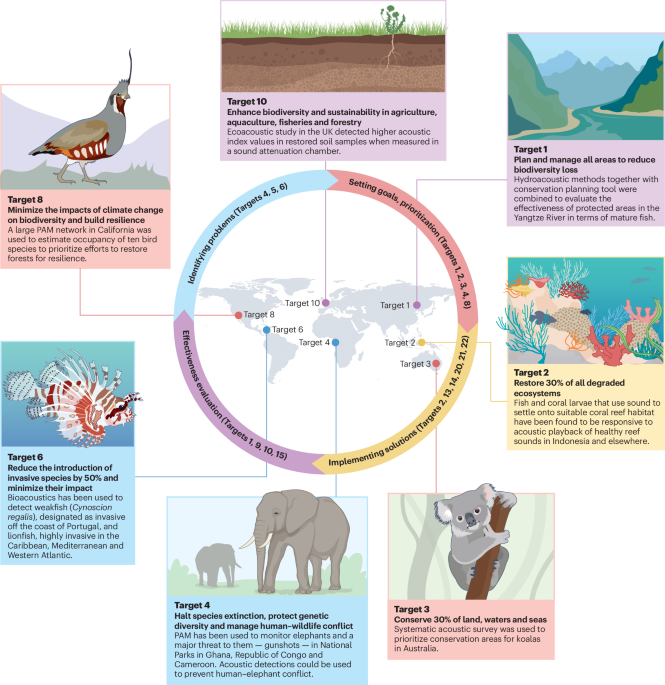
Whisson, D. A., Rivera, P. & Rendall, A. R. Systematic acoustic surveys inform priority conservation areas for koalas in a modified landscape. Landsc. Ecol. 38, 1279–1290 (2023).
Brunk, K. M. et al. Bioregional-scale acoustic monitoring can support fire-prone forest restoration planning. Front. Ecol. Environ. 23, e2843 (2025).
Johnson, B. A., Barrett, K., Homyack, J. A. & Baldwin, R. F. Anuran occupancy and breeding site use of aquatic systems in a managed pine landscape. For. Ecol. Manag. 368, 45–54 (2016).
Bender, M. J., Castleberry, S. B., Miller, D. A. & Bently Wigley, T. Site occupancy of foraging bats on landscapes of managed pine forest. For. Ecol. Manag. 336, 1–10 (2015).
Perea, S. et al. Bat winter foraging habitat use in working forests: a multispecies spatial occupancy approach. Anim. Conserv. 27, 478–491 (2024).
Perea, S. et al. Disentangling winter relationships: bat responses to forest stand structure, environmental conditions, and prey composition. For. Ecol. Manag. 578, 122484 (2025).
Rankin, D. T. & Perlut, N. G. The effects of Forest Stand Improvement Practices on occupancy and abundance of breeding songbirds. For. Ecol. Manag. 335, 99–107 (2015).
James, R. et al. Modelling the occupancy of two bird species of conservation concern in a managed Acadian Forest landscape: applications for forest management. For. Ecol. Manag. 555, 121725 (2024).
Peterson, T. S., Mcgill, B., Hein, C. D. & Rusk, A. Acoustic exposure to turbine operation quantifies risk to bats at commercial wind energy facilities. Wildl. Soc. Bull. 45, 552–565 (2021).
Behr, O. et al. Standardised and referenced acoustic monitoring reliably estimates bat fatalities at wind turbines: comments on ‘Limitations of acoustic monitoring at wind turbines to evaluate fatality risk of bats’. Mammal Rev. 53, 65–71 (2023).
Peterson, T., Rusk, A., Byrne, C., Aghababian, S. & Edwards, S. Acoustic exposure reveals variation in curtailment effectiveness at reducing bat fatality at wind turbines. Ecosphere 16, e70277 (2025).
Erbe, C., MacGillivray, A. & Williams, R. Mapping cumulative noise from shipping to inform marine spatial planning. J. Acoust. Soc. Am. 132, EL423–EL428 (2012).
Costa, B., Taylor, J. C., Kracker, L., Battista, T. & Pittman, S. Mapping reef fish and the seascape: using acoustics and spatial modeling to guide coastal management. PLoS ONE 9, e85555 (2014).
Barlow, D. R. & Torres, L. G. Planning ahead: dynamic models forecast blue whale distribution with applications for spatial management. J. Appl. Ecol. 58, 2493–2504 (2021).
Bosi, S. et al. Is maritime spatial planning a tool to mitigate the impacts of underwater noise? A review of adopted and upcoming maritime spatial plans in Europe. Mar. Policy 155, 105725 (2023).
Tanaka, K. et al. Spatiotemporal variations in the acoustic presence of dugongs and vessel traffic around Talibong Island, Thailand: inputs for local coastal management from passive acoustical aspects. Ocean Coast. Manag. 245, 106810 (2023).
Southall, B. L. et al. Marine mammal noise-exposure criteria: initial scientific recommendations. Bioacoustics 17, 273–275 (2008).
Tougaard, J., Henriksen, O. D. & Miller, L. A. Underwater noise from three types of offshore wind turbines: estimation of impact zones for harbor porpoises and harbor seals. J. Acoust. Soc. Am. 125, 3766–3773 (2009).
Blackwell, S. B. et al. Effects of airgun sounds on bowhead whale calling rates in the Alaskan Beaufort Sea. Mar. Mammal Sci. 29, E342–E365 (2013).
Mooney, T. A., Andersson, M. H. & Stanley, J. Acoustic impacts of offshore wind energy on fishery resources: an evolving source and varied effects across a wind farm’s lifetime. Oceanography 33, 82–95 (2020).
Stocker, M. Best available science? Are NOAA Fisheries marine mammal noise exposure guidelines up to date? In Proc. 177th Meeting of the Acoustical Society of America 36, 010001 (Acoustical Society of America, 2019).
Van Parijs, S. M. et al. Establishing baselines for predicting change in ambient sound metrics, marine mammal, and vessel occurrence within a US offshore wind energy area. ICES J. Mar. Sci. 82, fsad148 (2025).
Fouquet, A. et al. Simulated chorus attracts conspecific and heterospecific Amazonian explosive breeding frogs. Biotropica 53, 63–73 (2021).
Spatz, D. R. et al. Tracking the global application of conservation translocation and social attraction to reverse seabird declines. Proc. Natl Acad. Sci. USA 120, e2214574120 (2023).
Znidersic, E. & Watson, D. M. Acoustic restoration: using soundscapes to benchmark and fast-track recovery of ecological communities. Ecol. Lett. 25, 1597–1603 (2022).
Gordon, T. A. C. et al. Acoustic enrichment can enhance fish community development on degraded coral reef habitat. Nat. Commun. 10, 5414 (2019).
Aoki, N. et al. Soundscape enrichment increases larval settlement rates for the brooding coral Porites astreoides. R. Soc. Open Sci. 11, 231514 (2024).
Bomford, M. & O’Brien, P. H. Sonic deterrents in animal damage control: a review of device tests and effectiveness. Wildl. Soc. Bull. 18, 411–422 (Wiley, 1990).
Dong, Z.-J. et al. High-frequency and high-amplitude sounds enhance bird deterrence. Sci. Rep. 15, 30945 (2025).
Weaver, S. P., Hein, C. D., Simpson, T. R., Evans, J. W. & Castro-Arellano, I. Ultrasonic acoustic deterrents significantly reduce bat fatalities at wind turbines. Glob. Ecol. Conserv. 24, e01099 (2020).
Veneranta, L., Lehtonen, T. K., Lehtonen, E. & Suuronen, P. Acoustic seal deterrents in mitigation of human–wildlife conflicts in the whitefish fishery of the River Iijoki in the northern Baltic Sea area. Fish. Manag. Ecol. 31, e12680 (2024).
Beattie, M., Nowacek, D. P., Bogdanoff, A. K., Akins, L. & Morris, J. A. The roar of the lionfishes Pterois volitans and Pterois miles. J. Fish Biol. 90, 2488–2495 (2017).
Holmes, R. B., Hamilton, N. M., Dunkley, K. & Herbert-Read, J. E. Lionfish (Pterois volitans) show social attraction to conspecifics when selecting shelters. Ethology 131, 31–38 (2025).
Schakner, Z. A. & Blumstein, D. T. Behavioral biology of marine mammal deterrents: a review and prospectus. Biol. Conserv. 167, 380–389 (2013).
Hans Enukwa, E. Human-elephant conflict mitigation methods: a review of effectiveness and sustainability. J. Wildl. Biodivers. 1, 69–78 (2017).
Wijayagunawardane, M. P. B. et al. The use of audio playback to deter crop-raiding Asian elephants. Wildl. Soc. Bull. 40, 375–379 (2016).
Abrahms, B. et al. Climate change as a global amplifier of human–wildlife conflict. Nat. Clim. Change 13, 224–234 (2023).
Wiley, D., Leila, H., Michael, T., Kurt, S. & Craig, M. Marine sanctuaries and marine planning. Coast Guard Proc. Mar. Saf. Secur. Counc. 70, 10–15 (2013).
Indeck, K. L., Baumgartner, M. F., Lecavalier, L., Whoriskey, F. & Davies, K. T. A. Passive acoustic gliders are effective monitoring tools for dynamic management plans aimed at mitigating whale-vessel strikes. Conserv. Lett. 18, e13102 (2025).
Baumgartner, M. Efficacy of real-time passive acoustic monitoring near wind energy industrial activities for mitigating risks to right whales. Endanger. Species Res. 57, 413–430 (2025).
Metcalf, O. C., Ewen, J. G., McCready, M., Williams, E. M. & Rowcliffe, J. M. A novel method for using ecoacoustics to monitor post-translocation behaviour in an endangered passerine. Methods Ecol. Evol. 10, 626–636 (2019).
Brancalion, P. H. S., Hua, F., Joyce, F. H., Antonelli, A. & Holl, K. D. Moving biodiversity from an afterthought to a key outcome of forest restoration. Nat. Rev. Biodivers. 1, 248–261 (2025).
Buřivalová, Z., Yoh, N., Butler, R. A., Chandra Sagar, H. S. S. & Game, E. T. Broadening the focus of forest conservation beyond carbon. Curr. Biol. 33, R621–R635 (2023).
La Manna, G. et al. Soundscape analysis can be an effective tool in assessing seagrass restoration early success. Sci. Rep. 14, 20910 (2024).
Vega-Hidalgo, Á, Flatt, E., Whitworth, A. & Symes, L. Acoustic assessment of experimental reforestation in a Costa Rican rainforest. Ecol. Indic. 133, 108413 (2021).
Choksi, P. et al. Listening for change: quantifying the impact of ecological restoration on soundscapes in a tropical dry forest. Restor. Ecol. 31, e13864 (2023).
Müller, J. et al. Soundscapes and deep learning enable tracking biodiversity recovery in tropical forests. Nat. Commun. 14, 6191 (2023).
Ramesh, V. et al. Using passive acoustic monitoring to examine the impacts of ecological restoration on faunal biodiversity in the Western Ghats. Biol. Conserv. 282, 110071 (2023).
Kümmet, S. et al. Acoustic indices predict recovery of tropical bird communities for taxonomic and functional composition. Conserv. Lett. 18, p.e13131 (2025).
Lamont, T. A. C. et al. The sound of recovery: coral reef restoration success is detectable in the soundscape. J. Appl. Ecol. 59, 742–756 (2022).
Robinson, J. M., Breed, M. F. & Abrahams, C. The sound of restored soil: using ecoacoustics to measure soil biodiversity in a temperate forest restoration context. Restor. Ecol. 31, e13934 (2023).
Larkin, J. T. et al. A large-scale assessment of eastern whip-poor-will (Antrostomus vociferus) occupancy across a gradient of forest management intensity using autonomous recording units. J. Environ. Manag. 366, 121786 (2024).
Fiss, C. J. et al. Performance of unmarked abundance models with data from machine-learning classification of passive acoustic recordings. Ecosphere 15, e4954 (2024).
Ng, E. M.-Y. et al. Severe fire has impacted populations of the California spotted owl more than fuels management or drought-related tree mortality. For. Ecol. Manag. 603, 123469 (2026).
Parmentier, E., Lecchini, D., Frederich, B., Brie, C. & Mann, D. Sound production in four damselfish (Dascyllus) species: phyletic relationships? Biol. J. Linn. Soc. 97, 928–940 (2009).
Parmentier, E., Kéver, L., Casadevall, M. & Lecchini, D. Diversity and complexity in the acoustic behaviour of Dacyllus flavicaudus (Pomacentridae). Mar. Biol. 157, 2317–2327 (2010).
Parmentier, E. et al. First use of acoustic calls to distinguish cryptic members of a fish species complex. Zool. J. Linn. Soc. 195, 964–975 (2022).
Chase, T. J., Pratchett, M. S., Frank, G. E. & Hoogenboom, M. O. Coral-dwelling fish moderate bleaching susceptibility of coral hosts. PLoS ONE 13, e0208545 (2018).
Shantz, A. A. et al. Positive interactions between corals and damselfish increase coral resistance to temperature stress. Glob. Change Biol. 29, 417–431 (2023).
Campos-Cerqueira, M. et al. How does FSC forest certification affect the acoustically active fauna in Madre de Dios, Peru? Remote Sens. Ecol. Conserv. 6, 274–285 (2020).
Zwerts, J. A., Wiegers, J. N. (Y.), Sterck, E. H. M. & Van Kuijk, M. (M.). Exploring spatio-temporal variation in soundscape saturation of an African tropical forest landscape. Ecol. Indic. 137, 108712 (2022).
Burivalova, Z. et al. Using soundscapes to investigate homogenization of tropical forest diversity in selectively logged forests. J. Appl. Ecol. 56, 2493–2504 (2019).
Burivalova, Z., Miteva, D., Salafsky, N., Butler, R. A. & Wilcove, D. S. Evidence types and trends in tropical forest conservation literature. Trends Ecol. Evol. 34, 669–679 (2019).
Deichmann, J. L. et al. It’s time to listen: there is much to be learned from the sounds of tropical ecosystems. Biotropica 50, 713–718 (2018).
Gibb, R., Browning, E., Glover-Kapfer, P. & Jones, K. E. Emerging opportunities and challenges for passive acoustics in ecological assessment and monitoring. Methods Ecol. Evol. 10, 169–185 (2019).
Reynolds, N., Mota, B. & Nightingale, J. M. Open-access satellite data for peatland condition and restoration monitoring in the UK: a review. Front. Environ. Sci. 13, 1685165 (2025).
Dröge, S., Prasetyo, L. B. & Muys, B. Acoustic indices as proxies for biodiversity in certified and non-certified cocoa plantations in Indonesia. Environ. Monit. Assess. 197, 61 (2024).
Zwerts, J. A. et al. Methods for wildlife monitoring in tropical forests: comparing human observations, camera traps, and passive acoustic sensors. Conserv. Sci. Pract. 3, e568 (2021).
Kitzes, J. & Schricker, L. The necessity, promise and challenge of automated biodiversity surveys. Environ. Conserv. 46, 247–250 (2019).
Sarkar, D. & Chapman, C. A. The smart forest conundrum: contextualizing pitfalls of sensors and AI in conservation science for tropical forests. Trop. Conserv. Sci. 14, 19400829211014740 (2021).
Longdon, J., Gabrys, J. & Blackwell, A. F. Taking data science into the forest. Interdiscip. Sci. Rev. 49, 82–103 (2024).
Bell, K. & Malerba, M. E. Biodiversity monitoring for biocredits: a case study comparing acoustic, eDNA, and traditional methods. Biodivers. Conserv. 34, 2513–2528 (2025).
Hoefer, S., Allen-Ankins, S., McKnight, D. T., Nordberg, E. J. & Schwarzkopf, L. Sensors versus surveyors: comparing passive acoustic monitoring, camera trapping and observer-based monitoring for terrestrial mammals. Methods Ecol. Evol. 16, 2603–2621 (2025).
Darras, K., Furnas, B., Fitriawan, I., Mulyani, Y. & Tscharntke, T. Estimating bird detection distances in sound recordings for standardizing detection ranges and distance sampling. Methods Ecol. Evol. 9, 1928–1938 (2018).
Crunchant, A., Borchers, D., Kühl, H. & Piel, A. Listening and watching: do camera traps or acoustic sensors more efficiently detect wild chimpanzees in an open habitat? Methods Ecol. Evol. 11, 542–552 (2020).
Dalpaz, L. et al. Better together: analysis of integrated acoustic and visual methods when surveying a cetacean community. Mar. Ecol. Prog. Ser. 678, 197–209 (2021).
Dantzker, M. S. et al. Deciphering complex coral reef soundscapes with spatial audio and 360° video. Methods Ecol. Evol. 16, 2622–2637 (2025).
Growcott, J. et al. The secret acoustic world of leopards: a paired camera trap and bioacoustics survey facilitates individual identification of leopards via their roars. Remote Sens. Ecol. Conserv. 11, 361–374 (2025).
Au, W. W. L. & Hastings, M. C. Principles of Marine Bioacoustics (Springer, 2008).
Suthers, R. A., Fitch, W. T., Fay, R. R. & Popper, A. N. (eds) Vertebrate Sound Production and Acoustic Communication, Vol. 53 (Springer, 2016).
Sueur, J. Sound Analysis and Synthesis with R (Springer, 2018).
Salafsky, N. et al. Defining and using evidence in conservation practice. Conserv. Sci. Pract. 1, e27 (2019).
Teixeira, D., Maron, M. & Van Rensburg, B. J. Bioacoustic monitoring of animal vocal behavior for conservation. Conserv. Sci. Pract. 1, e72 (2019).
Campos-Cerqueira, M. & Aide, T. M. Improving distribution data of threatened species by combining acoustic monitoring and occupancy modelling. Methods Ecol. Evol. 7, 1340–1348 (2016).
Van Hoeck, R. V. et al. Passive acoustic monitoring complements traditional methods for assessing marine habitat enhancement outcomes. Ecosphere 12, e03840 (2021).
Wood, C. M., Barceinas Cruz, A. & Kahl, S. Pairing a user-friendly machine-learning animal sound detector with passive acoustic surveys for occupancy modeling of an endangered primate. Am. J. Primatol. 85, e23507 (2023).
Duarte, A. et al. Passive acoustic monitoring and convolutional neural networks facilitate high-resolution and broadscale monitoring of a threatened species. Ecol. Indic. 162, 112016 (2024).
Cañas, J. S. et al. A dataset for benchmarking Neotropical anuran calls identification in passive acoustic monitoring. Sci. Data 10, 771 (2023).
Tan, M. K. et al. The calling songs of some katydids (Orthoptera, Tettigonioidea) from the tropical forests of Southeast Asia. J. Orthoptera Res. 32, 1–24 (2023).
Funosas, D. et al. A finely annotated dataset for the automated acoustic identification of European Orthoptera and Cicadidae. Sci. Data 13, 830 (2026).
Callaghan, C. T., Poore, A. G. B., Hofmann, M., Roberts, C. J. & Pereira, H. M. Large-bodied birds are over-represented in unstructured citizen science data. Sci. Rep. 11, 19073 (2021).
Jäckel, D. et al. Opportunities and limitations: a comparative analysis of citizen science and expert recordings for bioacoustic research. PLoS ONE 16, e0253763 (2021).
Johnston, A., Matechou, E. & Dennis, E. B. Outstanding challenges and future directions for biodiversity monitoring using citizen science data. Methods Ecol. Evol. 14, 103–116 (2023).
Rumelt, R., Mere Roncal, C., Basto, A., Buřivalová, Z. & Searcy, C. Combining acoustic survey and citizen science data yields enhanced species distribution models for tropical rainforest birds. PLoS ONE 20, e0327944 (2025).
Looby, A. et al. A quantitative inventory of global soniferous fish diversity. Rev. Fish Biol. Fish. 32, 581–595 (2022).
Looby, A. et al. FishSounds version 1.0: a website for the compilation of fish sound production information and recordings. Ecol. Inform. 74, 101953 (2023).
Kahl, S., Wood, C. M., Eibl, M. & Klinck, H. BirdNET: a deep learning solution for avian diversity monitoring. Ecol. Inform. 61, 101236 (2021).
van Merriënboer, B. et al. Perch 2.0: the bittern lesson for bioacoustics. Preprint at arXiv https://doi.org/10.48550/arXiv.2508.04665 (2026).
Knight, E. C. et al. Recommendations for acoustic recognizer performance assessment with application to five common automated signal recognition programs. Avian Conserv. Ecol. 12, art14 (2017).
Villon, S. et al. A new method to control error rates in automated species identification with deep learning algorithms. Sci. Rep. 10, 10972 (2020).
Wood, C. M. & Kahl, S. Guidelines for appropriate use of BirdNET scores and other detector outputs. J. Ornithol. 165, 777–782 (2024).
Tseng, S., Hodder, D. P. & Otter, K. A. Setting BirdNET confidence thresholds: species-specific vs. universal approaches. J. Ornithol. 166, 1123–1135 (2025).
Scanferla, J. et al. Determining species-specific thresholds to improve precision in passive acoustic monitoring. Ecol. Inform. 91, 103423 (2025).
Wood, C. M. et al. Detecting small changes in populations at landscape scales: a bioacoustic site-occupancy framework. Ecol. Indic. 98, 492–507 (2019).
Katsis, L. K. D. et al. A comparison of statistical methods for deriving occupancy estimates from machine learning outputs. Sci. Rep. 15, 14700 (2025).
Wood, C. M. & Peery, M. Z. What does ‘occupancy’ mean in passive acoustic surveys? Ibis 164, 1295–1300 (2022).
Gaston, K. J. How large is a species’ geographic range? Oikos 61, 434 (1991).
Nichols, J. D. in Applied Ecology and Human Dimensions in Biological Conservation (eds Verdade, L. et al.) 117–131 (Springer, 2014).
Callaghan, C. T., Santini, L., Spake, R. & Bowler, D. E. Population abundance estimates in conservation and biodiversity research. Trends Ecol. Evol. 39, 515–523 (2024).
Marques, T. A. et al. Estimating animal population density using passive acoustics. Biol. Rev. 88, 287–309 (2013).
Pérez-Granados, C. & Traba, J. Estimating bird density using passive acoustic monitoring: a review of methods and suggestions for further research. Ibis 163, 765–783 (2021).
Hutschenreiter, A. et al. How to count bird calls? Vocal activity indices may provide different insights into bird abundance and behaviour depending on species traits. Methods Ecol. Evol. 15, 1071–1083 (2024).
Garcia, M. et al. Acoustic abundance estimation for Critically Endangered North Atlantic right whales in Cape Cod Bay, Massachusetts, USA. Endanger. Species Res. 56, 101–115 (2025).
Kitzes, J. et al. Integrating AI models into ecological research workflows: the case of terrestrial bioacoustics. Methods Ecol. Evol. 17, 257–271 (2026).
Royle, J. A. & Nichols, J. D. Estimating abundance from repeated presence–absence data or point counts. Ecology 84, 777–790 (2003).
Strebel, N. et al. Estimating abundance based on time-to-detection data. Methods Ecol. Evol. 12, 909–920 (2021).
Rhinehart, T. A. et al. Addressing widespread detection heterogeneity in avian occupancy modeling using passive acoustic surveys. Ornithol. Appl. 128, 1–15 (2026).
Chiatante, G. & Canestrelli, D. Temporal dynamics of animal vocal behavior affect semi-automatic identifications. Ecol. Process. 15, 4 (2026).
Royle, J. A., Dawson, D. K. & Bates, S. Modeling abundance effects in distance sampling. Ecology 85, 1591–1597 (2004).
Sebastián-González, E. et al. Density estimation of sound-producing terrestrial animals using single automatic acoustic recorders and distance sampling. Avian Conserv. Ecol. 13, art7 (2018).
Yip, D. A. et al. Sound level measurements from audio recordings provide objective distance estimates for distance sampling wildlife populations. Remote Sens. Ecol. Conserv. 6, 301–315 (2020).
Royle, J. A. Modelling sound attenuation in heterogeneous environments for improved bioacoustic sampling of wildlife populations. Methods Ecol. Evol. 9, 1939–1947 (2018).
Patricelli, G. L., Dantzker, M. S. & Bradbury, J. W. Acoustic directionality of red-winged blackbird (Agelaius phoeniceus) song relates to amplitude and singing behaviours. Anim. Behav. 76, 1389–1401 (2008).
Pérez-Granados, C. et al. Vocal activity rate index: a useful method to infer terrestrial bird abundance with acoustic monitoring. Ibis 161, 901–907 (2019).
Pérez-Granados, C. et al. Assessment of cue counting for estimating bird density using passive acoustic monitoring: recommendations for estimating a reliable cue rate. Avian Conserv. Ecol. 16, art11 (2021).
Navine, A. K., Camp, R. J., Weldy, M. J., Denton, T. & Hart, P. J. Counting the chorus: a bioacoustic indicator of population density. Ecol. Indic. 169, 112930 (2024).
Zwart, M. C., Baker, A., McGowan, P. J. K. & Whittingham, M. J. The use of automated bioacoustic recorders to replace human wildlife surveys: an example using nightjars. PLoS ONE 9, e102770 (2014).
Buxton, R. T. & Jones, I. L. Measuring nocturnal seabird activity and status using acoustic recording devices: applications for island restoration: acoustic monitoring of nocturnal seabirds. J. Field Ornithol. 83, 47–60 (2012).
Pérez-Granados, C. et al. Effort needed to accurately estimate vocal activity rate index using acoustic monitoring: a case study with a dawn-time singing passerine. Ecol. Indic. 107, 105608 (2019).
Pillay, R., Fletcher, R. J., Sieving, K. E., Udell, B. J. & Bernard, H. Bioacoustic monitoring reveals shifts in breeding songbird populations and singing behaviour with selective logging in tropical forests. J. Appl. Ecol. 56, 2482–2492 (2019).
Staicer, C. A., Ingalls, V. & Sherry, T. W. Singing behavior varies with breeding status of American redstarts (Setophaga ruticilla). Wilson J. Ornithol. 118, 439–451 (2006).
Blackwell, S. B. et al. Effects of airgun sounds on bowhead whale calling rates: evidence for two behavioral thresholds. PLoS ONE 10, e0125720 (2015).
Navine, A. K., Denton, T., Weldy, M. J. & Hart, P. J. All thresholds barred: direct estimation of call density in bioacoustic data. Front. Bird Sci. 3, 1380636 (2024).
Wilson, S. J. & Bayne, E. M. Use of an acoustic location system to understand how presence of conspecifics and canopy cover influence ovenbird (Seiurus aurocapilla) space use near reclaimed wellsites in the boreal forest of Alberta. Avian Conserv. Ecol. 13, art4 (2018).
Spillmann, B. et al. Validation of an acoustic location system to monitor Bornean orangutan (Pongo pygmaeus wurmbii) long calls. Am. J. Primatol. 77, 767–776 (2015).
Hedwig, D., DeBellis, M. & Wrege, P. H. Not so far: attenuation of low-frequency vocalizations in a rainforest environment suggests limited acoustic mediation of social interaction in African forest elephants. Behav. Ecol. Sociobiol. 72, 33 (2018).
Kershenbaum, A., Owens, J. L. & Waller, S. Tracking cryptic animals using acoustic multilateration: a system for long-range wolf detection. J. Acoust. Soc. Am. 145, 1619–1628 (2019).
Kyhn, L. A. et al. From echolocation clicks to animal density—acoustic sampling of harbor porpoises with static dataloggers. J. Acoust. Soc. Am. 131, 550–560 (2012).
Rhinehart, T. A., Chronister, L. M., Devlin, T. & Kitzes, J. Acoustic localization of terrestrial wildlife: current practices and future opportunities. Ecol. Evol. 10, 6794–6818 (2020).
Terry, A. M., Peake, T. M. & McGregor, P. K. The role of vocal individuality in conservation. Front. Zool. 2, 10 (2005).
Knight, E. et al. Individual identification in acoustic recordings. Trends Ecol. Evol. 39, 947–960 (2024).
Xie, J., Yang, J., Ding, C. & Li, W. High accuracy individual identification model of crested ibis (Nipponia nippon) based on autoencoder with self-attention. IEEE Access 8, 41062–41070 (2020).
Lapp, S. et al. Automated identification of individual birds by song enables multi-year recapture from passive acoustic monitoring data. Preprint at bioRxiv https://doi.org/10.1101/2025.06.26.661638 (2025).
Balantic, C. & Donovan, T. Dynamic wildlife occupancy models using automated acoustic monitoring data. Ecol. Appl. 29, e01854 (2019).
Winiarski, J. M. et al. Passive acoustic monitoring can provide insights into occupancy dynamics and impacts of disturbance for at-risk species. Ecol. Appl. 36, e70177 (2026).
Perea, S. et al. Seven-year impact of white-nose syndrome on tri-colored bat (Perimyotis subflavus) populations in Georgia, USA. Endanger. Species Res. 48, 99–106 (2022).
Udell, B. J. et al. Using mobile acoustic monitoring and false-positive N-mixture models to estimate bat abundance and population trends. Ecol. Monogr. 94, e1617 (2024).
Fleishman, E. et al. Ecological inferences about marine mammals from passive acoustic data. Biol. Rev. 98, 1633–1647 (2023).
Chao, A. et al. Quantifying sample completeness and comparing diversities among assemblages. Ecol. Res. 35, 292–314 (2020).
Sethi, S. S. et al. Large-scale avian vocalization detection delivers reliable global biodiversity insights. Proc. Natl Acad. Sci. USA 121, e2315933121 (2024).
Noble, A. E. et al. Unsupervised clustering reveals acoustic diversity and niche differentiation in pulsed calls from a coral reef ecosystem. Front. Remote Sens. 5, 1429227 (2024).
Bradfer-Lawrence, T., Buřivalová, Z. & Dent, D. H. Deriving meaning from acoustic data in hyper-diverse ecosystems. Trends Ecol. Evol. 40, 431–435 (2025).
Bradfer-Lawrence, T., Buřivalová, Z. & Dent, D. H. Conservation needs curiosity, innovation and complementarity: reply to Sugai and Costa-Pereira. Trends Ecol. Evol. 40, 937–938 (2025).
Chen, Z. & Wiens, J. J. The origins of acoustic communication in vertebrates. Nat. Commun. 11, 369 (2020).
Harris, S. A., Shears, N. T. & Radford, C. A. Ecoacoustic indices as proxies for biodiversity on temperate reefs. Methods Ecol. Evol. 7, 713–724 (2016).
Sethi, S. S. et al. Characterizing soundscapes across diverse ecosystems using a universal acoustic feature set. Proc. Natl Acad. Sci. USA 117, 17049–17055 (2020).
Keen, S. C. et al. A machine learning approach for classifying and quantifying acoustic diversity. Methods Ecol. Evol. 12, 1213–1225 (2021).
Alcocer, I., Lima, H., Sugai, L. S. M. & Llusia, D. Acoustic indices as proxies for biodiversity: a meta-analysis. Biol. Rev. 97, 2209–2236 (2022).
Bradfer-Lawrence, T., Desjonqueres, C., Eldridge, A., Johnston, A. & Metcalf, O. Using acoustic indices in ecology: guidance on study design, analyses and interpretation. Methods Ecol. Evol. 14, 2192–2204 (2023).
Bradfer-Lawrence, T. et al. The Acoustic Index User’s Guide: a practical manual for defining, generating and understanding current and future acoustic indices. Methods Ecol. Evol. 16, 1040–1050 (2025).
Fairbrass, A. J., Rennert, P., Williams, C., Titheridge, H. & Jones, K. E. Biases of acoustic indices measuring biodiversity in urban areas. Ecol. Indic. 83, 169–177 (2017).
Minello, M., Calado, L. & Xavier, F. C. Ecoacoustic indices in marine ecosystems: a review on recent developments, challenges, and future directions. ICES J. Mar. Sci. 78, 3066–3074 (2021).
Sethi, S. S. et al. Limits to the accurate and generalizable use of soundscapes to monitor biodiversity. Nat. Ecol. Evol. 7, 1373–1378 (2023).
Sugai, L. S. M. et al. Acoustic indices are not useful for biodiversity research. Methods Ecol. Evol. 17, 1506–1518 (2026).
Sueur, J., Farina, A., Gasc, A., Pieretti, N. & Pavoine, S. Acoustic indices for biodiversity assessment and landscape investigation. Acta Acust. United Acust. 100, 772–781 (2014).
Farina, A. & Gage, S. H. (eds) Ecoacoustics: The Ecological Role of Sounds (Wiley, 2017).
Towsey, M. et al. Visualization of long-duration acoustic recordings of the environment. Procedia Comput. Sci. 29, 703–712 (2014).
Berman, L. M. et al. Acoustic indices reveal fundamental differences in daily phenology of tropical and temperate forest soundscapes. Glob. Ecol. Biogeogr. 35, e70224 (2026).
Xie, X. et al. Are river protected areas sufficient for fish conservation? Implications from large-scale hydroacoustic surveys in the middle reach of the Yangtze River. BMC Ecol. 19, 42 (2019).
Vermeij, M. J. A., Marhaver, K. L., Huijbers, C. M., Nagelkerken, I. & Simpson, S. D. Coral larvae move toward reef sounds. PLoS ONE 5, e10660 (2010).
Swider, C. R., Gemelli, C. F., Wrege, P. H. & Parks, S. E. Passive acoustic monitoring reveals behavioural response of African forest elephants to gunfire events. Afr. J. Ecol. 60, 882–894 (2022).
Avicena, N. R. et al. Living with elephants: deep learning models performance in examining Asian elephant (Elephas maximus) sounds from Sri Lanka and Malaysia with considerations for application. Biol. Conserv. 309, 111272 (2025).
McDonald-Madden, E. et al. Monitoring does not always count. Trends Ecol. Evol. 25, 547–550 (2010).
Lennox, R. J. et al. A novel framework to protect animal data in a world of ecosurveillance. BioScience 70, 468–476 (2020).
Longdon, J. et al. Justice-oriented Design Listening: participatory ecoacoustics with a Ghanaian forest community. In Proc. CHI Conference on Human Factors in Computing Systems, 1–12 (ACM, 2024).
López-Baucells, A. et al. Optimizing bat bioacoustic surveys in human-modified Neotropical landscapes. Ecol. Appl. 31, e02366 (2021).
López-Baucells, A. et al. Stronger together: combining automated classifiers with manual post-validation optimizes the workload vs reliability trade-off of species identification in bat acoustic surveys. Ecol. Inform. 49, 45–53 (2019).
Wood, C. M., Kahl, S., Chaon, P., Peery, M. Z. & Klinck, H. Survey coverage, recording duration and community composition affect observed species richness in passive acoustic surveys. Methods Ecol. Evol. 12, 885–896 (2021).
Darras, K. F. A. et al. High microphone signal-to-noise ratio enhances acoustic sampling of wildlife. PeerJ 8, e9955 (2020).
Van Parijs, S. et al. Management and research applications of real-time and archival passive acoustic sensors over varying temporal and spatial scales. Mar. Ecol. Prog. Ser. 395, 21–36 (2009).
Roch, M. A. et al. Management of acoustic metadata for bioacoustics. Ecol. Inform. 31, 122–136 (2016).
Araya-Salas, M., Smith-Vidaurre, G. & Webster, M. Assessing the effect of sound file compression and background noise on measures of acoustic signal structure. Bioacoustics 28, 57–73 (2019).
MacPhail, A. G. et al. Audio data compression affects acoustic indices and reduces detections of birds by human listening and automated recognisers. Bioacoustics 33, 74–90 (2024).
Sueur, J., Aubin, T. & Simonis, C. Seewave, a free modular tool for sound analysis and synthesis. Bioacoustics 18, 213–226 (2008).
Araya-Salas, M. & Smith-Vidaurre, G. warbleR: an R package to streamline analysis of animal acoustic signals. Methods Ecol. Evol. 8, 184–191 (2017).
Araya-Salas, M. et al. ohun: an R package for diagnosing and optimizing automatic sound event detection. Methods Ecol. Evol. 14, 2259–2271 (2023).
Lapp, S. et al. OpenSoundscape: an open-source bioacoustics analysis package for Python. Methods Ecol. Evol. 14, 2321–2328 (2023).
Nguyen Hong Duc, P. et al. Assessing inter-annotator agreement from collaborative annotation campaign in marine bioacoustics. Ecol. Inform. 61, 101185 (2021).
Becker, F. K., Shabangu, F. W., Gridley, T., Wittmer, H. U. & Marsland, S. Sounding out a continent: seven decades of bioacoustics research in Africa. Bioacoustics 31, 646–667 (2022).
Brown, A., Garg, S. & Montgomery, J. Scalable preprocessing of high volume environmental acoustic data for bioacoustic monitoring. PLoS ONE 13, e0201542 (2018).
Kershenbaum, A. et al. Automatic detection for bioacoustic research: a practical guide from and for biologists and computer scientists. Biol. Rev. 100, 620–646 (2025).
Michielsen, R. J. et al. The effectiveness of ecoacoustic indices in representing bird species richness relies on technical parameters. Ecol. Inform. 92, 103493 (2025).
Yoh, N., Haley, C. L. & Burivalova, Z. Time series methods for the analysis of soundscapes and other cyclical ecological data. Methods Ecol. Evol. 15, 1158–1176 (2024).
Paris, D., Winn, M., Tuck, E., & Yang, K. W. Humanizing Research: Decolonizing Qualitative Inquiry with Youth and Communities (SAGE Publications, 2014).
Kukutai, T. & Taylor, J. (eds) Indigenous Data Sovereignty: Toward an Agenda (ANU Press, 2016).
Ritts, M. & Bakker, K. Conservation acoustics: animal sounds, audible natures, cheap nature. Geoforum 124, 144–155 (2021).
Podolskiy, E. A., Ogawa, M., Otsuki, M., Hasegawa, K. & Sugiyama, S. Repeated narwhal interactions with moorings challenge safety assumptions of passive acoustic monitoring in the Arctic. Commun. Biol. 8, 1557 (2025).
Lindenmayer, D. & Scheele, B. Do not publish. Science 356, 800–801 (2017).
Donald, P. F. et al. Assessing the global prevalence of wild birds in trade. Conserv. Biol. 38, e14350 (2024).
DePuy, W., Thung, P., Schreer, V. & Erb, W. M. Navigating scale and interdisciplinary dynamics in conservation social science. Conserv. Biol. 39, e70005 (2025).
Stefanoudis, P. V. et al. Turning the tide of parachute science. Curr. Biol. 31, R184–R185 (2021).
Asase, A., Mzumara-Gawa, T. I., Owino, J. O., Peterson, A. T. & Saupe, E. Replacing “parachute science” with “global science” in ecology and conservation biology. Conserv. Sci. Pract. 4, e517 (2022).
De Vos, A. & Schwartz, M. W. Confronting parachute science in conservation. Conserv. Sci. Pract. 4, e12681 (2022).
Rayadin, Y. & Buřivalová, Z. What does it take to have a mutually beneficial research collaboration across countries? Conserv. Sci. Pract. 4, e528 (2022).
Hood, J. D., Flogeras, D. G. & Theriault, J. A. Improved passive acoustic band-limited energy detection for cetaceans. Appl. Acoust. 106, 36–41 (2016).
Lapp, S. et al. Automated recognition of ruffed grouse drumming in field recordings. Wildl. Soc. Bull. 47, e1395 (2023).
Mellinger, D. K. & Clark, C. W. Methods for automatic detection of mysticete sounds. Mar. Freshw. Behav. Physiol. 29, 163–181 (1997).
Fodor, G. The ninth annual MLSP competition: first place. In 2013 IEEE International Workshop on Machine Learning for Signal Processing (MLSP), 1–2 (IEEE, 2013).
Kitzes, J. & Merenlender, A. Large roads reduce bat activity across multiple species. PLoS ONE 9, e96341 (2014).
Lasseck, M. Large-scale identification of birds in audio recordings. In CLEF 2014 Working Notes, 643–653 (CEUR-WS.org, 2014).
Corrada Bravo, C. J., Álvarez Berríos, R. & Aide, T. M. Species-specific audio detection: a comparison of three template-based detection algorithms using random forests. PeerJ Comput. Sci. 3, e113 (2017).
Stowell, D. Computational bioacoustics with deep learning: a review and roadmap. PeerJ 10, e13152 (2022).
Ghani, B., Denton, T., Kahl, S. & Klinck, H. Global birdsong embeddings enable superior transfer learning for bioacoustic classification. Sci. Rep. 13, 22876 (2023).
Miao, Z. et al. New frontiers in artificial intelligence for biodiversity research and conservation with multimodal language models. Methods Ecol. Evol. 17, 238–256 (2026).
Chronister, L. M. et al. Evaluating the predictors of habitat use and successful reproduction in a model bird species using a large-scale automated acoustic array. Ecography 2025, e06940 (2025).
Jacuzzi, G. & Olden, J. D. Few-shot transfer learning enables robust acoustic monitoring of wildlife communities at the landscape scale. Ecol. Inform. 90, 103294 (2025).