
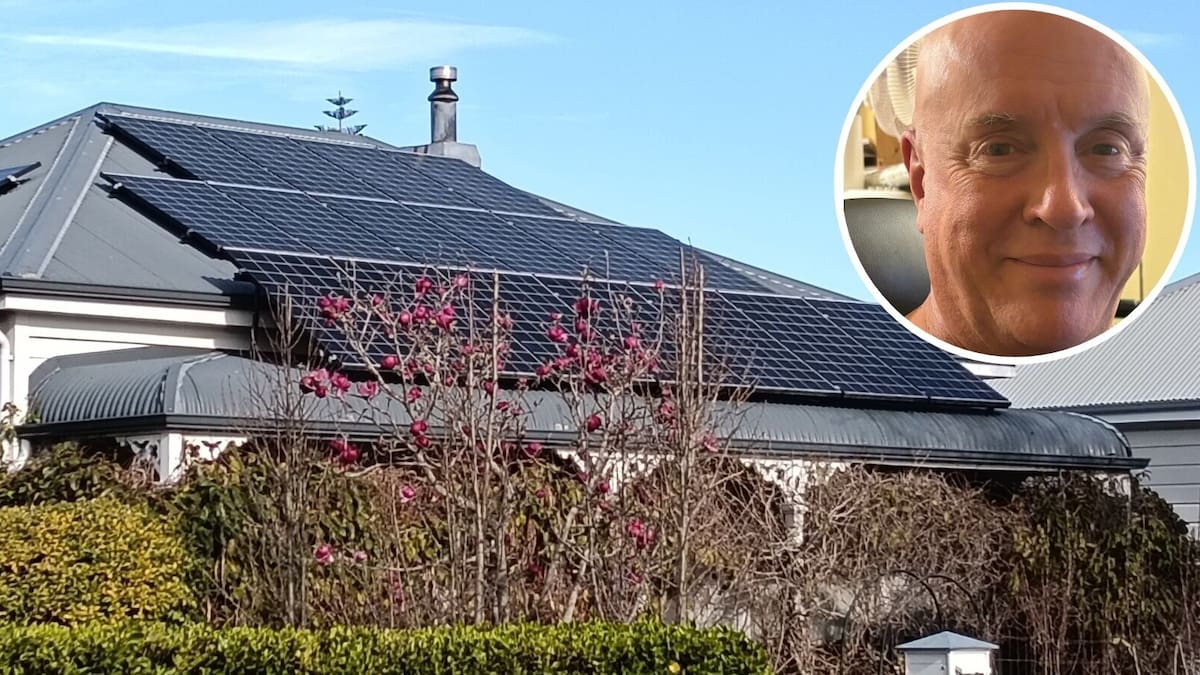
Napier City Council has proposed allowing non-notified six-storey developments on dozens of streets near the central city and Taradale under its new District Plan, which is currently going through 12 separate Environment Court appeals.
One of the 1595 properties proposed to be opened up for six-storey development is a 39-home complex opposite the Watsons’ home, owned by Kāinga Ora.
Outlined in green is Kainga Ora property being prepared for sale and potentially rezoned for high-density housing. Outlined in yellow is the Watson Family Trust property, where a costly solar system could be overshadowed by future six-storey buildings.
In June, Kāinga Ora regional director for East North Island Graeme Broderick said the units in a “high-value area” had reached the end of their life as social housing and it now made financial sense to sell them.
The complex, opposite Napier Health on Wellesley Rd with entrances and homes facing Hall St and Nelson Cres, has a capital value (CV) of nearly $9m.
Watson said he feared his family’s fully decoupled, asset-protected residential micro-grid was now at risk of being ruined by a developer swooping in, buying the Kāinga Ora complex and building a six-storey, 19.5m-high high-density housing development in its place.
He said a development of that size, if allowed under the District Plan, would block the sun during the home’s peak power-generating hours.
“This home represents our entire, multi-generational family estate and our lifetime investment into renewable energy resilience,” Watson said.
“Every dollar went directly into bringing this integrated infrastructure online. My parents knew (and I knew), that I would not be able to afford electricity once they were gone, once I went on superannuation, which I did last year,” he said.
“A high-rise built anywhere within that massive site will project a sweeping shadow that completely jumps the tight road gap, burying our infrastructure in darkness.”
Harrison’s Solar Hawke’s Bay owner Laura Duncan provided Watson with an updated return-on-investment assessment, based on a situation where a six-storey apartment building was built approximately 10m north of the existing dwelling.
In it, Duncan wrote that in her professional opinion, a development would significantly diminish the performance and financial return of the system – from generation of 46.9 kilowatt-hours (kWh) of power a day to just 28.0kWh/day.
Duncan said the Watsons’ annual savings would drop from $5190 to $2850, with the payback more than doubling from 12-and-a-half years to 26 years.
Watson said his family were speaking out now to protect the rights of people investing in clean energy across New Zealand.
An artist’s impression of a multi-storey apartment building taken from Napier City Council’s Proposed District Plan (High Density Residential Zone).
Watson said he had also approached the National MP for Napier, Katie Nimon, for help over his concerns.
Nimon said her office took the concerns seriously, making inquiries with the relevant agencies, raising the broader policy issues with the appropriate ministers and advocating on Watson’s behalf throughout the process.
“The specific situation remains hypothetical, as there is no confirmed development proposal and the property is not currently for sale,” she said.
“Without a defined proposal, there is limited scope for further action.
“While I appreciate the constituent is disappointed, MPs cannot intervene in individual property or planning matters or direct the decisions of government agencies.”
Watson said the issue was not going to go away.
“Eventually the property will be sold, as will others in the new high-density zones.
“It’s not just our family that will have to deal with huge buildings towering over our home, blocking out the sun.”
Watson said he wanted covenants, caveats or sale conditions to be placed on the site, mandating that any “private developer purchasing the site must step back, tier or design the northern facade of the future structure to preserve the existing solar path of 8 Hall Street”.
In correspondence seen by Local Democracy Reporting (LDR) between Kāinga Ora and Nimon’s office, Kāinga Ora’s manager, ministerial services, Emma Atkins, wrote: “Kāinga Ora will offer the property for sale and is not marketing it for any specific outcome, development type or future use.
“The tender process will not specify or require a particular development proposal.
“Consequently, Kāinga Ora is unable to provide information regarding any potential future development, site layout, building massing or associated shading effects.
“Assessing the property’s development potential and undertaking any related due diligence is the responsibility of prospective purchasers.”
Kāinga Ora regional director east North Island Graeme Broderick told LDR the agency understood that changes to neighbouring properties could create uncertainty.
“However, once a property is sold, Kāinga Ora has no role in, or influence over, how it may be developed in the future,” Broderick said.
Napier’s proposed District Plan is facing 12 appeals lodged with the Environment Court.
A spokeswoman for the Environment Court said some appeals against the plan had been resolved, but others were continuing.
“I am unable to say when the appeals will be heard, or if they will be at all,” she said.
“At this stage, no hearing time has been sought or directed. Consequently, I cannot advise when a decision [on the District Plan] is expected.”
They said numerous decisions resolving specific topics and appeals would likely be issued throughout the proceedings.
Napier City Council said its proposed District Plan – first proposed in 2023 and amended in 2025 – was not yet fully operative.
It said the proposed high-density residential provisions showed where buildings of up to six storeys could be built, but that didn’t mean every site would have a six-storey development.
“The council cannot comment on the potential impact of a hypothetical future development on an individual property or solar installation.
“Any future development would need to be assessed against the planning provisions that apply at the time.”
In a Talking Point in Hawke’s Bay Today on the proposed District Plan in November 2023, former Napier Mayor Kirsten Wise wrote that Napier had a housing problem.
She said the council would look to introduce medium- and high-density residential zones around commercial centres and main transport routes, away from natural hazards.
“We envisage high-density residential zones could be terraced homes and urban apartment living up to six storeys close to Napier city centre and Taradale town centre.”
High-density zones
Under Napier’s proposed District Plan, 1595 properties would be rezoned to allow high-density residential use on a non-notified basis.
The streets where the properties were located were:
Nelson Cres, Kennedy Rd, Higgins St, Georges Drive, Peddie St, Mckenzie Ave, Herrick St, Gloucester St, Avondale Rd, Devon St, Douglas Mclean Ave, Hammond Rd, Wellesley Rd, Eton Rd, Hastings St, Carnell St, Jull St, Church Rd, Gebbie Rd, White St, Oxford St, Puketapu Rd, Meeanee Rd, Devonshire Place, Roskilda Cres, Marine Parade, Hall St, Latham St, Murphy Rd, Elbourne St, Winifred St, McDonald St, Munroe St, Lee Rd, Gebbie St, Sale St, Owen St, Neeve Rd, Storkey Rd, Russell Rd, Thackeray St, Nuffield Ave, Wilding Ave and Weatherfield Mews.
– LDR is local body journalism co-funded by RNZ and NZ On Air.