
T
he system involves arrangements of mirrors that split a laser beam into 14 “light beads.” A beam splitter doubles this to 28. “They split their laser into an arrayed comb of spots, then scan those [light beads] through the sample in parallel, so you can measure many more points at a time,” Cohen says.
The mirrors produce slight delays between beads, making it possible to place excitation precisely and increasing the area that can be scanned—up to 590 × 400 microns, and in one case recording from 180 neurons simultaneously. The team also demonstrated a deep mode, recording from neurons 500 microns within the brain, and a rapid mode, capable of 2 kilohertz frame rates.
To maximize the population you can image, you need to think very strategically about how to maximize efficiency in terms of energy, time and space.
—
—
Alipasha Vaziri
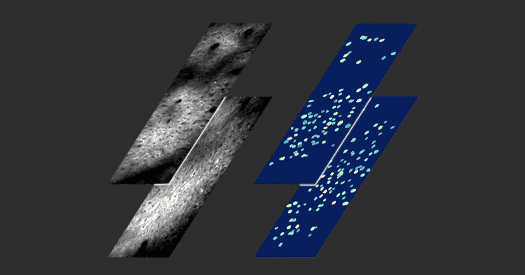
A similar approach, which also splits the laser and was published in December, solved many of the same problems, but “the main advance in the newest work from Vaziri is that the locations of the pulses can be more easily reconfigured,” Cohen says. This versatility is particularly useful for scanning two planes simultaneously.
Vaziri’s team demonstrated this multilevel scanning on mice while their whiskers were stimulated. “We put one plane in layer 2/3 and another in layer 4 of the mouse cortex,” Vaziri says. “By imaging these two planes, we showed that neurons in layer 4 were activated first, then layer 2/3 neurons.”
Neuroscientists could use this to trace how information flows, both “within and between cortical layers during sensory processing, or other cortical computations,” Cohen says.
Another configuration maximized sensitivity, making it possible to detect changes below neurons’ firing threshold. “Subthreshold activity is important because it gives information about connected neurons,” Vaziri says. “If you imagine combining this with techniques such as optogenetics, you move towards an optical approach for circuit mapping.”
The platform’s flexibility should enable the team to incorporate future advances in voltage indicators, which are constantly improving. “That was in our minds from the outset, to take advantage of ongoing improvements,” Vaziri says.
Going forward, however, the “cost and complexity [of the platform] are a challenge that will have to be dealt with if these are going to be widely used,” Cohen says.