
Or at least not on this tour and the All Blacks’ mid-week opponents are not of the calibre of their predecessors, and nor have they been afforded the right circumstances to get the best out of themselves.
The deeper reality of all this is that professionalism has killed the romance of the amateur age primarily because it has created an uneven playing field in specific regard to Rugby’s Greatest Rivalry.
We live now in a structured age, one that has made it enormously difficult – impossible even – to pit full strength club teams, in peak season, against the touring All Blacks.
It hardly helps that the South Africans now have a foot in each hemisphere – with their clubs locked into a Northern competition while the Springboks are aligned with the South, creating a player welfare nightmare in trying to find rest periods for key talent.
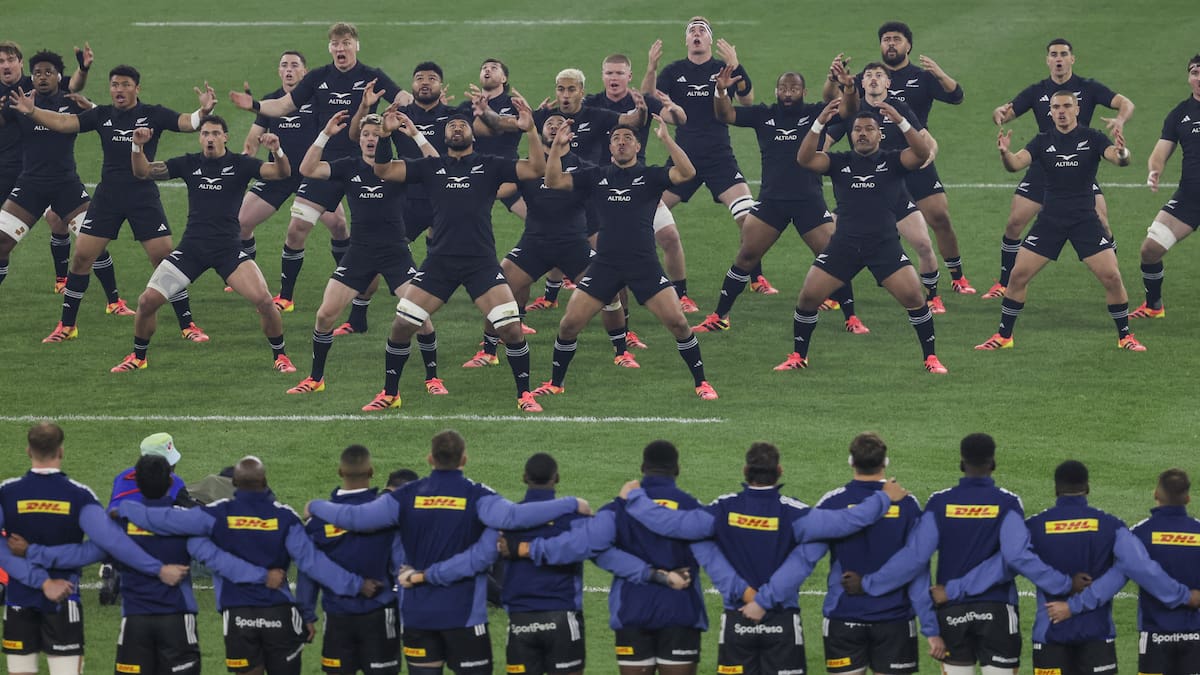
The All Blacks faced an under-prepared Stormers side in their opening tour match. Photo / SmartFrame
The upshot is what we have is watered down South African teams – they have all been denied access to their Springbok players – trying to prepare in the middle of their off-season.
It’s no small matter. The Stormers were able to produce a defiant performance in what was not just their first game since playing Leinster in the semi-final of the URC in early June, but their first contact session as they get ready for the September restart of their new season.
But that really was against the odds. These games are not peak All Blacks versus peak club teams and everyone in South Africa knows it, which is partly why ticket sales for these games have been difficult.
The truth is that the Sharks, who finished 10th in the recently finished URC, are an average club team at the best of times, but without their six-strong Springbok contingent and having to prepare for this game mid-way through their off-season, they shouldn’t be any real match for what is a close-to-full-strength All Blacks selection.
The hype machine will say otherwise – and push the narrative that the clock has been wound back to the good old days – and try to sell this as a fearsome Natal team ready to soften up the All Blacks. But no one should buy that.
The All Blacks should not have been pushed around by the Stormers the way they were and that performance should not be the basis from which nostalgic arguments are made to say that South Africa, like they were in the 1970s and 1980s, are growing grizzled forwards on trees and could pull any eight blokes out of the pub and have them form a handy scrum.
Expectations need to be reset to reflect the circumstances and the All Blacks judged not against their peers of the 1970s and 1980s, but against the modern backdrop of these being heavy mismatches – none more so weighted in the visitor’s favour than the clash against the Sharks at King’s Park.
The season just finished was not an aberration. The Sharks have made little-to-no impact in the URC – one semi-final appearance aside – and nor have they figured in the latter stages of the European Champions Cup – one quarter-final appearance aside.
They have mostly finished in the lower half of a competition which is much like Super Rugby in that there is genuine quality at the top of the table, but some average teams in the lower half.
The expectation, therefore, is that the All Blacks should win and that they should win well. To flip the script for a second, the Springboks, when they come to New Zealand in four years, will expect to beat a weakened Highlanders side fielding players in the midst of their off-season.
But just as importantly, the All Blacks need to deliver vast improvements in all the key parts of their game that are going to be tested once they come up against the Boks in the test series.
On this list are their scrummaging, accuracy under the high ball, discipline, and defence of the driving maul – all parts of their game that they have known for months will be tested by every South African team they play.
Their efforts in these key facets against the Stormers were well below expectation and it was interesting to note in the build-up to South Africa’s test against the Pumas the following day, former Springbok loose forward Schalk Burger, in his role as an analyst for broadcaster Super Sport, said the All Blacks maul defence looked like a point of weakness.
He and his fellow analyst, former Springboks captain Jean de Villiers, seemed genuinely surprised at how poorly the All Blacks dealt with the high ball, driving maul and scrummaging power of the Stormers – especially as they knew these were the areas in which they would be attacked.
The All Blacks are, of course, much-changed for the Sharks encounter and so the great hope is that the arrival of Ethan de Groot and Fletcher Newell will fix the scrum; Damian McKenzie will tidy up the backfield; Ruben Love will play closer to the gainline and better facilitate the attack and the intensity and accuracy will lift now that the All Blacks have had a swing and a miss.
Gregor Paul is one of New Zealand’s most respected rugby writers and columnists. He has won multiple awards for journalism and written several books about sport.
Listen to Elliott Smith’s live commentary on Newstalk ZB Sport and iHeartRadio, or join the Alternative Commentary Collective on iHeartRadio and Radio Hauraki.