
An independent University of Auckland review, commissioned by NZTA and the Office for Seniors after advocacy from pressure group Grey Power, found no evidence to support the need for routine cognitive assessments for healthy older drivers.
NZTA said the purpose of the literature review was to provide an independent evidence base to help health practitioners determine the most appropriate cognitive screening tool when cognitive assessment was required.
The shift away from routine cognitive screening could reduce additional testing – and costs – for some older drivers.
Grey Power Hastings president Ron Wilkins said it marked a “significant victory” after years of campaigning over assessments members found stressful, inconsistent and expensive.
He said several of the organisation’s more than 900 Hastings members had delayed renewing their licences or stopped driving because of the process, which could cost some up to $200.
Wilkins knows the process well.
He has completed assessments at 75, 80, 82 and 84, despite driving every day.
His testing included counting forwards and backwards in multiples of three, listing supermarket items and remembering a series of fruit names.
“I was even sweating when I first turned 80, knowing they had asked stupid questions.”
Wilkins said the process created unnecessary anxiety and did not necessarily demonstrate whether someone could drive safely.
“The doctor should be the one who says, ‘Ron, I believe you should have to go for a cognitive test’,” he said.
“I wouldn’t be a Grey Power president if I was having cognitive problems.”
The more holistic approach encouraged health practitioners to assess a driver’s overall health, medical history, vision and physical abilities, with cognitive or on-road assessments used only when clinically indicated.
“Safety must come first,” Wilkins said.
“But it should be based on the individual, not simply their age.”
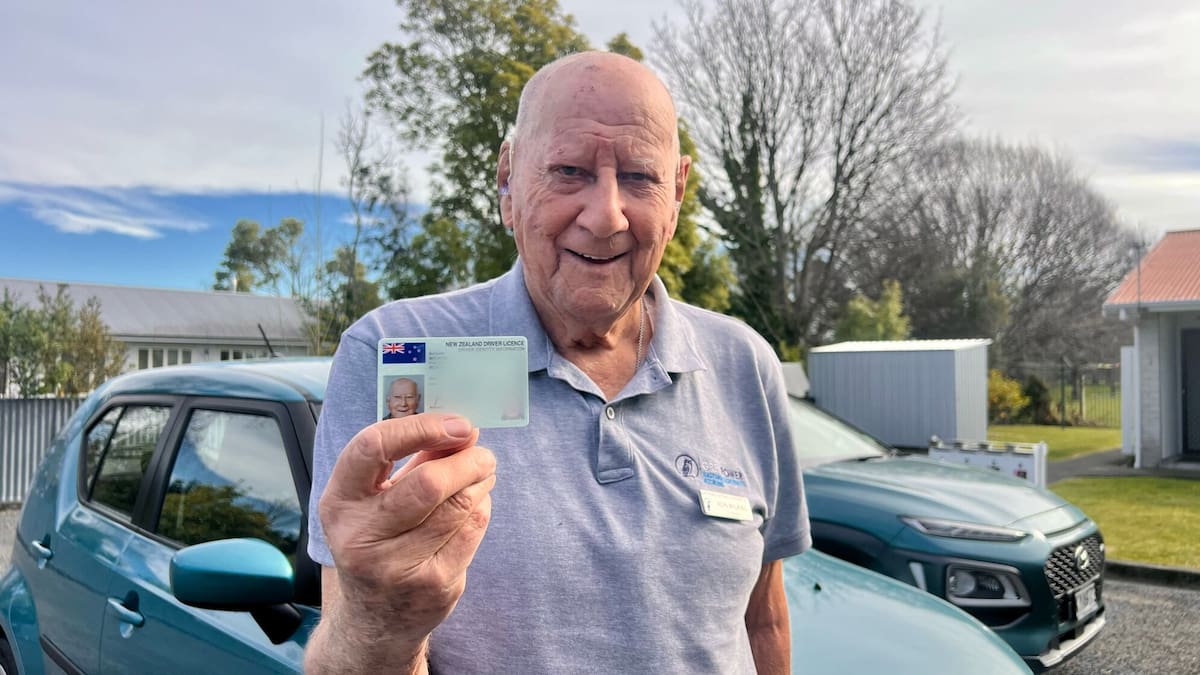
Ron Wilkins behind the wheel. He has completed licence renewal assessments at ages 75, 80, 82 and 84 and says the proliferation of cognitive tests had become a headache for older drivers. Photo / Rafaella Melo
Grey Power New Zealand president David Marshall said driving was vital to many older people’s independence, wellbeing and social connection.
He said Grey Power wanted to hear from members who continued to experience routine cognitive testing without a clear clinical reason.
“Monitoring how these guidelines are implemented will help ensure they are being applied consistently.”
NZTA said there were currently 13,144 licensed drivers aged 75 and over in Hawke’s Bay who had renewed their licences since turning 75.
Head of driving regulation Chris Rodley said the guidance itself had not changed since 2024, but the literature review provided further evidence to support health practitioners.
The findings showed there was no universally accepted cognitive test for assessing fitness to drive, and that commonly used global cognitive assessments did not accurately predict performance on the road.
Cognitive screening could still be used when changes in a person’s health or vision raised concerns, or when they were assessed by a practitioner who did not know their medical history well.
Rodley said assessments could vary between people, or even between visits for the same person as they aged, because practitioners were expected to assess each driver individually.
Zane Jones, 82, said inconsistency was already part of the problem.
When she renewed her licence two years ago, she paid more than $100 for a medical assessment and expected to complete cognitive questions.
Instead, she said the nurse spoke casually with her while completing paperwork before telling her she had passed.
“I said, ‘but I haven’t had any questions’,” Jones recalled.
“She said, ‘You don’t need to do the questions.’”
Jones was now booked for another assessment this month but said she did not know what the process would involve this time.
NZTA said people aged 75 and over paid a $21.50 licence-renewal fee, while medical assessment costs were set independently by health practitioners and could vary.
The driver’s licence he does not use
For Tony Bushby, 82, the issue is not about staying behind the wheel at all.
The Havelock North pensioner has not driven or owned a car for about 25 years.
He continues renewing his driver’s licence every two years because it is the only widely accepted photo identification he has.
“Without the driver’s licence, you’ve got no ID, you don’t exist,” he said.
“You can’t do business in the bank. You can’t transfer money from one account to another.”
Bushby, originally from Australia, said his passport expired about a decade ago, and renewing it would require travelling to an Australian consular service, adding transport, accommodation and food costs.
His latest driver licence renewal involved about $125 for the medical assessment, as well as the NZTA licence fee.
“When your only income is the pension, it really hurts,” he said.
“You’ve got to really think about what you’re spending.”
Bushby said his doctor knew he did not drive, but still had to assess him as medically fit because the licence legally allowed him to do so.
NZTA said alternative forms of photo identification included a passport or a Kiwi Access Card, formerly known as the 18+ card.
Bushby said a Kiwi Access Card would not solve all of his problems.
He regularly sends money to a friend in the Philippines to help with her grandchildren’s schooling and said the international money-transfer service he used required identification such as a driver licence or passport.
Western Union’s New Zealand website says customers registering to send money online must verify their identity using a New Zealand driver licence or passport.
The Ministry of Justice also did not accept Kiwi Access cards as identification for some processes.